
Haptic Geometric Board
Obliczymy ostateczną cenę na podstawie wybranego pliku. Sprawdzisz ją i zaakceptujesz przed płatnością.
Zapisane na tym urządzeniu.
Informacje o modelu
- Źródło
- Printables
- Kategoria
- Haptic Models
- Licencja
- Creative Commons — Attribution — Noncommercial — Share Alike
Background
My father often says, “Begreifen kommt von greifen.” This is a German wordplay that’s quite hard to translate directly into English. "Begreifen" means "to understand," while "greifen" means "to grasp" something physically with your hands. So, literally, it suggests that understanding comes from hands-on experience — and he's not wrong.
Take your 3D printers as an example. You could read everything there is about them — browse the internet, pour over books, even comb through entire libraries. You could absorb all the information, memorize every technical specification, but that wouldn’t necessarily enable you to build a printer. Think back to your first clogged nozzle. Did you know right away how to fix it? Or were you sitting in front of your printer with tools, watching a tutorial or a YouTube video on how to clean it?
And when did you finally learn how to clean your nozzle? Simple. The moment you did it yourself — with your own hands. The more often you repeat the process, the better you get at it. That’s how we humans learn: by doing and practicing. The more senses we engage, the faster we grasp things.
So, how effective is it to learn solely from books or screens? Well, if your goal is to become a walking encyclopedia, that might suffice. But if you truly want to understand something, there's no substitute for hands-on experience.
Model
A geoboard is an educational tool for kids in primary/elementary school, used to visually demonstrate geometric concepts. It is used to:
- Create and explore the properties of geometric shapes like triangles and quadrilaterals.
- Calculate areas and perimeters.
- Explore symmetry, including line and point symmetry.
- Visualize coordinate systems and spatial relationships.
- Understand different types of triangles and quadrilaterals.
- Illustrate mathematical theorems, such as the Pythagorean theorem.
It helps develop spatial reasoning and a better understanding of geometric relationships.
Here is an example to illustrate two mathematical theorems for calculating a triangle.
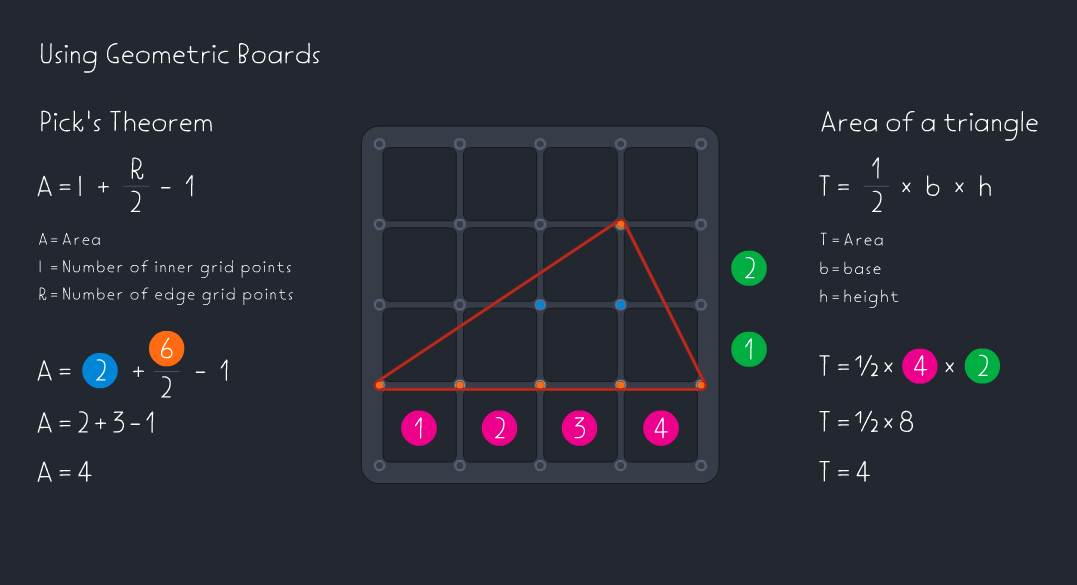
The model consists of four geometric boards with a storage box.
- 1 board with a 5 x 5 grid
- 1 board with a 6 x 6 grid
- 1 board with a circular grid
- 1 board with an isometric grid
- 1 storage box with recessed bowl to store the rubber bands.
Printing
Any solid filament, such as PLA, PETG, etc., is suitable as a filament. All parts can be printed without support. The 3MF files are already optimally aligned for printing.
Settings (All Parts)
- Nozzle: 0.4 mm
- Infill: 15 %
- Supports: No
- Raft: No
- Layer Height: 0.20 mm
Additional Parts
You’ll need rubber bands for the model, which you can buy at any supermarket or on Amazon. (e.g. Amazon)