
Closed curve puzzle (easy)
Obliczymy ostateczną cenę na podstawie wybranego pliku. Sprawdzisz ją i zaakceptujesz przed płatnością.
Zapisane na tym urządzeniu.
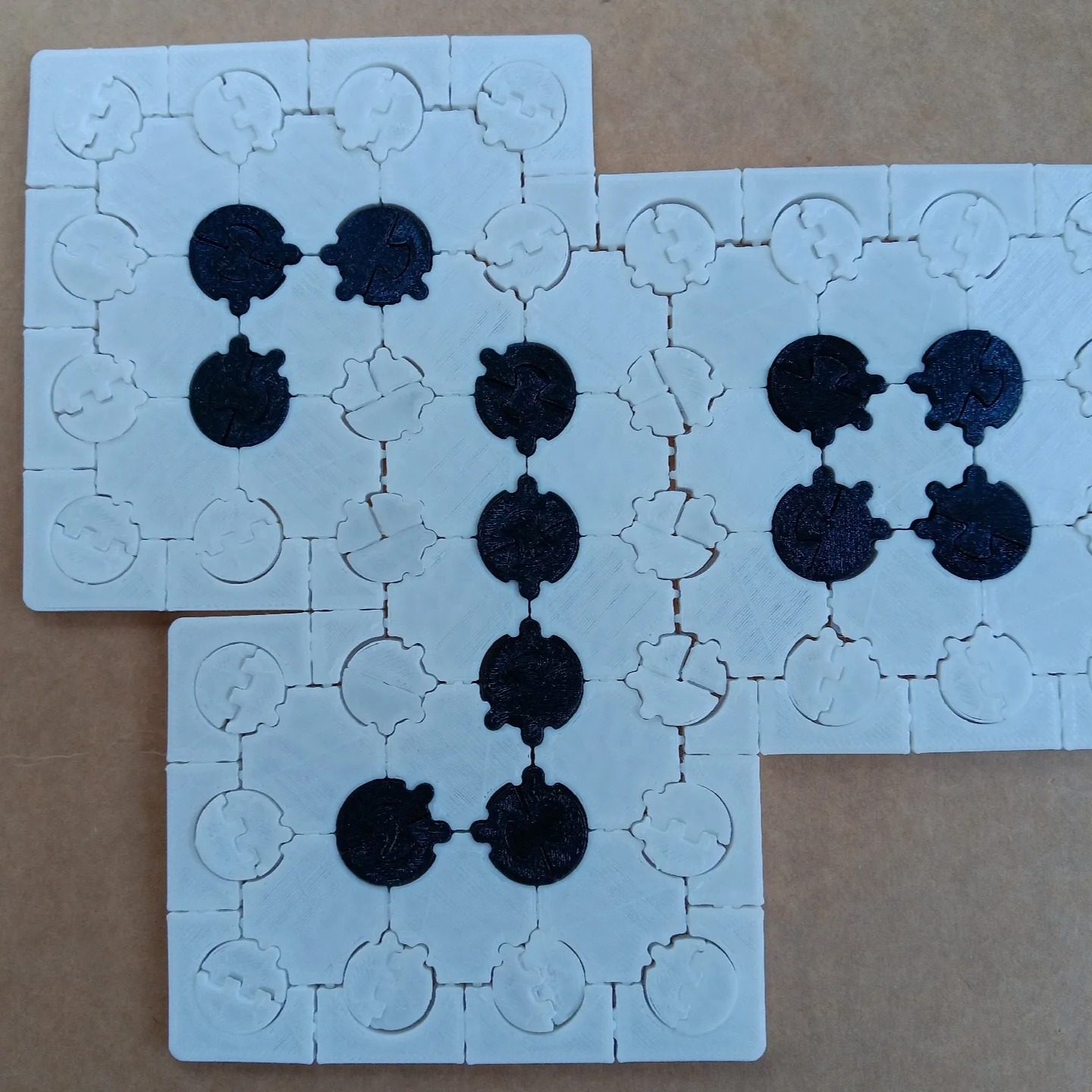
An open-ended puzzle with multiple solutions consisting of simple closed curves based on parentheses matching.
- Ocena
- 0 / 5
- Polubienia
- 1
- Pobrania
- 7
- Wydruki
- 0
- Wyświetlenia
- 70
- Oceny
- 0
Aktualizacja u źródła:
Informacje o modelu
- Źródło
- Printables
- Kategoria
- Puzzles & Brain-teasers
- Licencja
- Creative Commons — Attribution — Share Alike
See https://conwaylife.com/forums/viewtopic.php?f=12&t=4300&p=135096 for a more detailed explanation. The curves in these tiles are based on parentheses matching, and pull in surprisingly many concepts from combinatorics and graph theory.
In the original write-up, I used 5 matched pairs of parentheses. There are 42 of them, which is a lot to print. If you go down to 4 matched pairs, you get a more manageable 14 (the preceding Catalan number), and that's what I chose as a 3D print puzzle.
The idea is to start with tiles based on matching points along a line. The points along the bottom of each tile are connected with circular arcs. E.g., (()(())) would connect 0-indexed positions 0 and 7, 1 and 2, 3 and 6, 4 and 5. These arcs can be completed into closed curves by connected each even position to the subsequent odd positions: 0-1, 2-3, 3-4, 6-7. This is represented by the following tile, filling in the curves:

When you place these tiles together, you may get one or more closed curves. A question that comes to mind is how to pair them up to form a simple closed curve without holes? E.g., like this:
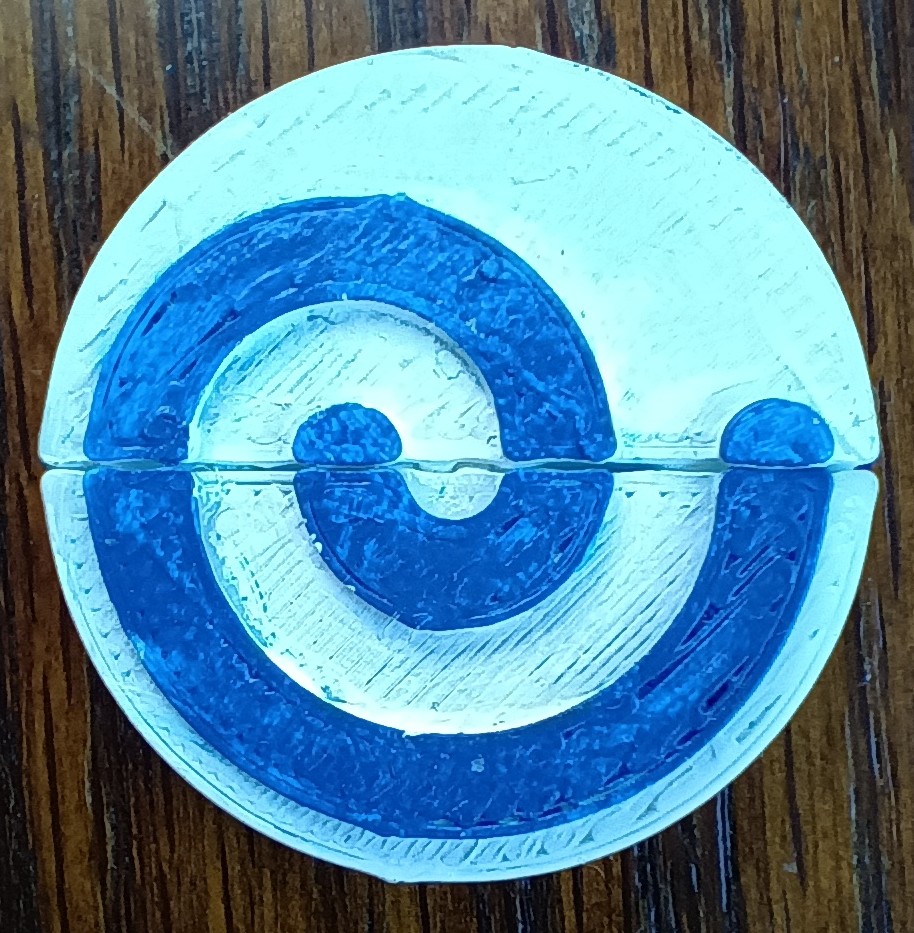
Despite the complexity, you can immediately see if the result is a simple closed curve without holes when you place the tiles together. A puzzle, not the only one, is to see whether you can pair up all the titles this way. You may even want to count how many such pairings there are.
Note that tiles are not guaranteed to match up to simple closed curves without holes. Here are some pairings that violate this condition.
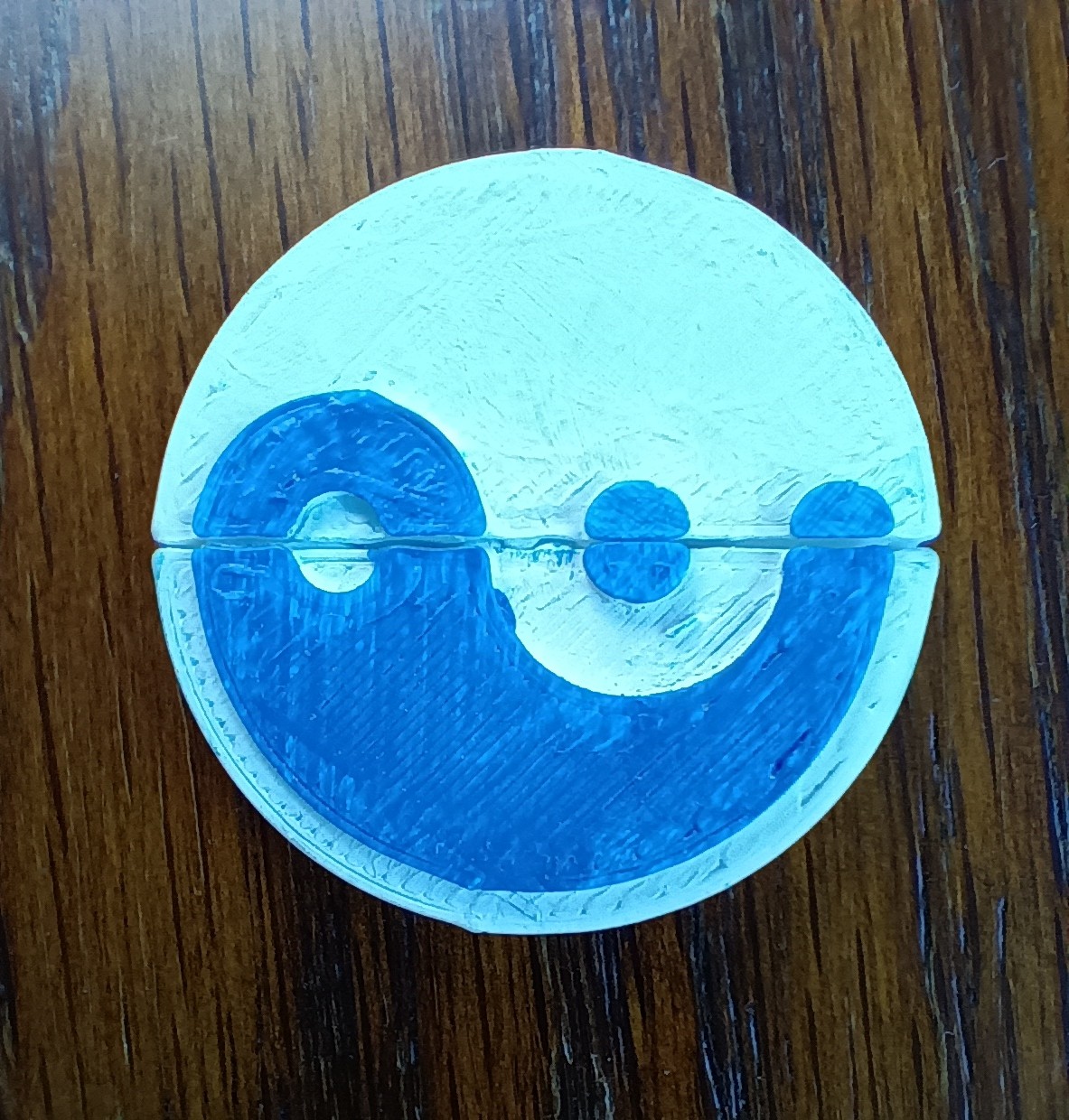
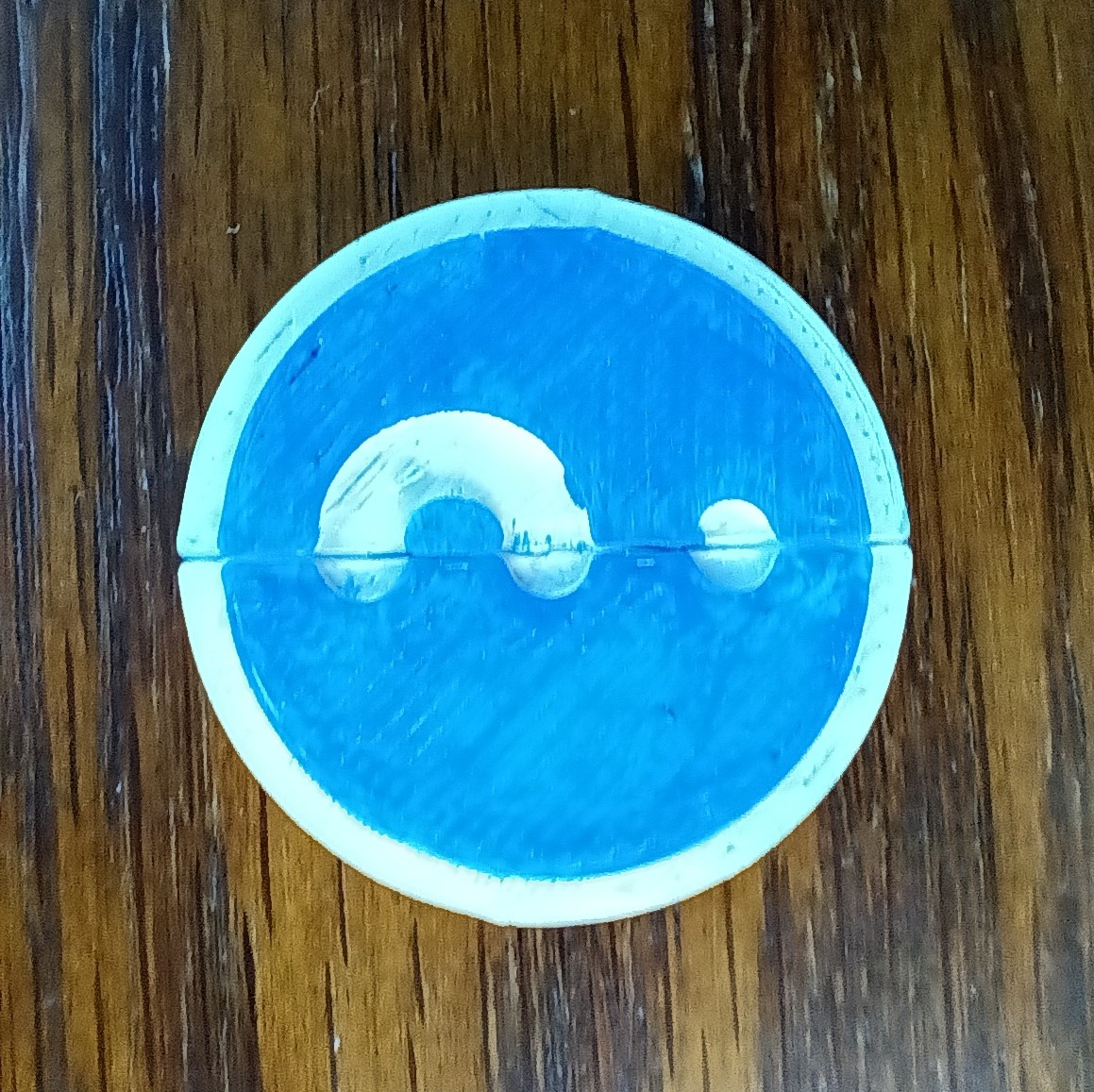
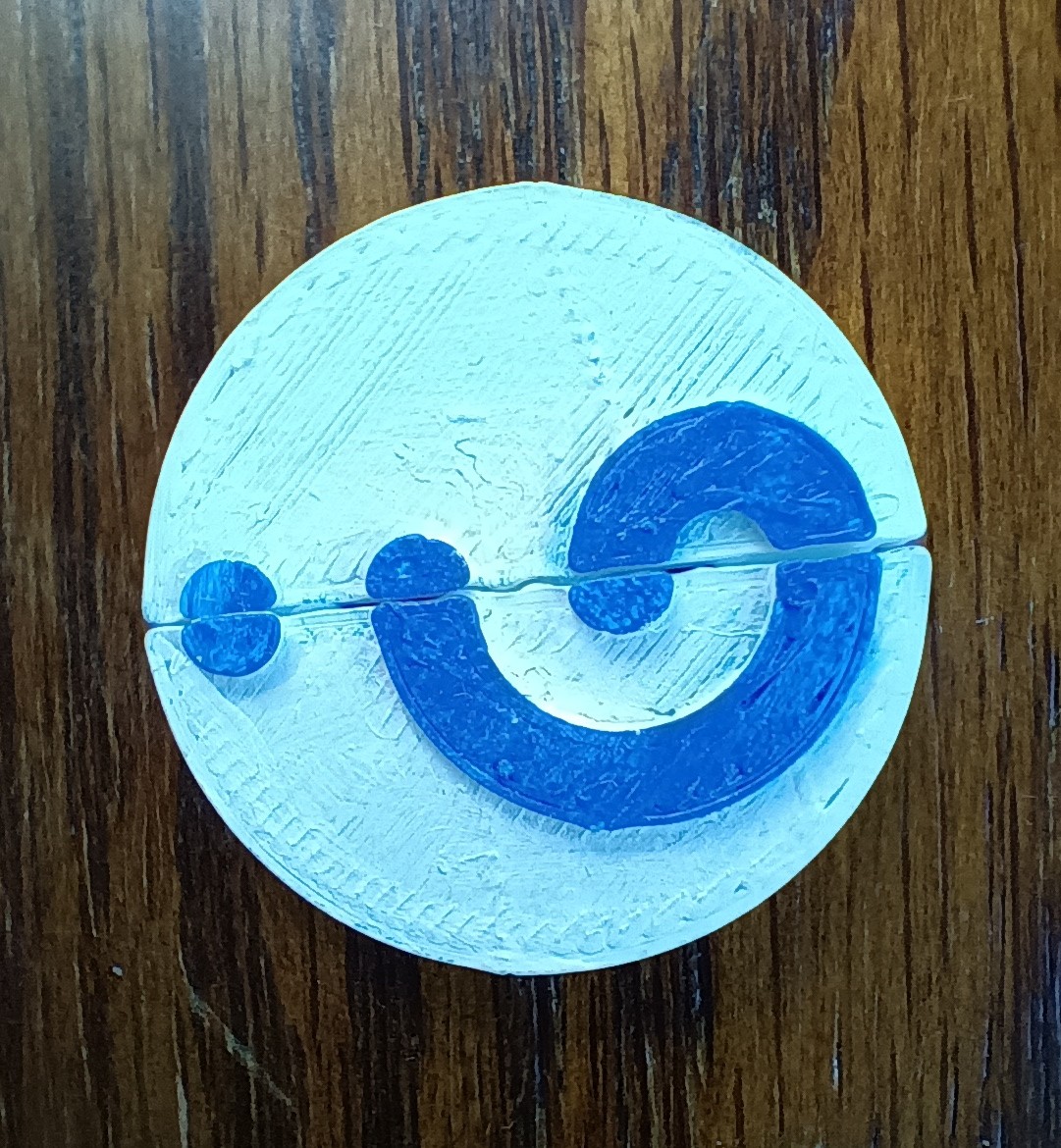
There's a little bit of theory to determine a necessary but not sufficient condition for tiles to combine into a simple closed curve, but I'll leave it as an exercise. Hint: you are trying to create a single connected graph without cycles, so you need to count the number of components in tiles.
Note that once you identify compatible pairs, you can interpret solutions as perfect matchings and find and count the number of matchings.
Apart from theory, these are intended to be fun to put together and observe the shapes that form. I think of them as characters from an alien alphabet.
To make the raised curves show up, you can either switch the filament as I did with the green-colored curves or paint them as I did with the blue ones. Switching filament is easier once you get the hang of it, but these are not hard to paint.
I have two alternative ways of holding tiles together. One is a pure snap fit, which is probably the simplest, and is similar to other recent tilings I've posted. The other uses a hinged shape but includes a snap in the middle for stability. You can try both. I was experimenting with the hinge approach out of curiosity, but there is no obvious advantage. It does not print quite as reliably. It does result in a stronger hold if that matters to you.