
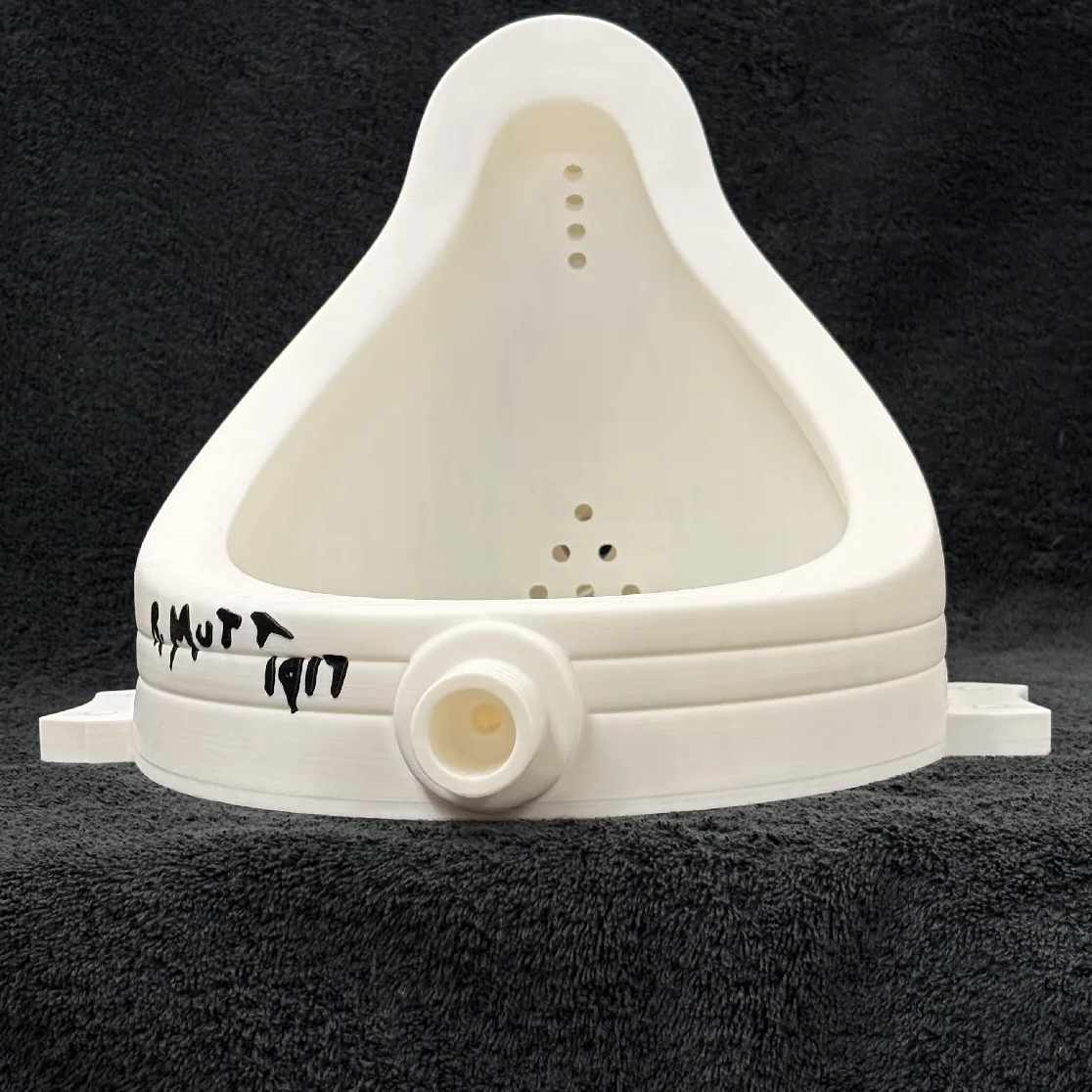
Model of Marcel Duchamp's Fountain by williamCromar
Obliczymy ostateczną cenę na podstawie wybranego pliku. Sprawdzisz ją i zaakceptujesz przed płatnością.
Zapisane na tym urządzeniu.
Part of Prêt à Faire, an independent transformative performance supported by Penn State Abington. CC BY-NC-SA 4.0.
- Ocena
- 5 / 5
- Polubienia
- 20
- Pobrania
- 230
- Wydruki
- 1
- Wyświetlenia
- 1042
- Oceny
- 1
Aktualizacja u źródła:
Informacje o modelu
- Źródło
- Printables
- Kategoria
- Sculptures
- Licencja
- Creative Commons — Attribution — Noncommercial — Share Alike
This model is one of the collection Prêt à Faire: Printable Readymade Models.
Prêt à Faire is an autonomous artistic project, scholarly reference work, and institutional critique by williamCromar, supported by a faculty grant from Penn State Abington with fabrication assistance from the Abington MakerSpace. This project is entirely independent and maintains no formal affiliation, endorsement, or sponsorship with Association Marcel Duchamp, the Estate of Marcel Duchamp, ARS, ADAGP, or any curating museum. When referencing or sharing this work, users must maintain a clear distinction in authorship and nomenclature from the historical referent. Cite this asset as: Model of Marcel Duchamp’s [Object Name] by williamCromar. Basic models are available under a CC BY-NC-SA 4.0 license; premium tiers operate under a separate commercial framework. For full conceptual and legal text, visit https://sites.psu.edu/pretafaire/disclaimer-and-licensing/
If you'd like a version of this model that is optimized and fully prepared for full-scale printing, visit my Club at
1 | Concept & Provenance
This asset is an independent, transformative performance by williamCromar exploring distributed culture through the lens of public-domain source geometry. The historical referent—the infamous 1917 Fountain signed under the pseudonym R. Mutt—is widely cited as the foundational milestone of 20th-century conceptual art. The historical discourse surrounding this lost original, as well as subsequent mid-century exhibition variations, forms the basis for this digital structural study.
Find out more about the work:
The original work can only be seen in a famous photograph by Alfred Stieglitz, although we can see other editions in various odd exhibition situations. In addition to these sources, to assist the modeling effort I used source material found at:
 Fountain by R. Mutt, 1917, |  Duchamp’s studio at |  Marcel Duchamp, Fountain, |
To facilitate an instructional research initiative supported by a faculty grant from Penn State Abington, I required a high-fidelity reference model for our campus makerspace. Finding existing online datasets structurally inadequate for rigorous educational demonstration, I forensically reconstructed this geometry from the ground up. My research involved cross-referencing public historical documentation, including the geometric parameters recorded in William A. Camfield’s exhibition catalogs and public photographic archives of various historical installations, such as the 1964 variant housed at the Pompidou Center. This model synthesizes those public dimensional data points into an original, independent digital manifestation.
Various historical editions include:
 Philadelphia, |  Stockholm, |  1964 edition, found in locations worldwide |
Fountain has been famously appropriated or commented upon by legions of artists. Just a few of these artists who have incorporated it into their practice include:
 Sherrie Levine, Fountain (Buddha), 1996 |  Mike Bidlo, Fractured Fountain (Not Duchamp Fountain 1917), 2015 |  Ray Beldner, Peelavie, 2003 |
2 | Scope & Scale
As a work of Post-Appropriation and remix praxis, this model is an independent interpretation optimized specifically for FDM fabrication, structural durability, and scale variance. The geometry deliberately adapts historical visual motifs into a printable medium, celebrating the physical deviations required by the additive manufacturing process as part of the artwork's transformative expression.
There are variations on the model to allow printing at a range of scales, from 3 inches long to 75% of original size. Be mindful of the version appropriate to your desired scale.
Larger scales require a large-format printer such as a Prusa XL.
An amazing version optimized for full-scale printing by serious makers is available at this link.
3 | Printing Notes
There are two resolutions for the model to print, and a version specifically modeled for tiny scales. They are modeled at full size and must be scaled in the slicer. I also have a copy of the R. Mutt signature, which can be merged with the urinal to create a multi-color print. There is a 3MF file with the signature merged to the urinal for easy multi-material printing setup.
Recommended materials:
Polymaker Panchroma Silk White PLA has a nice sheen that evokes porcelain
Polymaker Panchroma Silk Black PLA for the signature
My settings:
Print Settings: 0.20mm Structural
Filament: Prusament PLA
Printer: Prusa XL (for a 75% scale model)
Supports: Everywhere
Infill: 10% (for a 75% scale model), which helps with opacity
Brim: None
Advanced settings:
Layers and perimeters: Extra perimeters on
Infill: Gyroid fill pattern, Aligned Rectangular top and bottom fill pattern
Support material: Organic style, use paint-on supports to control
Stats for a 75% size print:
Total material used: ~845 grams white, ~15 grams black
Total time: ~1 day, 10 hours
As true for any massive work, this is a risky print for the Prusa XL. The usual safeguards apply: dry your filament like you mean it, clean and degrease the build plate, and control the environment.
Stats for a 50-ish% size print (48.6% is the largest that can fit on an MK3/4):
Total material used: ~326 grams white, ~10 grams black
Total time: ~14 hours
This is a less risky (but scale-wise, perhaps less satisfying!) print; however, it still needs care.
No assembly is required for this print.
4 | Presentation Notes
Place the finished model on a table or pedestal at a comfortable viewing height.
6 | Change Log
12 JUL 2026: Added a link to the optimized full-scale Club version, and revised some text formatting.
21 DEC 2025: Added images of a 75% scale print, set as cover.
9 DEC 2025: Included images of nominal 50% scale print and a 3MF file with 50% and 75% pre-formatted for your convenience.
3 DEC 2025: Rewrote the description for clarity and consistent formatting across the Prêt à Faire collection.
9 NOV 2025: I added a file for placing the signature letters in relief for multi-color printing. Since this can be tricky in the slicer, I've also included a 3MF file including letters merged with the body of the urinal. This merge also contains a manipulated cylinder to smooth out a rough patch that emerges when printing at large scale (here, 75% size of original). Though this file is set for the XL, it can be scaled and manipulated for a smaller multi-material printer.
31 JUL 2025: I conducted small-scale physical fabrication testing. Art-historical records note that miniature representations of this industrial form appeared in historical portfolios like the late-1930s Box in a Valise. In testing our independent geometry at a corresponding micro-scale (approx. 3.5 inches tall), I observed surface warping due to nominal slicing wall constraints:

So back to the drawing board. I re-engineered the file to include an optimized, thicker-walled geometric profile specifically for small-scale printing:

So if you want to print small, find the “small-print” version of the file!
Disclaimer
Prêt à Faire is an autonomous artistic project, scholarly reference work, and institutional critique by williamCromar, supported by a faculty grant from Penn State Abington with fabrication assistance from the Abington MakerSpace. This project is entirely independent and maintains no formal affiliation, endorsement, or sponsorship with Association Marcel Duchamp, the Estate of Marcel Duchamp, ARS, ADAGP, or any curating museum. When referencing or sharing this work, users must maintain a clear distinction in authorship and nomenclature from the historical referent. Cite this asset as: Model of Marcel Duchamp’s Fountain by williamCromar. Basic models are available under a CC BY-NC-SA 4.0 license; premium tiers operate under a separate commercial framework. For the full conceptual and legal text, visit https://sites.psu.edu/pretafaire/disclaimer-and-licensing/.