
Model of Marcel Duchamp's 50cc of Paris Air by williamCromar
Obliczymy ostateczną cenę na podstawie wybranego pliku. Sprawdzisz ją i zaakceptujesz przed płatnością.
Zapisane na tym urządzeniu.
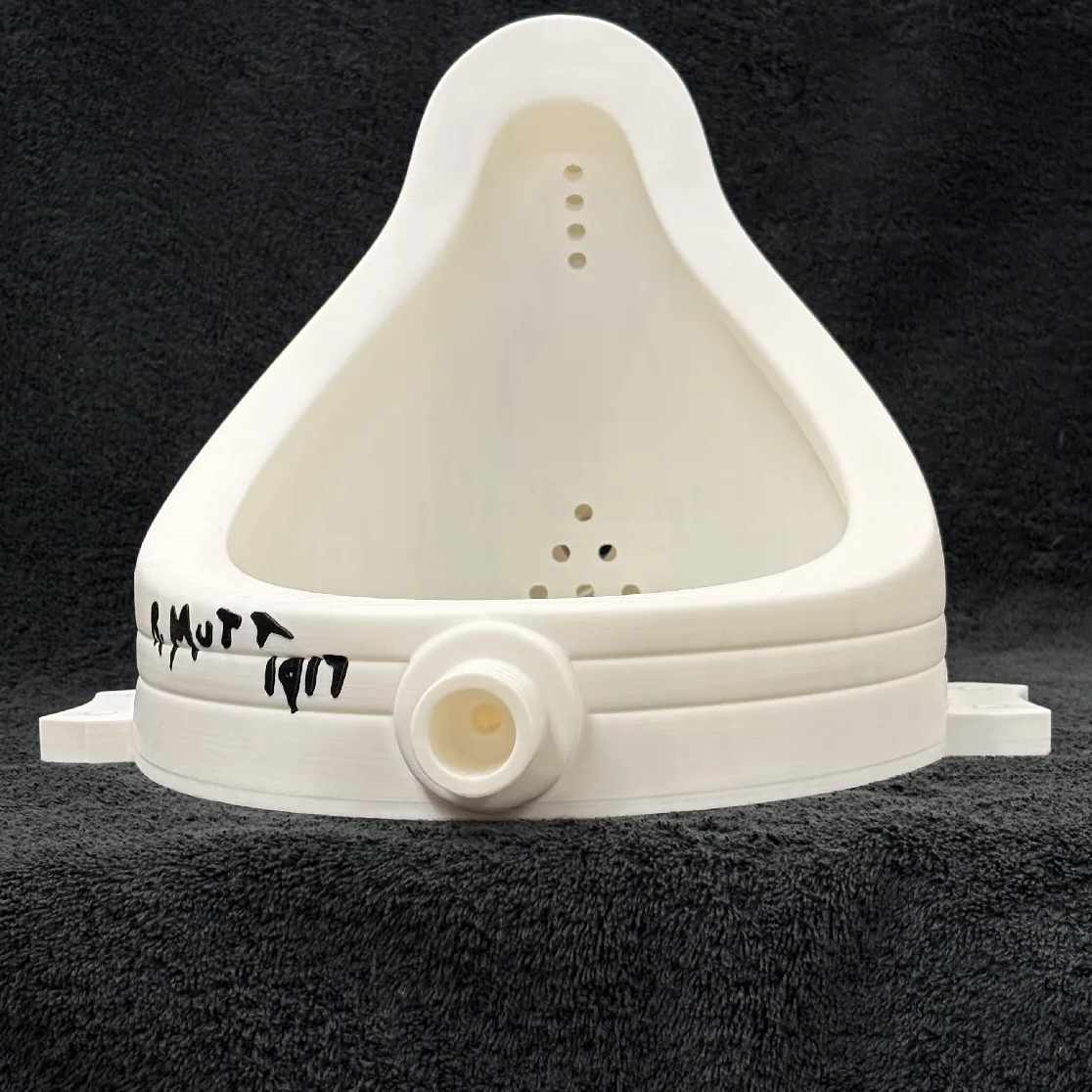
Part of Prêt à Faire, an independent transformative performance supported by Penn State Abington. CC BY-NC-SA 4.0.2
- Ocena
- 0 / 5
- Polubienia
- 1
- Pobrania
- 11
- Wydruki
- 0
- Wyświetlenia
- 88
- Oceny
- 0
Aktualizacja u źródła:
Informacje o modelu
- Źródło
- Printables
- Kategoria
- Sculptures
- Licencja
- Creative Commons — Attribution — Noncommercial — Share Alike
This open-access reference model is one of the collection Prêt à Faire: Printable Readymade Models. As a small object, this model needs no deluxe full-scale version, but to explore full-scale geometric variations or untextured component archives operating under a separate commercial license framework as part of this broader marketplace critique, view the premium tiers associated with this collection.
1 | Concept & Provenance
This asset is an independent, transformative performance by williamCromar exploring distributed culture through the lens of public-domain source geometry. The historical referent—the 1919 Readymade 50cc of Paris Air (originally titled Air de Paris)—challenges traditional boundaries of material form.
A description from the Philadelphia Museum of Art website notes:
Duchamp purchased this "empty" ampoule from a pharmacist in Paris as a souvenir for his close friend and patron, Walter C. Arensberg. A vial with nothing in it may be the most insubstantial "work of art" imaginable. From a molecular point of view, air is not considered nothing, but when displayed so carefully in an art museum it seems to be less than one might expect. Its precise meaning was rendered even more unstable in 1949, when the ampoule was accidentally broken and repaired, thus begging the question: Is the air even from Paris anymore?
To support an instructional research initiative funded by a faculty grant from Penn State Abington, I forensically modeled this geometry from the ground up using public historical data. Rather than copying any proprietary museum scans, this digital study cross-references the public dimensional traits of the 1919 original and subsequent mid-century variants, such as the 1964 variant housed at the Centre Pompidou and the 1974 version at the Moderna Museet.
Explore the historical research context of this study at:
Historical reference parameters analyzed:
 Philadelphia |  Pompidou Center, Paris |  Moderna Museet, Stockholm |
As a work of Post-Appropriation, this model is an independent digital manifestation optimized specifically for stereolithography (resin) fabrication, structural durability, and scale stability. The geometry deliberately adapts historical visual motifs into a printable medium. The files are modeled at full historical size and should be fabricated without scaling to maintain proper thin-walled tolerances.
2 | Printing Notes
Reconstructing this fluid, glass-blown geometry for additive manufacturing presents an excellent technical challenge. This model is engineered to slice and print successfully in transparent resin. Capturing this specific organic envelope cleanly via layer-by-layer filament deposition remains a difficult calibration task, though makers are welcome to experiment with FDM workflows. This archive provides two primary structural configurations:
Solid: A fully dense geometric file optimized for solid material casting or clear material experimentation.
Hollow: Engineered with an integrated drain opening to clear uncured material. The wall boundaries are set to a precise 2.5 mm thickness—a structural threshold that successfully prevents post-cure surface distortions. This directory includes a specialized Label file designed to mechanically plug the drain orifice, rendering the final physical surface completely closed.
Prototypes for this study were validated using an Elegoo Mars 3 resin printer, alongside industrial-tier material jetting fabrication to analyze advanced transparency properties.
3 | Assembly Notes
Images illustrate how the label sets in the hole. There is much post-processing still to do to smooth out the support nubs and create transparency with a finish coat:
 |  |  |
In MY case, after post-processing, it will have trapped some “Philadelphia Air,” so perhaps the title of the work should change accordingly? A finished print is illustrated in the title images. This is one of the ONLY files in the collection that involves post-processing... It's the exception that proves the rule!
My process for finishing:
I sanded down support scars with 400, then 800, then 1000, and finally 2000 grit files.
I used Deluxe Materials Looks Like Glass to finish the interior and exterior of the ampoule.
For the interior, I simply poured the material in the hole, plugged it, then slowly turned the ampoule to cover the entire surface, pouring it out when finished.
For the exterior, I dipped the hook and let it dry upside down by suspending it from the hole
Then I turned it over to hang by the dry hook and coated the exterior liberally with a brush. The material self-levels and drips to a smooth surface. One must take care to dab away droplets when hanging to dry.
For the label, I used a simple flat enamel primer spray paint, which retained the contrast for the text on the label.
I super-glued the label into the hole.
4 | Presentation Notes
One historical approach to displaying this motif is suspension from a ceiling structure using thin wire or monofilament line. In the Philadelphia Museum of Art, where the historical original resides, it is displayed resting on a pedestal due to structural fragility. However, interacting with the form directly by holding it in one's hands captures the intimate spirit of the object's origin as a personal gift to a patron and friend.
6 | Change Log
21 JUL 2026: Uploaded higher-resolution files featuring minor tolerance revisions and updated technical documentation.
16 DEC 2025: Revised project documentation for layout clarity and consistent formatting across the Prêt à Faire collection. Integrated preconfigured .chitubox and .ctb slicing profiles for resin workflows, and updated primary cover images with finished transparent resin prints.
13 AUG 2025: Continuous file refinement loop: Logged successful testing results from the hollow resin workflow and published active fabrication progress photos.
Disclaimer
Prêt à Faire is an autonomous artistic project, scholarly reference work, and institutional critique by williamCromar, supported by a faculty grant from Penn State Abington with fabrication assistance from the Abington MakerSpace. This project is entirely independent and maintains no formal affiliation, endorsement, or sponsorship with Association Marcel Duchamp, the Estate of Marcel Duchamp, ARS, ADAGP, or any curating museum. When referencing or sharing this work, users must maintain a clear distinction in authorship and nomenclature from the historical referent. Cite this asset as: Model of Marcel Duchamp’s [Object Name] by williamCromar. Basic models are available under a CC BY-NC-SA 4.0 license; premium tiers operate under a separate commercial framework. For full conceptual and legal text, visit https://sites.psu.edu/pretafaire/disclaimer-and-licensing/