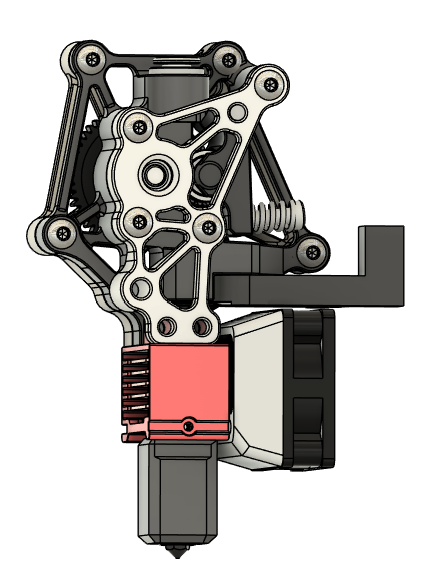
Constellation Extruder for Elegoo Centauri Carbon + TZ hotends
Obliczymy ostateczną cenę na podstawie wybranego pliku. Sprawdzisz ją i zaakceptujesz przed płatnością.
Zapisane na tym urządzeniu.
A sherpa-like skeltonized extruder for the Elegoo Centauri carbon that allows use of TZ (bambu clone) family hotends
- Ocena
- 4,857 / 5
- Polubienia
- 298
- Pobrania
- 687
- Wydruki
- 13
- Wyświetlenia
- 12 421
- Oceny
- 14
Aktualizacja u źródła:
Informacje o modelu
- Źródło
- Printables
- Kategoria
- Other Printer Parts & Upgrades
- Licencja
- Creative Commons — Attribution
Description
Fully tested scratch design inspired by the Sherpa mini-inspired design! This extruder replaces the stock centauri carbon extruder and allows use of a Bambu Lab clone hotends with swappable nozzles (commonly sold as TZ2.0, TZ3.0, TZ4.0 etc) as well as any X1C-compatible hotend.
This gets you:
No more bent nozzles! Unlike the CC hotend TZ2.0-4.0 have supported heatblocks that are more robust
A 23% weight reduction in the extruder. (66.9 g for the stock extruder vs 51 g for the constellation HF) TZ hotends are also 12g lighter than the CC hotend
More easily available replacement parts
Standard V6 nozzles (on constellation HF and SF)
Ability to do revo-like cold swaps (on constellation CS)
Better access to the extruder to clear clogs
Why the name and render color scheme? It fits Elegoo's celestial object nomeclature and the screw pattern reminds me of a constellation.
V2.1: Now with CANVAS compatible versions of CS and HF now available! Constellation SF has been deprecated due to low demand. Documentation is being revised and the CANVAS versions may need a small amount of manual support on the multiplexer mount and filament detector hole. Other improvements:
significantly better mounting point alignment with carriage
completely revised pneumatic fitting geometry that should eliminate pullout issues.- Note: you must remove the rubber sealing ring on the bottom of the ECAS fitting now.
Wear between tensioner gear and wall now fixed.
Versions
There are three version which have all been tested as of 9/17/25:
Constellation HF: A high flow system using TZ1.0-3.0 hotends, a melt zone extender, and a V6 nozzle. Currently tested up to 42 mm^3 flow with PLA+ before underextruding (30% more than stock!). Total cost $25-35
Constellation SF: A low cost high flexibility standard flow system using TZ1.0-3.0 hotends, a V6 nozzle, and no melt zone extender. total cost $15-25. DEPRECATED
Constellation CS: A standard flow system that is primarily aimed at TZ4.0 hotends that will allow revo-like cold nozzle swaps. This version is also compatible with any hotend that can be used on a Bambu Lab X1C, P1S, P1P etc. Total Cost $25-35.

BOM
For The base components for all three versions are as follows.
The parts from the stock extruder (gears, pins, filament cutter parts, etc) For instructions on removal follow this guide to step 10
a bambu clone hotend
2 M3x6 BHCS
2 M3x8 BHCS
3 M3x16 BHCS
1 M3x20 BHCS
2 M3x24 BHCS
10 M3x4mm longx5mm OD (voron standard size) heatset inserts
preferably the bambu hotend shoulder screws, although the stock centauri hotend mounting screws, two M3x14 BHCS, or whatever is included with your TZ hotend. See notes below*
I highly recommend buying extra MR84 bearings for the drive gear. the bearings on my extruder housing were very stuck, and unless you know what you are doing you can damage them during removal
ECAS04 Bowden connector.
Additional parts specific to For Constellation HF:
A melt zone extender such as the trianglelabs MZE
Additional parts specific to For Constellation SF and CS:
1 extra heatset insert
1 extra M3x24 BHCS.
2 m2.5 screws, 4-6 mm long, to fix the hotend fan duct to the hotend.
* Real bambu hotend mount screws are partially threaded M3 with a 3.17 (1/8") nonthreaded region rather than a more standard 3.0 mm, the bore on TZ hotends is the same 3.2 mm as on OEM bambu hotends but the provided screws are standard 3mm bore, so there is a bit of slop unless you use screws from bambu. If you want to you can get a tighter fit by wrapping the nonthreaded portion of the screw with 1-3 turns of Kapton tape.
The step file includes locations for screws and heatset inserts. If you aren't sure how to put it together follow the step file (the HF version has accurate screw lengths etc), or refer the the sherpa mini build instructions which is very similar. I am in the process of preparing an assembly manual.
Print settings
NO SUPPORT NEEDED- a removable support is built into the bottom plate of the extruder where the motor pinion gear is. This is the only one in the model.
ozzle and 0.2 mm layer height recommended (see sherpa instructions for more detailed settings). You may have problem with the built in support if you deviate from this. The filament path is an optimized hex profile, but you may need to carefully clean up the holes on the tensioner arm if your printer tolerances are not perfectly dialed in.
CS and SF specific notes:
Constellation CS
Now tested, The fan is a bit of a tight fit but it works.
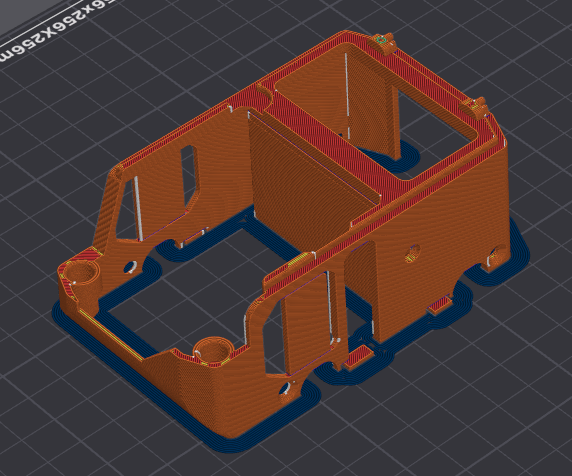
The filament arm position moves a few mm so the stock midcowling will not work. My gamma printhead front and back cover are probably better options but you can also print the midcowling model included in the CS folder if you want to keep the stock front cover. . It has built in supports, print in the orientation shown below with a brim. The cowling uses voron-sized 6x3mm round magnets. It should be easy to modify for other magnet sizes if needed.
Here is a video of a cold nozzle swap on constellation CS and a TZ4.0 hotend. I have arthritis so I used a 9mm socket to get a better grip on the nozzle but it can probably be done with your fingers too.
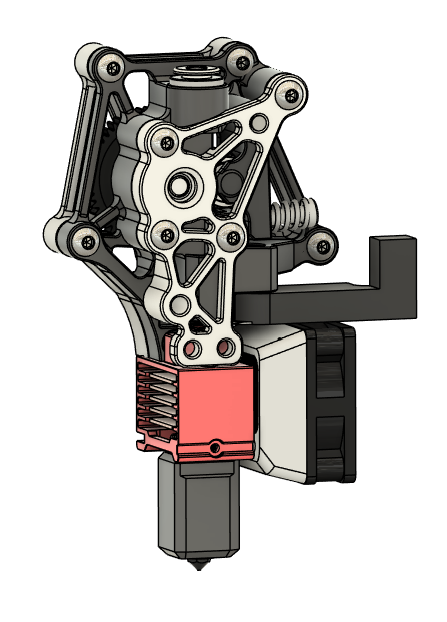
Constellation SF
This version is a low cost system for TZ 1.0-3.0 with an M6 nozzle but no melt zone extender. Same general notes as to CS apply, but no printable midcowling is needed. The fan shroud is the same as CS. No detailed docs available yet pending testing on my end.