
Model of Marcel Duchamp's Bottle Rack by williamCromar
Obliczymy ostateczną cenę na podstawie wybranego pliku. Sprawdzisz ją i zaakceptujesz przed płatnością.
Zapisane na tym urządzeniu.
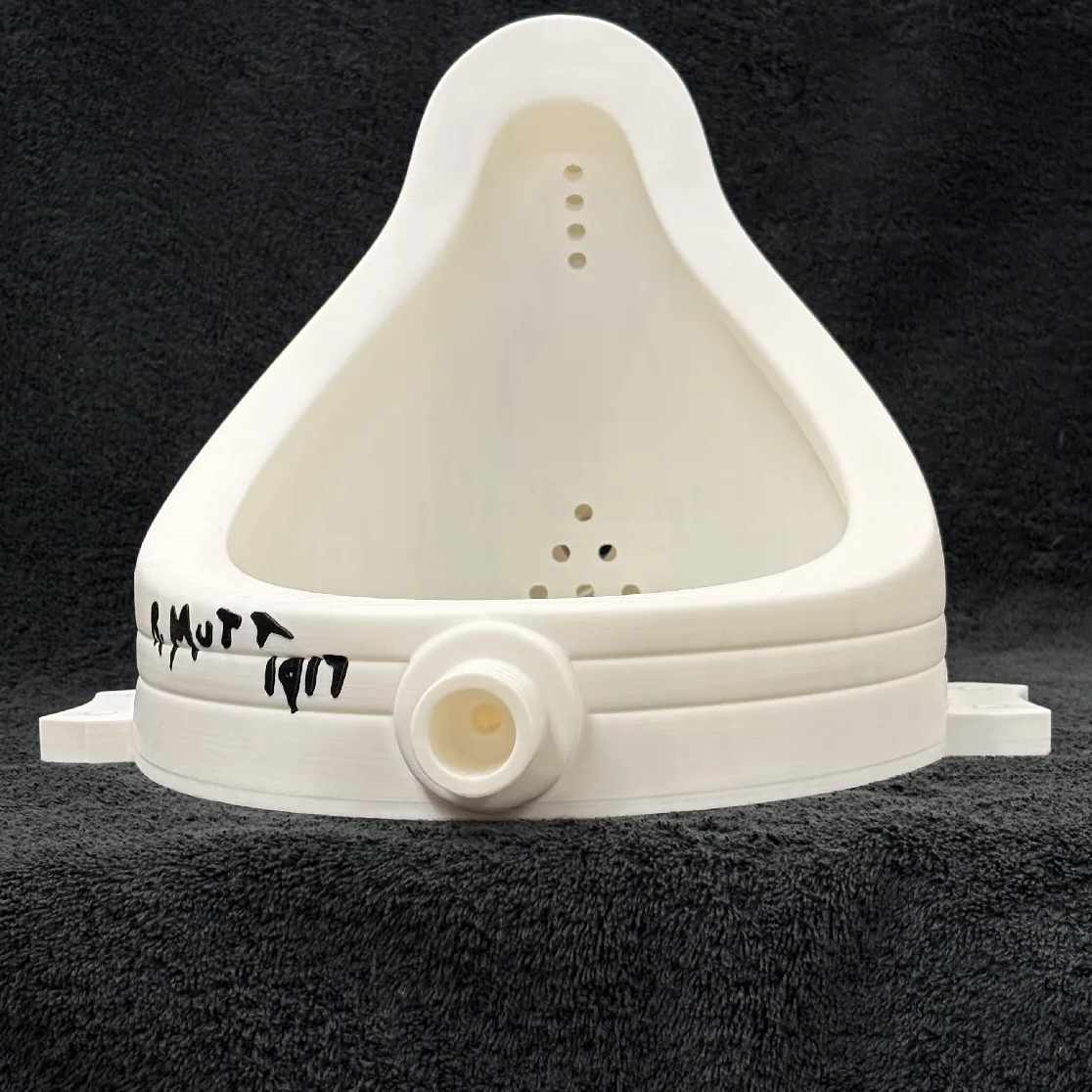
Part of Prêt à Faire, an independent transformative performance supported by Penn State Abington. CC BY-NC-SA 4.0.2
- Ocena
- 0 / 5
- Polubienia
- 2
- Pobrania
- 21
- Wydruki
- 0
- Wyświetlenia
- 169
- Oceny
- 0
Aktualizacja u źródła:
Informacje o modelu
- Źródło
- Printables
- Kategoria
- Sculptures
- Licencja
- Creative Commons — Attribution — Noncommercial — Share Alike
This open-access reference model is one of the collection Prêt à Faire: Printable Readymade Models. To explore the premium, full-scale editions operating under a distinct commercial license framework as part of this broader marketplace critique, visit:
1 | Concept & Provenance
This asset is an independent, transformative performance by williamCromar exploring distributed culture through the lens of public-domain source geometry. Unlike the Bicycle Wheel that preceded it, the historical 1914 Bottle Rack (originally titled Porte-bouteilles) was selected as an unaltered industrial object, representing a key milestone in the Readymade concept.
To facilitate an instructional research initiative supported by a faculty grant from Penn State Abington, I forensically reconstructed this structural geometry from the ground up utilizing public data points and historical documentation. Because the historical original is lost, this model archive provides independent digital manifestations that cross-reference the distinct public dimensional traits of two historical mid-century variations:
The 1961 variation housed at the Philadelphia Museum of Art.
The 1964 Galerie Schwarz configuration, found in several museum archives worldwide.
Find out more about the historical research context of this study at:
Historical reference parameters analyzed include:
 Philadelphia | 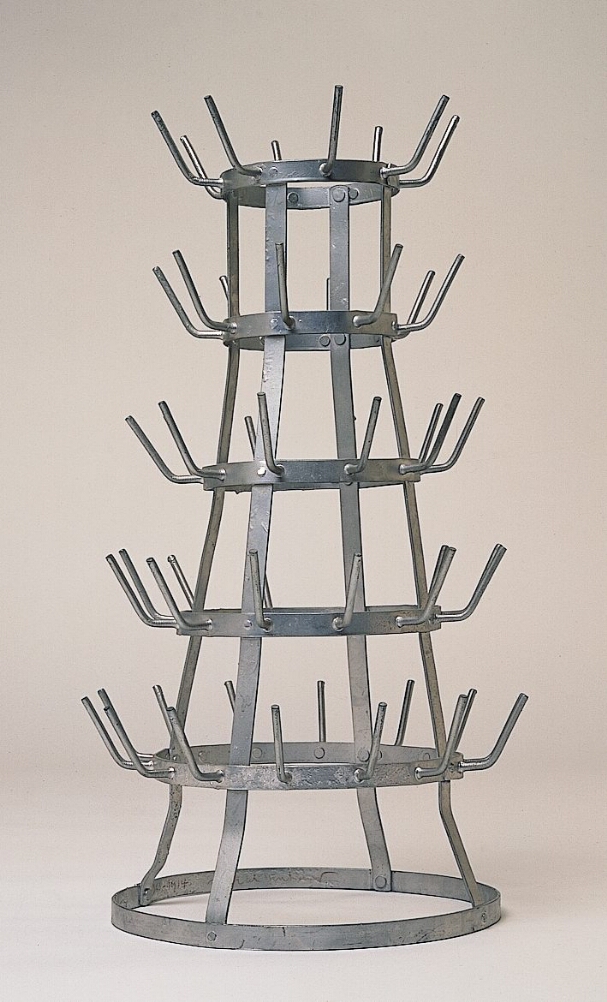 Norton Simon Museum | 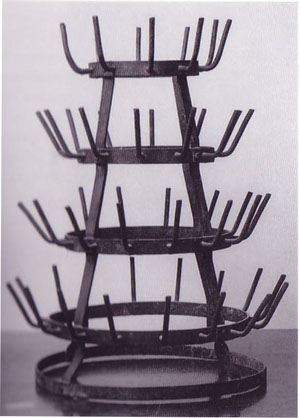 Private collection |
The historical visual motifs analyzed here have been referenced, appropriated, or commented upon by many contemporary practitioners. Relevant precedents include André Raffray’s graphite shadow studies, Ola Korbańska’s structural reconfigurations, and Jeff Koons’ integration of the motif into his Gazing Ball series.
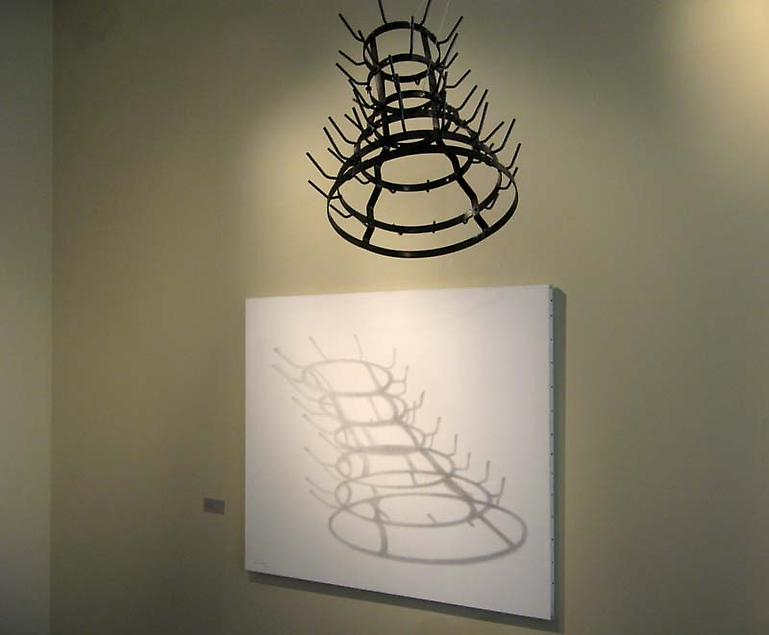 André Raffray, Shadow of the “Bottle Rack” by Marcel Duchamp, 1993 |  Ola Korbańska, 6 CIRCLES / 4 LINES / 50 'L', 2016 | 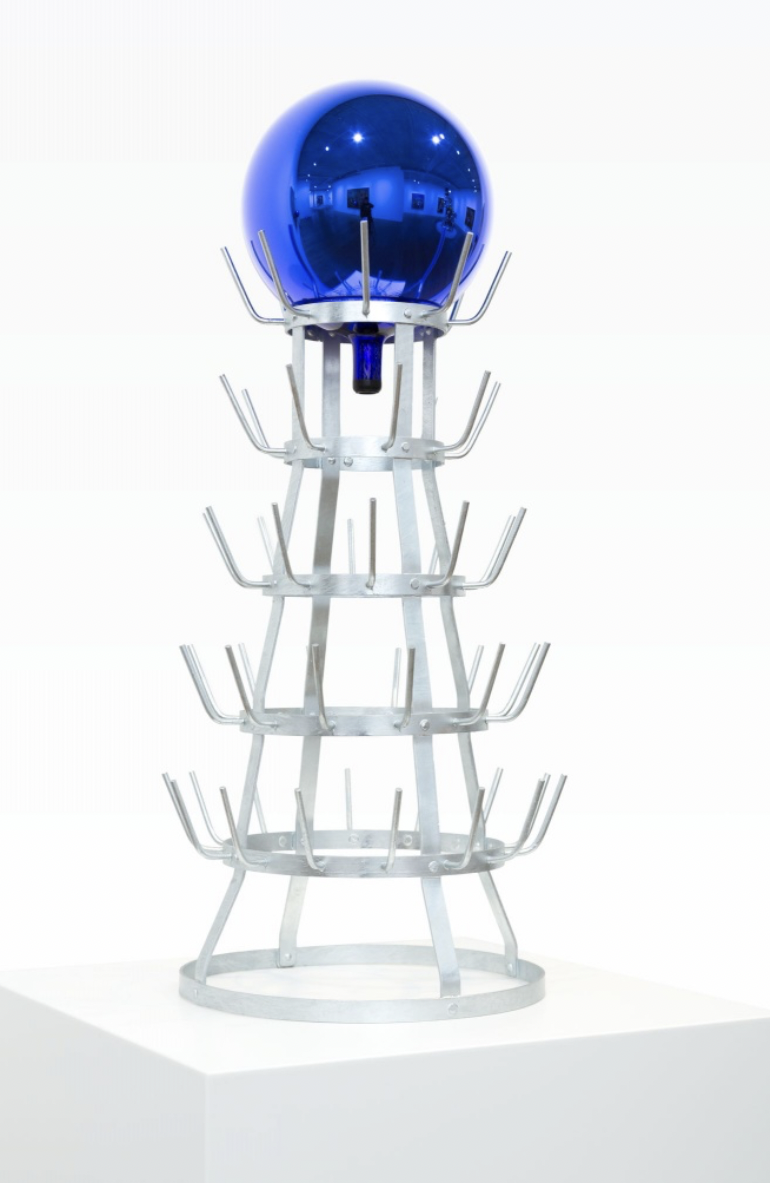 Jeff Koons, Gazing Ball, 2016 |
2 | Scope & Scale
As a work of Post-Appropriation and remix praxis, this model is an independent digital manifestation optimized specifically for FDM fabrication, structural durability, and scale variance. The geometry deliberately adapts historical visual motifs into a printable medium, celebrating the physical deviations required by the additive manufacturing process as part of the artwork's transformative expression:
It is designed to be printed at a range of scales as noted below.
Printing at smaller scales is not recommended.
Many parts require a large-format printer such as a Prusa XL.
To explore the premium, full-scale editions operating under a separate commercial license framework, visit this link.
3 | Printing Notes
This listing offers distinct geometric configurations mapped to the respective historical reference variants:
1961 Variation Layout (Philadelphia Reference):
Pre-assembled. This unified mesh can be fabricated up to approximately 60% of historical scale on a Prusa XL using organic support structures, as documented in the reference images.
Elements to assemble. Multi-part elements designed for post-printing assembly. This layout minimizes the requirement for slicing supports and accommodates a wider scaling threshold. On a large-format printer (XL), successful prints range from 75% down to 50% scale. On standard beds (MK4), scaling thresholds range from 50% down to approximately 30%. Fabricating below a 30% scale threshold is not recommended.
1964 Variation Layout (Schwarz Reference):
Pre-assembled. This configuration is optimized for printing between 40% and 60% of historical scale on a large-format bed utilizing organic supports. Scaling below 40% is not recommended due to critical structural tolerances.
For advanced fabricators seeking a 1:1 full-scale structural manifestation, the corresponding multi-part component files are distributed under a separate commercial license framework via our premium subscription tiers.
File Formats
[Model_Name].3mf/.stl→ Best for quick printing. Pre-meshed at a high resolution, these files will slice exactly as they appear in the smooth website preview.[Model_Name].step→ Best for remixing and maximum quality. These files contain precise CAD data. Note: Ignore the blocky look in the online browser viewer; it will download and slice with perfectly smooth mathematical curves inside your slicer.
If you are printing elements to assemble and you are not using the 3MF file, print in the following quantities:
Columns: 6
Rings 1, 2, 3, and 5: 1 of each
Ring 4 and 6: total of 2, one for Ring 4 and one for Ring 6
Long bolts: 6
Short bolts: 18
Bolt end caps: 24
Recommended material:
I used Prusament Galaxy Silver and Polymaker Panchroma Metallic Silver PLA for my illustrated prototypes to emulate the galvanized metal of the original.
My settings:
Print Settings: 0.15mm Structural
Filament: Prusament PLA
Printer: Prusa XL (for a 75% scale model)
Supports: Everywhere
Infill: 15%
Brim: None
Advanced settings:
Layers and perimeters: all defaults
Infill: Gyroid fill pattern, Concentric top and bottom fill pattern
Support material: Organic style
Stats for a 1961 edition 75% size print:
Total material used: ~180 grams
Total time: ~20 hours
Total number of build plates: 4
4 | Assembly Notes
I used slow-dry gel super glue to assemble. Use the images as a guide.
Make note of the long versus short bolts when assembling; the long bolts go at the overlap.
Starting with Ring 1, set the 4 columns vertically, and clamp them to allow the glue to set. Use a carpenter square or drafting triangle for alignment.
Take care to place ring 1 in the correct orientation: the direction of the overlap should match the images.
Work up Ring 2, 3, 4, 5, and 6 in the same manner. The overlaps should align along the same column.
5 | Presentation Notes
Place this fabricated physical manifestation on a table or pedestal at a comfortable viewing height, allowing spectators to interact with the geometry from all angles.
6 | Change Log
28 JUN 2026: Major architectural and file optimization updates:
Integrated file structures mapping the 1964 Schwarz historical variant.
Added a structural reference link to the full-scale deluxe edition operating under a separate commercial license framework.
Aligned the scale parameters of the 1961 reference files to ensure absolute dimensional parity across the Prêt à Faire structural study.
Reconfigured all preconfigured 3MF plating files.
Re-ordered parts listings for an optimized data previewing experience (placing STL files first to bypass browser rendering constraints on mathematically precise universal STEP data).
2 DEC 2025: Included documented historical artist precedents in the description.
22 NOV 2025: Revised project documentation for layout clarity and consistent formatting across the Prêt à Faire collection.
20 NOV 2025: I added STEP files to facilitate advanced digital geometric research.
9 NOV 2025: Uploaded photographic documentation of a fully assembled physical prototype fabricated in metallic-pigmented polymer to evaluate surface reflections. Integrated the validated 3MF slicing layout utilized on the large-format printer.
1 NOV 2025: Revised the geometric tolerances of long bolts, short bolts, and structural bolt caps to optimize mechanical press-fits during assembly.
8 OCT 2025: Fabricated single-instance prototypes of a single ring, a pair of support columns, a pair of structural caps, and individual mechanical bolts to validate dimensional tolerances prior to executing full component prints.
Disclaimer
Prêt à Faire is an autonomous artistic project, scholarly reference work, and institutional critique by williamCromar, supported by a faculty grant from Penn State Abington with fabrication assistance from the Abington MakerSpace. This project is entirely independent and maintains no formal affiliation, endorsement, or sponsorship with Association Marcel Duchamp, the Estate of Marcel Duchamp, ARS, ADAGP, or any curating museum. When referencing or sharing this work, users must maintain a clear distinction in authorship and nomenclature from the historical referent. Cite this asset as: Model of Marcel Duchamp’s [Object Name] by williamCromar. Basic models are available under a CC BY-NC-SA 4.0 license; premium tiers operate under a separate commercial framework. For full conceptual and legal text, visit https://sites.psu.edu/pretafaire/disclaimer-and-licensing/