
Model of Marcel Duchamp's Fresh Widow by williamCromar
Obliczymy ostateczną cenę na podstawie wybranego pliku. Sprawdzisz ją i zaakceptujesz przed płatnością.
Zapisane na tym urządzeniu.
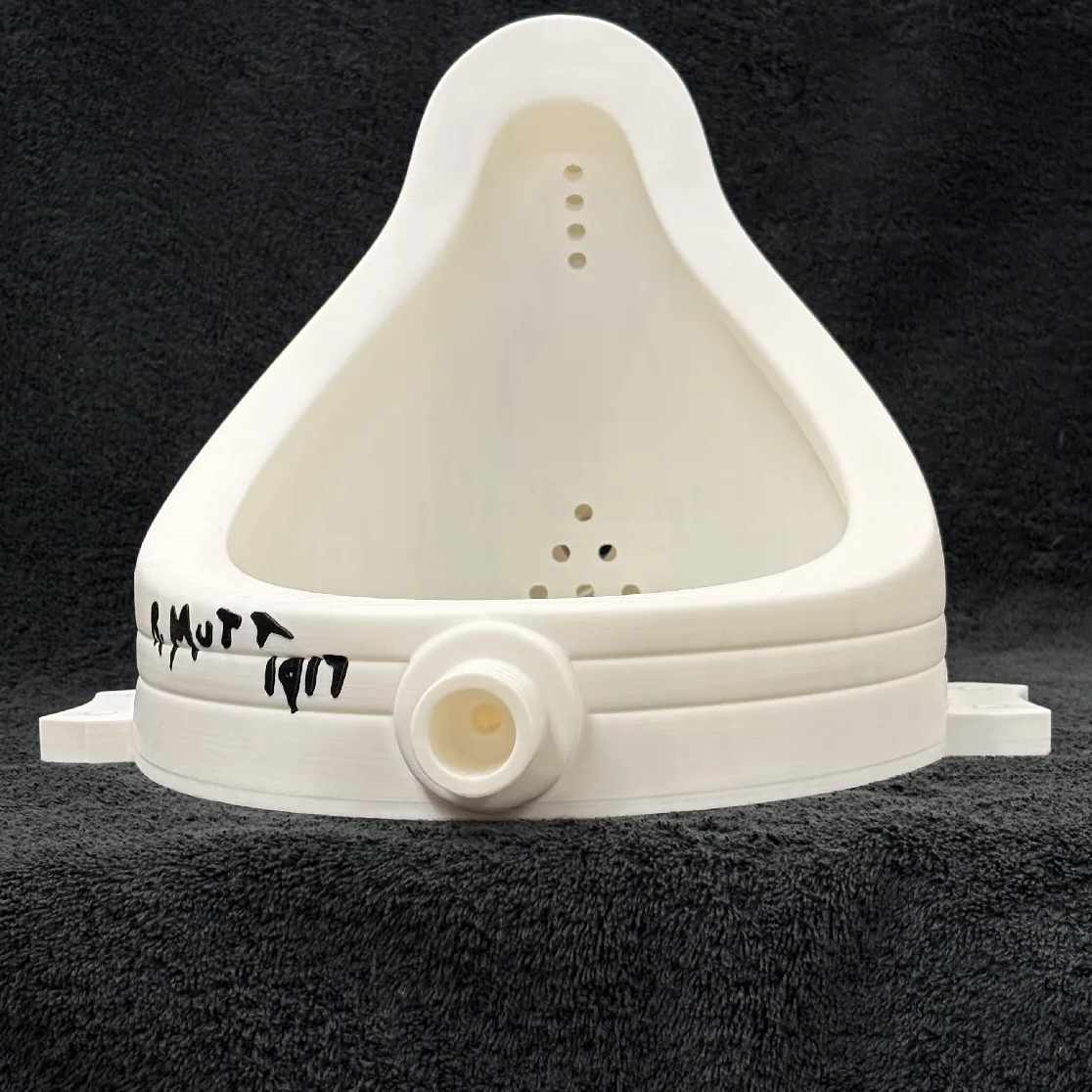
Part of Prêt à Faire, an independent transformative performance supported by Penn State Abington. CC BY-NC-SA 4.0.
- Ocena
- 0 / 5
- Polubienia
- 2
- Pobrania
- 10
- Wydruki
- 0
- Wyświetlenia
- 90
- Oceny
- 0
Aktualizacja u źródła:
Informacje o modelu
- Źródło
- Printables
- Kategoria
- Sculptures
- Licencja
- Creative Commons — Attribution — Noncommercial — Share Alike
This open-access reference model is one of the collection Prêt à Faire: Printable Readymade Models. To explore the full-scale deluxe edition operating under a distinct commercial license framework as part of this broader marketplace critique, visit:
1 | Concept & Provenance
This asset is an independent, transformative performance by williamCromar exploring distributed culture through the lens of public-domain source geometry. The historical referent—the 1920 Fresh Widow—is the first work Duchamp officially attributed to his female alter ego, Rose Sélavy (later Rrose Sélavy).
To support an instructional research initiative funded by a faculty grant from Penn State Abington, I modeled this geometry from the ground up using public historical data. While many of his original surviving Readymades reside in Philadelphia, the 1920 original of this specific work is held by MoMA. The historical object is a miniature scale model of a French window, where the view is completely obscured by black leather panels fixed behind the glass panes. Fabricating this digital model highlights an intentional conceptual irony: your printing workflow requires taking great pains to print clear glass using transparent PETG, only to immediately obscure that transparency with black flexible TPU. This structural process transforms a scale model of a scale model into a contemporary critique of 3D printing with transparency.
Before printing, explore the historical research context of this study at:
Historical reference parameters analyzed:
 MoMA, New York |  Moderna Museet, Stockholm |  Pompidou Center, Paris |
As a work of Post-Appropriation, this model is an independent digital manifestation optimized specifically for multi-material FDM fabrication, structural durability, and scale variance. The geometry deliberately adapts historical visual motifs into a printable medium, celebrating the physical deviations required by the additive manufacturing process as part of the artwork's transformative expression.
Other contemporary practitioners have famously engaged with this specific visual motif, including Elaine Sturtevant, Dylan Macaulay, and Shen Yuan.
 |  |  |
2 | Printing Notes
There are two suggested scales to accommodate the hinge, at 25% and 50%:
Support is unavoidable with this print, but I suggest using an organic support on the build plate only. Don't let the hinges fill up with support! Use paint-on in the slicer to block support on the interior of the hinges if necessary.
If you have a Prusa XL multi-material printer, you will get the most satisfying results at the 50% scale. The letters on the base can be painted in the slicer to print in a contrasting black against the door's teal paint, which you can approximate with a similar filament color. I needed to merge helper disks to the corners of this piece to avoid lifting.
A 25% print can be made on a smaller machine — it can be printed anywhere from 33% to 25%. I do not recommend printing below 25%.
When printing, follow the note for quantity listed with each piece.
For the 25% version, you may print the hinge material and cut it to length to fit like door nails inside the hinges.
The panes can be dealt with in a couple of ways:
For the 50% version, just print the model as is using the appropriate material: PETG for "glass" and TPU for "leather."
For the 25% version, you may just print shiny black at a uniform scale of the pane model. For more accuracy, you may print the "leather" in black TPU and the "glass" in clear PETG. In this case, use the same pane model for each, but scale it non-uniformly so it's half of its ordinary thickness — print the leather/window panes at 25% X-Y and 12.5% Z.
Really amazing clear panes may be generated using Robeena Shepherd's glass profile for Prusament, and follow Engineering Project's advice regarding post-processing. I used a clear glossy UV varnish spray for a glass-like reflective finish.
The preferred orientation on the build plate is built into the 3MF file. Use this for reference if plating your own STL or STEP files.
Recommended materials:
Polymaker Panchroma Matte Arctic Teal PLA: Doors, frames, base, clips, hooks, hinge "nail" material
Hatchbox Matte Black PLA: Lettering on base
Prusament Clear PETG: "Glass" panes, doorknobs
SUNLU Black TPU: "Leather" panes
Prusament Jet Black PLA: Shiny one-piece panes, if not creating a glass and leather version
My general settings:
Print Settings: 0.2 mm Structural
Filament: As appropriate
Printer: Prusa XL or MK3 or MK4 with MMU (for multi-print of base)
Supports: Needed at hinges and in the inset for glass panes
Infill: 15%
Brim: None
Advanced settings:
Layers and perimeters: All defaults
Infill: Gyroid fill pattern, Aligned Rectangular top and bottom fill pattern set to 0 degrees
Support material: Organic style where needed
Stats for a 50% scale print with "leather" and "glass" panes:
Total material used: ~290g teal PLA, ~1.5g black PLA, ~50g black TPU, ~61g clear PETG
Total time: ~15 hours 45 minutes for all but the glass panes, 36 hours for glass panes (due to special profile for clear glass)
Total number of build plates: 5 on Prusa XL (1 for long jambs, 1 for all other door parts, 1 for TPU panes, 1 for glass panes, 1 for clear handles). XL is required for long jambs and doors at 50% scale; all other parts can be printed on a smaller machine.
3 | Assembly Notes
It's fairly self-evident which parts go where, but I do recommend taking care with the following:
Start by inserting the glass in the glass insets, using a tiny amount of super glue where the glass touches the frame.
If using clear/leather pane assemblies, insert the TPU elements WITHOUT glue.
Now secure the TPU elements with the small teal holder clips, super-gluing the round tabs into their slots. Yes, this is enough to hold the TPU pieces in without gluing them!
Insert the side jamb hinges onto the door hinges BEFORE joining frames together on the base. In a 25% version, use the printed hinge material and cut to length to make "nails." In a 50% version, nails are modeled. NO GLUE in the hinges!
Secret sauce: Use 3-4 pieces of paper as shims to level the doors at the base when you begin gluing the jambs to the base. Use Weld-On 16 or Gloop for these tongue-and-groove miter joints.
Glue the door head frame in the same manner, shimming doors with paper as needed to maintain square and level.
Glue the 4 hooks to the rear corners of the doors and glue the handles on the front.
Once the glue has set, remove the paper shims and enjoy the working hinge on these doors! Just be careful: only one door at a time. If both doors are open simultaneously, the center of gravity tilts the work forward. Evidently, Duchamp never meant the working doors to actually perform their function, or he might have had a larger base installed!
4 | Presentation Notes
Place the assembled physical manifestation on a pedestal or table at eye level. While some museum installations present the work as a flat bas-relief revealing only the front face, displaying it as a sculpture in the round allows viewers to examine the rear panel holders and structural hooks. The completed model features a high center of gravity; securing the base to your mounting surface with museum putty or wax is highly recommended to ensure stability during display. Best NOT to open both doors at once!
5 | Change Log
1 AUG 2026 | Major architectural and file optimization updates: Refined the geometry of the main window base to align with historical visual parameters. Re-engineered the 50% scale hinge, handle, rear panel holders, and locking hooks to incorporate mechanical data generated during development of the full-scale version. Preserved legacy component directories to support 25% scale prints, and reorganized the folder directory to ease file scaling. Revised technical documentation.
21 DEC 2025 | Uploaded photographic documentation of a completed 50% scale multi-material proof print, and integrated an updated structural hook file configured for 50% scale fabrications.
DEC 2025 | Uploaded component modifications, added a technical exploded isometric assembly diagram, and revised the description layout for consistent formatting across the Prêt à Faire collection.
8 OCT 2025 | Fabricated initial structural prototypes at 25% scale in simple white PLA to validate mechanical clearances. The friction-fit joints and custom hinge pin aligned smoothly without binding. Permanent installation will require standard cyanoacrylate or bonding adhesives.
Disclaimer
Prêt à Faire is an autonomous artistic project, scholarly reference work, and institutional critique by williamCromar, supported by a faculty grant from Penn State Abington with fabrication assistance from the Abington MakerSpace. This project is entirely independent and maintains no formal affiliation, endorsement, or sponsorship with Association Marcel Duchamp, the Estate of Marcel Duchamp, ARS, ADAGP, or any curating museum. When referencing or sharing this work, users must maintain a clear distinction in authorship and nomenclature from the historical referent. Cite this asset as: Model of Marcel Duchamp’s [Object Name] by williamCromar. Basic models are available under a CC BY-NC-SA 4.0 license; premium tiers operate under a separate commercial framework. For full conceptual and legal text, visit https://sites.psu.edu/pretafaire/disclaimer-and-licensing/