
Matching multicolor hexagon tiling (semi-symmetric quasigroup)
Obliczymy ostateczną cenę na podstawie wybranego pliku. Sprawdzisz ją i zaakceptujesz przed płatnością.
Zapisane na tym urządzeniu.
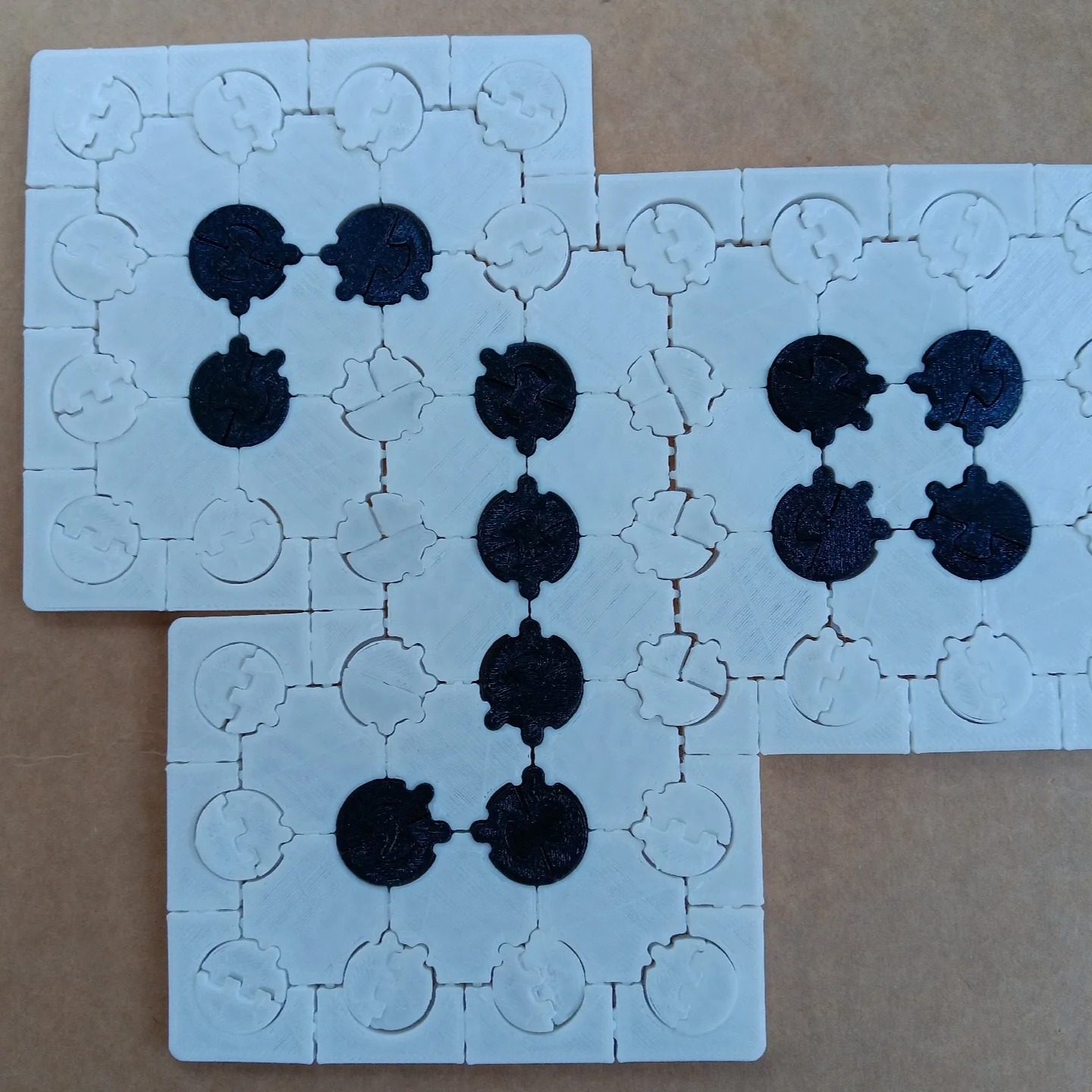
Of somewhat limited interest but illustrates a way to make pieces with multicolor surfaces to implement a color tiling.
- Ocena
- 0 / 5
- Polubienia
- 1
- Pobrania
- 6
- Wydruki
- 0
- Wyświetlenia
- 47
- Oceny
- 0
Aktualizacja u źródła:
Informacje o modelu
- Źródło
- Printables
- Kategoria
- Puzzles & Brain-teasers
- Licencja
- Creative Commons — Attribution — Share Alike
There are two printable objects: a hexagonal base and a rhombic color cap. Each base has 3 spots for caps, which should be printed in different colors. Attach the caps to the base upside down by sliding the tabs under the center divider and snapping the bump into the matching hole in the base.

You can assemble them different ways, but here is the example I used in 3 colors to realize a semi-symmetric quasigroup of 3 elements. My longer writeup is at https://conwaylife.com/forums/viewtopic.php?f=11&t=3663&p=67387

The edges of these tiles snap so that the rhombuses of any three incident tiles form a hexagons, intended to be assembled so the colors match in each hexagon, such as in this example.

Note that every pair of rhombus colors matches a unique color for the remaining rhombus.
red○red =black
black○black=green
green○green=red
With rotations
red○green=green○red=green,
red○black=black○red=black
green○black=black○green=black
When assembling with matching colors, there is always a way to add a new tile, and sometimes the choice is forced, e.g. at the bottom row of the photo above. The downward-facing hex triples are constrained by the central tile.
My original goal was to use these kinds of groups to design symmetric 1D cellular automata. You can use them for this, but I am not sure whether any of these are universal due to the quasigroup property.