
Model of Marcel Duchamp's Porte-chapeau (Hat Rack) by williamCromar
Obliczymy ostateczną cenę na podstawie wybranego pliku. Sprawdzisz ją i zaakceptujesz przed płatnością.
Zapisane na tym urządzeniu.
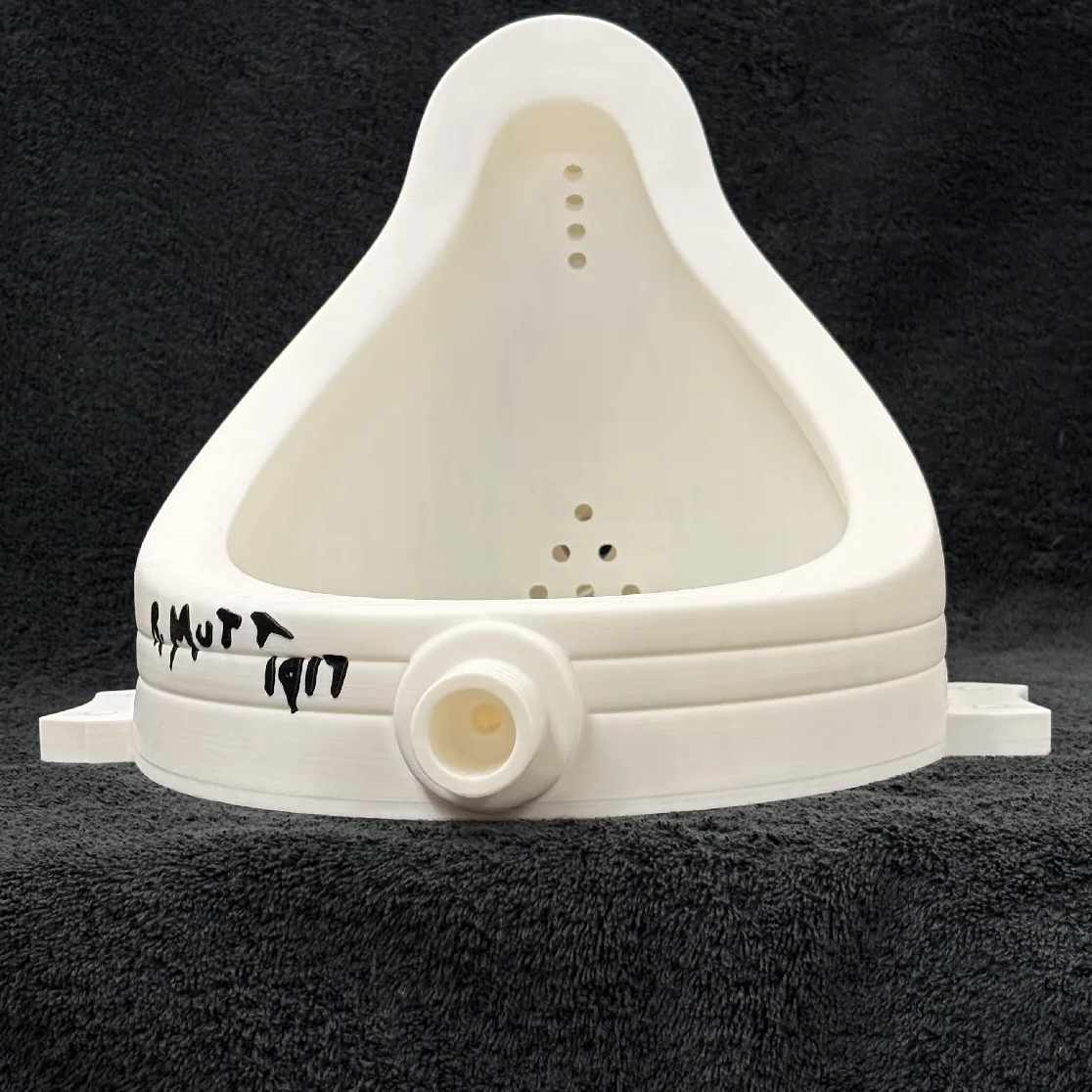
Part of Prêt à Faire, an independent transformative performance supported by Penn State Abington. CC BY-NC-SA 4.0.
- Ocena
- 0 / 5
- Polubienia
- 3
- Pobrania
- 20
- Wydruki
- 0
- Wyświetlenia
- 111
- Oceny
- 0
Aktualizacja u źródła:
Informacje o modelu
- Źródło
- Printables
- Kategoria
- Sculptures
- Licencja
- Creative Commons — Attribution — Noncommercial — Share Alike
This open-access reference model is one of the collection Prêt à Faire: Printable Readymade Models. To explore the non-textured advanced geometric variants operating under a distinct commercial framework as part of this broader marketplace critique, view the premium tiers associated with this project:
1 | Concept & Provenance
This asset is an independent, transformative performance by williamCromar exploring distributed culture through the lens of public-domain source geometry. The historical referent—the 1917 Readymade Hat Rack (originally titled Porte-chapeau)—was suspended from a studio ceiling, casting organic, shadow-based projections. To facilitate an instructional research initiative supported by a faculty grant from Penn State Abington, I forensically reconstructed this structural geometry from the ground up utilizing public data points, historical documentation, and public archival documentation.
Because the historical original is lost, subsequent mid-century variants display marked architectural inconsistencies, as documented by scholars like Rhonda Roland Shearer. This model stands as an independent digital manifestation that cross-references the public dimensional parameters of the 1964 Schwarz configuration.
Find out more about this work at:
 Detail of shadow |  Photo of the lost 1917 version |
 A loosely interpreted blueprint for |  Schwarz edition on display at the Hirshhorn Museum, Washington DC |
Scholarly analysis of these reference archives shows that the initial drafting parameters for the 1964 variant diverge significantly from its physical execution, an inconsistency deeply analyzed in Shearer's research.
The historical visual motifs analyzed here have been referenced and commented upon by contemporary practitioners, including:
 Yossi Breger, Hat Rack (Marcel Duchamp, 1917, 1964), Israel Museum, C-print, 2013 |  Sherrie Levine, Fedora, 2011 |
2 | Scope & Fabrication Strategy
As a work of Post-Appropriation, this model is an independent interpretation optimized specifically for FDM fabrication, structural durability, and scale variance. The geometry deliberately adapts historical visual motifs into a printable medium, celebrating the physical deviations required by the additive manufacturing process as part of the artwork's transformative expression. The files are configured at true historical scale and accommodate a range of dimensional scaling.
3 | Printing Notes
This listing offers two distinct structural configurations:
One is a fully assembled, non-textured geometric model, appropriate for 50% scale. STL, STEP, and plated 3MF files are provided.
The second is a wood-textured multi-part framework configured for full-scale printing, featuring split files for the hooks, base, and mounting plaque. Fully sliced 3MF plating layouts and STL files are provided, alongside universal STEP files where geometry permits.
Surface Texture Optimization Note: To generate a representation of wood grain in the physical print, early prototypes implemented custom structural modifiers. Current iterations utilize an optimized geometric surface modification process generated via BumpMesh by CNC Kitchen. Archival configurations of the baseline files remain accessible in the premium tier framework.
Recommended material:
SUNLU Walnut Wood Fiber PLA for all wood elements
Amolen Aged Brass Silk PLA for the plaque
My general settings:
Print Settings: 0.2mm Structural
Filament: Generic PLA
Printer: Prusa MK4
Supports: Paint-on (provided in the 3MF)
Infill: 10% (provides better weight when suspended)
Brim: None
Advanced settings:
Layers and perimeters: all defaults
Infill: Gyroid fill pattern, Concentric top and bottom fill pattern
Support material: Organic
Stats for the full-scale print:
Total material used: ~530 grams
Total time: ~40 hours 30 minutes
Total number of build plates: 4 (on the MK4, one for the base, three plates each with 2 hooks)
3 | Assembly Notes
Assembly is fairly self-explanatory. I used Weld-On 16 gel adhesive for all parts. When attaching the plaque, I attached the screws to the plaque first, then attached that assembly to the base.
4 | Presentation Notes
Suspend this from the ceiling using wire or monofilament. To explore the full conceptual scope of the work, orient a directional light source toward the model to project organic shadows onto an adjacent wall, activating the spatial and haptic dialogue central to the Prêt à Faire critique.
6 | Change Log
15 JUL 2026: Major architectural optimization updates:
Integrated specialized surface-textured components.
Exported high-resolution STL meshes and universal STEP files where geometry permits.
Reformatted technical documentation.
Added a structural reference link to the archived geometric variants operating under a separate commercial license framework.
17 DEC 2025: Integrated an experimental 3MF layout featuring customized surface geometry modifiers.
9 DEC 2025: Revised technical documentation for clarity and consistent formatting across the Prêt à Faire collection. Added images of a full-scale print using the surface geometry modifier.
4 OCT 2025: Uploaded photographic documentation of structural prototype fabrications utilizing test PLA to evaluate geometric fits. The physical tolerances are validated. Final material tests will evaluate dark tan PLA to analyze the interaction between opaque coloration and the structural surface textures.
Disclaimer
Prêt à Faire is an autonomous artistic project, scholarly reference work, and institutional critique by williamCromar, supported by a faculty grant from Penn State Abington with fabrication assistance from the Abington MakerSpace. This project is entirely independent and maintains no formal affiliation, endorsement, or sponsorship with Association Marcel Duchamp, the Estate of Marcel Duchamp, ARS, ADAGP, or any curating museum. When referencing or sharing this work, users must maintain a clear distinction in authorship and nomenclature from the historical referent. Cite this asset as: Model of Marcel Duchamp's Porte-chapeau (Hat Rack) by williamCromar. Basic models are available under a CC BY-NC-SA 4.0 license; premium tiers operate under a separate commercial framework. For full conceptual and legal text, visit https://sites.psu.edu/pretafaire/disclaimer-and-licensing/