
Educational Model of Non-circular Gears
Obliczymy ostateczną cenę na podstawie wybranego pliku. Sprawdzisz ją i zaakceptujesz przed płatnością.
Zapisane na tym urządzeniu.

They work as a variable speed gear system.
- Ocena
- 5 / 5
- Polubienia
- 51
- Pobrania
- 175
- Wydruki
- 1
- Wyświetlenia
- 672
- Oceny
- 1
Aktualizacja u źródła:
Informacje o modelu
- Źródło
- Printables
- Kategoria
- Engineering
- Licencja
- Creative Commons — Attribution
My Educational Mechanical Examples Series
This model is one of my educational mechanical mechanism examples on 80mm x 80mm base plates.
You can find all models in the series in this collection => [Mechanical Mechanism Examples]

The present model
This is an educational model of non-circular gears, which work as a variable speed gear system.


FOLLOW THIS LINK FOR THE INTRODUCTION VIDEO → https://youtu.be/AjaNT3_8q5M
*Somehow, the editor of printables is currently broken and does not allow me to embed the video.
Brief Description
Each of the two gears in this model has a non-circular reference curve.
The left gear uses an eccentric ellipse as its reference curve. The reference curve of the right gear was determined so that it can rotate while maintaining rolling contact with the eccentric ellipse of the other gear without slipping. Since the two reference curves have exactly the same circumference length, one full revolution of one gear results in a full revolution of the other. However, because the radial distances from the rotational pivots to the contact point change as the gears rotate, the angular velocity of the output gear varies even when the input gear rotates at a constant speed.
The tooth profiles of the two gears are generated in the same way as standard involute gears. In other words, the reference curve of each gear is rotated against a virtual rack-shaped cutting tool without slipping. As a result, their tooth shape is almost the same as that of a standard involute gears, whose radius is the same as the curvature radius of the reference curve. So, the tooth profile of a non-circular gear varies according to the curvature of the reference curve. In particular, near the pointed ends of the ellipse—where the curvature radius is small—undercut occurs at the tooth roots, just as in small-diameter involute gears. In addition, certain portions of the right gear have negative curvature, producing tooth shapes that locally resemble those of internal gears.
Note that the tooth shape depends only on the curvature of the reference curve, not on the distance from the rotational center.
Related Model
Case
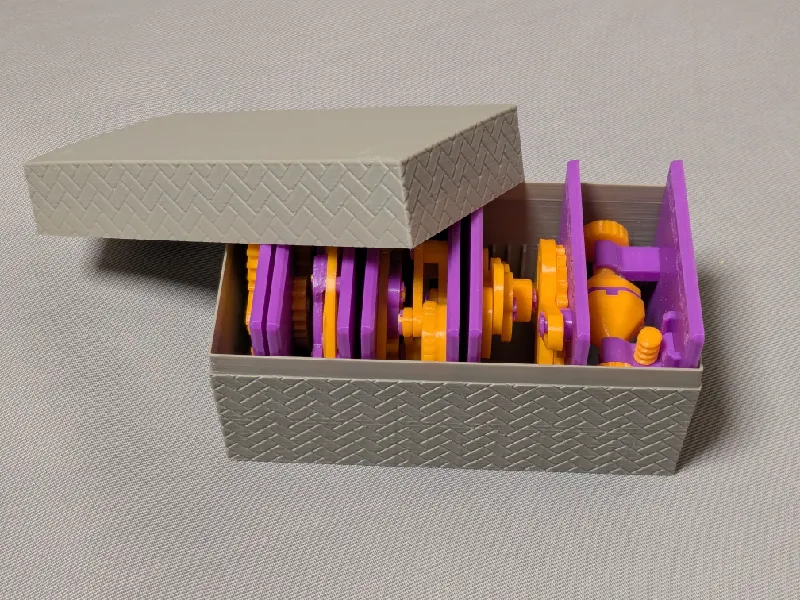
This model is compatible with the case included in my first set.
Printing
Use the models named
???-printable.stlfor printing.
The models named???-assembled.stlare provided just to show how they should be assembled.
Use well-dried PETG to have better dimensional accuracy.
Use 0.1 mm or 0.08 mm layer height to have smoother surfaces.
Use slow printing speed for overhangs.
Select “Random” seam position to have smoother rotation.
Randomly distributed seam should be easily worn out after some wearing.Printing
Sanding and Filing
Sometimes, the gears suffer from the stringing effect and/or elephant foot effect, resulting in a too tight fit to the shafts (they are designed with a 0.15 mm radial clearance).
If you see rough surface on the shafts due to stringing, sand off the roughness with a small piece of sand paper.

If you feel the gears do not rotate smoothly due to an elephant effect, widen the hole slightly by using a thin round bar file.

Without those issues, the parts should rotate very smoothly with minimal friction.
Assembly
Secure the gears on the shafts with the retaining rings.
Other examples
You may also be interested in the models in my educational mechanical mechanism examples.
Find them in this collection:
https://www.printables.com/@osamutake_3341417/collections/2728214

Happy printing!
Acknowledgement
I got into gears thanks to K.$uzuki's amazing articles and YouTube videos. Many of the mechanisms shown in this series came from the introductions on his website. He also makes excellent gear models himself. This series wouldn’t have existed without his inspiration.
I learned a lot about technical detail of designing gear tooth profiles from Haguruma-No-Hanashi website. I’m truly grateful for that.