
Involute Gear Pumps - Educational model
Obliczymy ostateczną cenę na podstawie wybranego pliku. Sprawdzisz ją i zaakceptujesz przed płatnością.
Zapisane na tym urządzeniu.

Two types of involute gear pumps
- Ocena
- 0 / 5
- Polubienia
- 31
- Pobrania
- 127
- Wydruki
- 0
- Wyświetlenia
- 601
- Oceny
- 0
Aktualizacja u źródła:
Informacje o modelu
- Źródło
- Printables
- Kategoria
- Engineering
- Licencja
- Creative Commons — Attribution
Discontinue Double Posting
====
====
I will discontinue double posting the models to Printables and MakerWorld because it became frustrating, with the unstable Printables' content editor... Please search for my new models in MakerWorld.
====
====
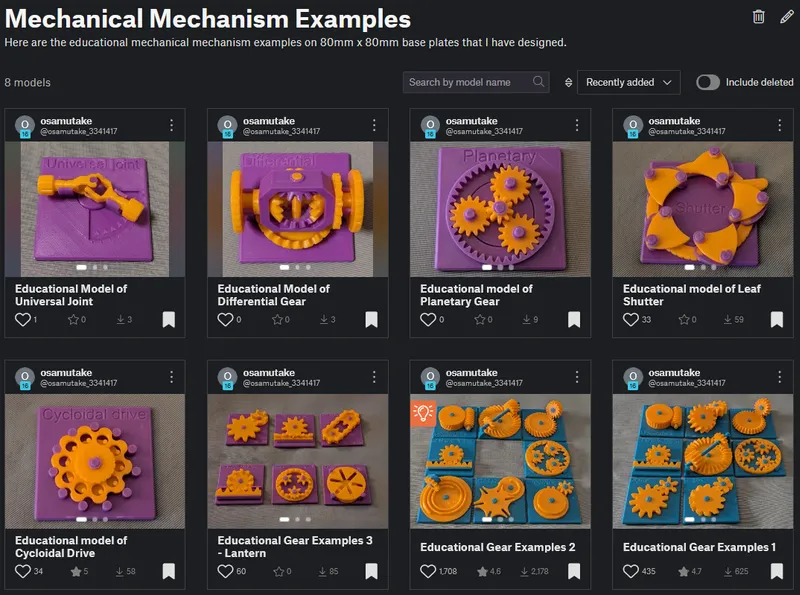
My Educational Mechanical Examples Series
This model is one of my educational mechanical mechanism examples on 80mm x 80mm base plates.
You can find all models in the series in this collection => [Mechanical Mechanism Examples]
This present model
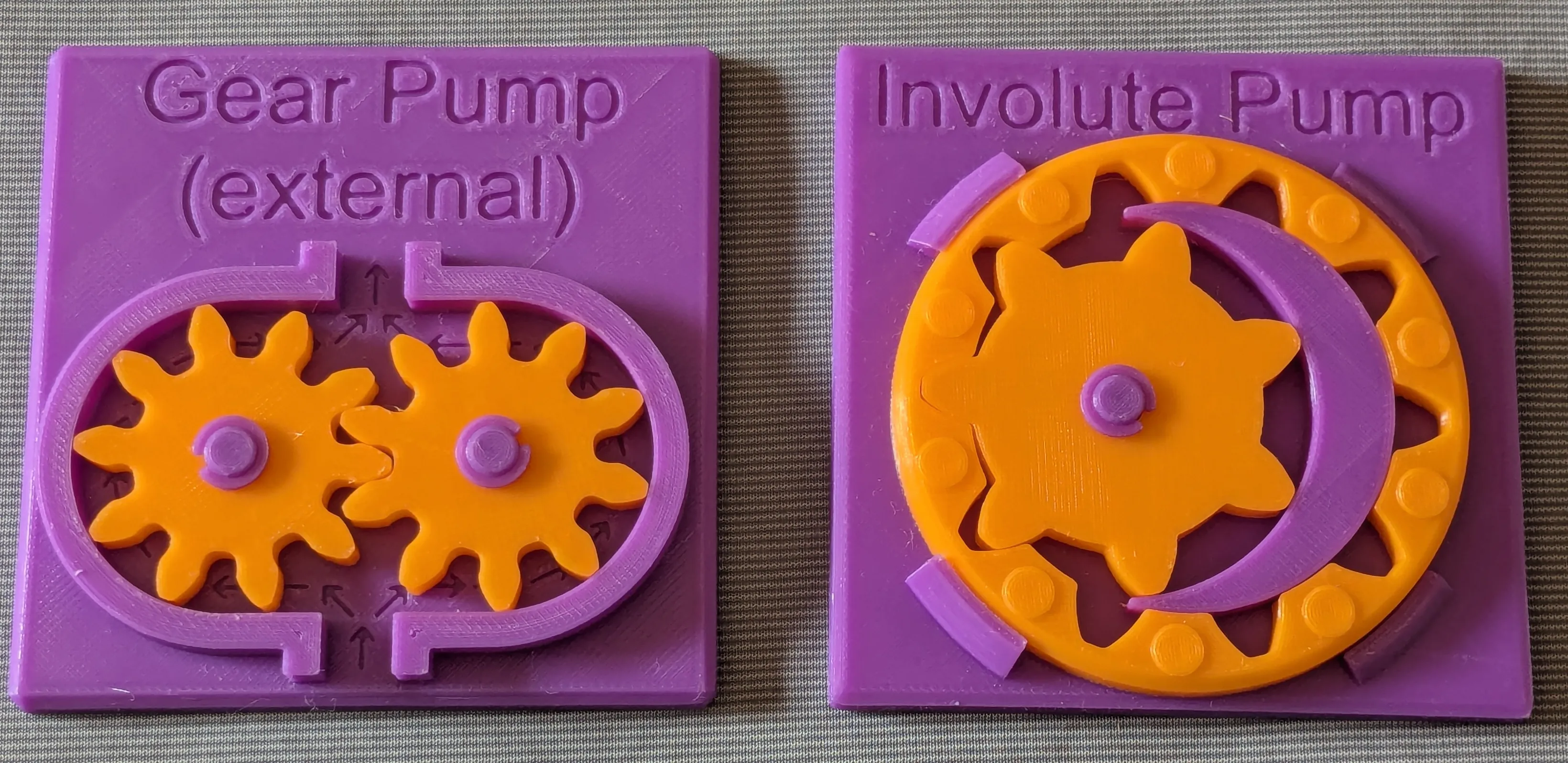
This is an educational models of two types of involute gear pumps.
One is an external gear pump (left), the other is an internal gear pump (right).
Brief Description
Gear pumps work by trapping a gas or liquid in the gaps between gear teeth and carrying it along as the gears rotate.
The two models shown here both use conventional involute gears, but their tooth height, pressure angle, and profile shift are adjusted so that the clearance at the meshing region between the two gears is minimized.
In the external gear pump on the left, the outer housing is formed so as to closely follow the tooth tips. Except near the inlet and outlet ports, the regions bounded by the housing and the tooth spaces are nearly sealed. As the gears rotate, these sealed pockets move from the inlet side to the outlet side, transporting the fluid. In the meshing region, the clearance between the two gears is made small to minimize backflow (leakage) from the outlet side to the inlet side.
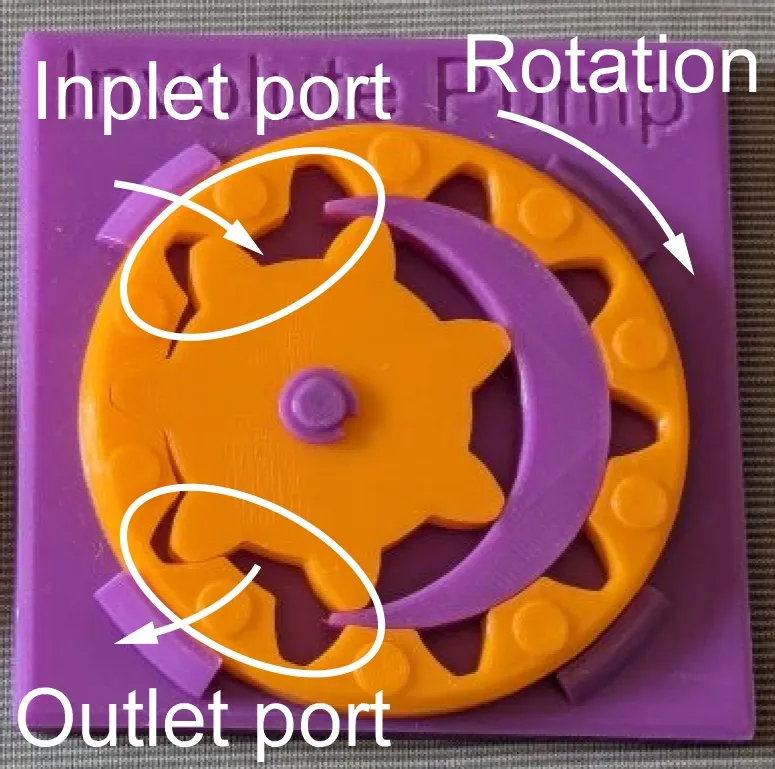
In the internal gear pump on the right, the model does not show distinct inlet or outlet openings. In this type of pump, the inlet and outlet are provided as ports in the side plate, as shown in the figure below. As
in the external gear pump, sealed pockets are formed between the crescent-shaped partition and the tooth spaces, and as the gears rotate, the fluid trapped in these pockets is carried from the inlet side to
the outlet side. At the leftmost point where the two gears mesh, the clearance between the gears becomes almost zero; moving away from that point, the tooth-space chamber volume increases on the inlet side and
decreases on the outlet side. As a result, fluid is drawn into the tooth spaces on the inlet side and expelled from them on the outlet side.
External gear pumps with involute spur gears are widely used in practice as one of the most common positive-displacement pumps in hydraulic, lubrication, and fuel systems. Internal gear pumps (the type with a crescent-shaped partition) are also widely used in industrial applications. On the other hand, many pumps are also in use that employ non-involute tooth profiles optimized for specific purposes.
Case
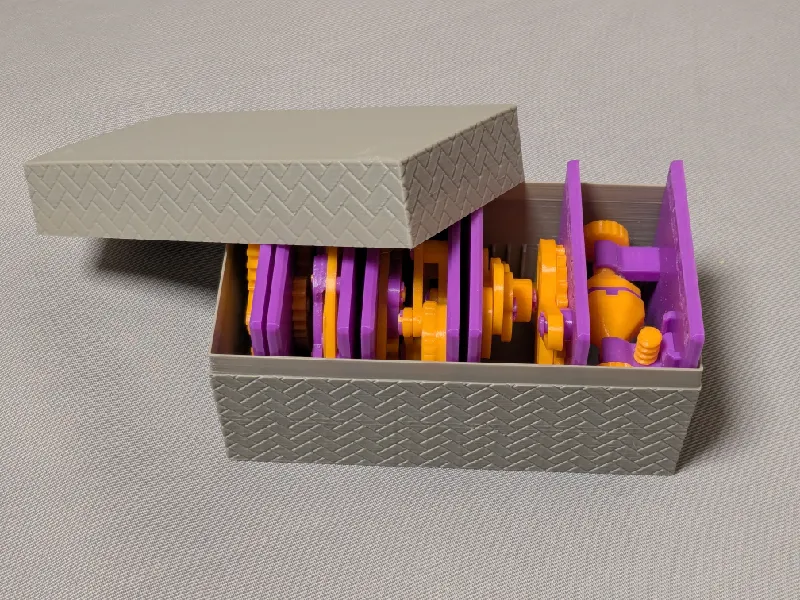
This model is compatible with the case included in my first set.
Printing
Use the models named
???-printable.stlfor printing.
The models named???-assembled.stlare provided just to show how they should be assembled.
Use well-dried PETG to have better dimensional accuracy.
Use 0.1 mm or 0.08 mm layer height to have smoother surfaces.
Use slow printing speed for overhangs.
Select “Random” seam position to have smoother rotation.
Randomly distributed seam should be easily worn out after some wearing.Printing
Sanding and Filing
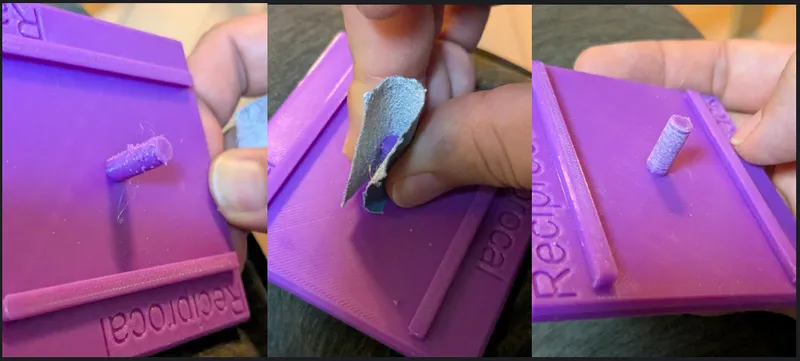
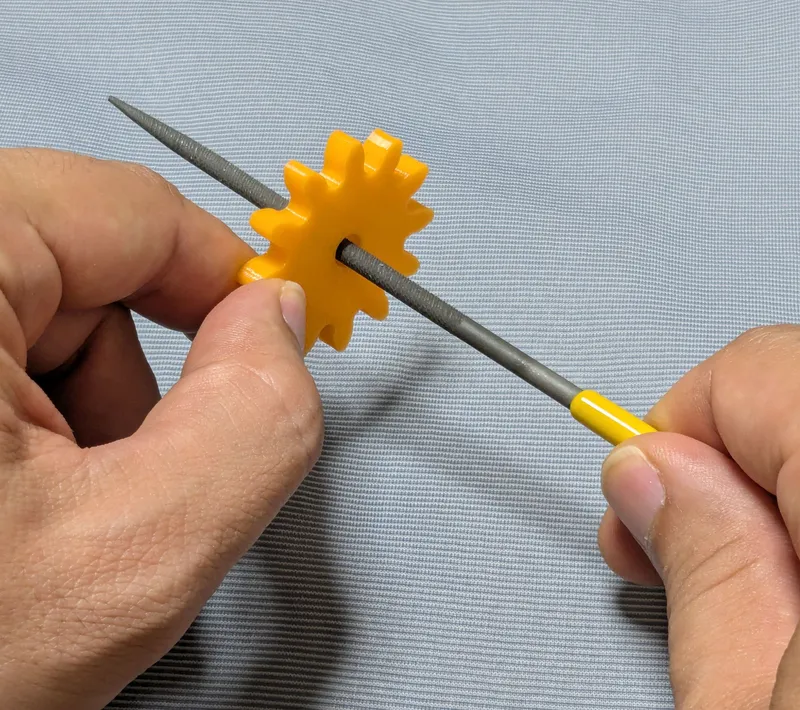
Sometimes, the gears suffer from the stringing effect and/or elephant foot effect, resulting in a too tight fit to the shafts (they are designed with a 0.15 mm radial clearance).
If you see rough surface on the shafts due to stringing, sand off the roughness with a small piece of sand paper.
If you feel the gears do not rotate smoothly due to an elephant effect, widen the hole slightly by using a thin round bar file.
Without those issues, the parts should rotate very smoothly with minimal friction.
Assembly
Just secure the gears and wheels by the retaining rings.
Other examples
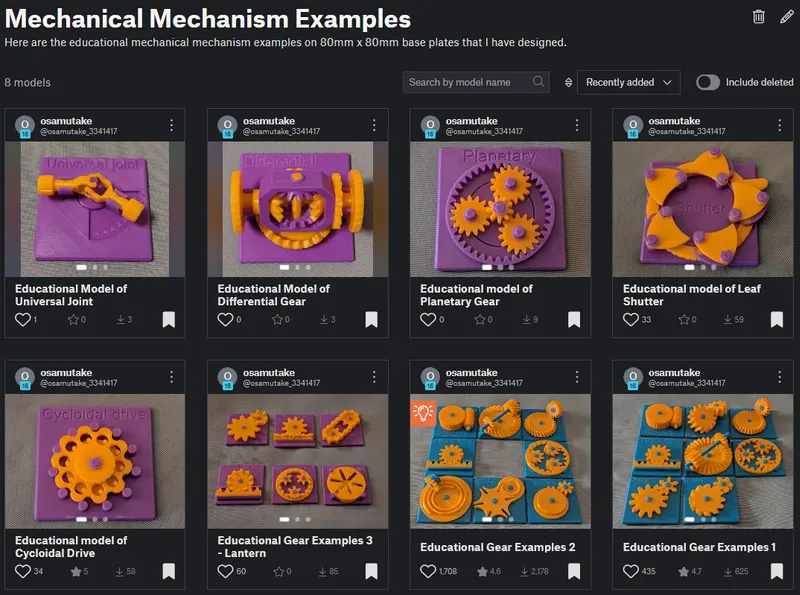
You may also be interested in the models in my educational mechanical mechanism examples.
Find them in this collection:
https://www.printables.com/@osamutake_3341417/collections/2728214
Happy printing!
Acknowledgement
I got into gears thanks to K.$uzuki's amazing articles and YouTube videos. Many of the mechanisms shown in this series came from the introductions on his website. He also makes excellent gear models himself. This series wouldn’t have existed without his inspiration.
I learned a lot about technical detail of designing gear tooth profiles from Haguruma-No-Hanashi website. I’m truly grateful for that.