
Parametric watertight planter dish
Obliczymy ostateczną cenę na podstawie wybranego pliku. Sprawdzisz ją i zaakceptujesz przed płatnością.
Zapisane na tym urządzeniu.
Informacje o modelu
- Źródło
- Printables
- Kategoria
- Other House Equipment
- Licencja
- Creative Commons — Public Domain
What?
I've created a simple parametric model to create custom-size dishes for pots/planters. You can configure the following using millimeters:
Diameter.
Base thickness.
Wall thickness.
Total heigth.
The angle of the external wall.
How?
I've uploaded a sample dish (see measurements below) and a .openscad file. To create your own simply download the software at https://openscad.org/, load the file and change the parameters as you need.
Need to know
I'm using the sample model I've uploaded as the reference to explain the parameters. It's been created with the default parameters on the OpenSCAD script, this is:
Diameter = 120mm
Angle = 15º
Height = 25mm
Wall thickness = 3mm
Base thickness = 1mm
The diameter defines the external circumference at the base. This implies that the internal diameter will be slightly smaller. As it's two conical shapes (the external one and an internal one being removed from it) the internal diameter is not calculated straight away; it's related to the wall thickness and the base thickness. If you want to make sure of the correct internal diameter you can double check its size using the Measure tool on the slicer:
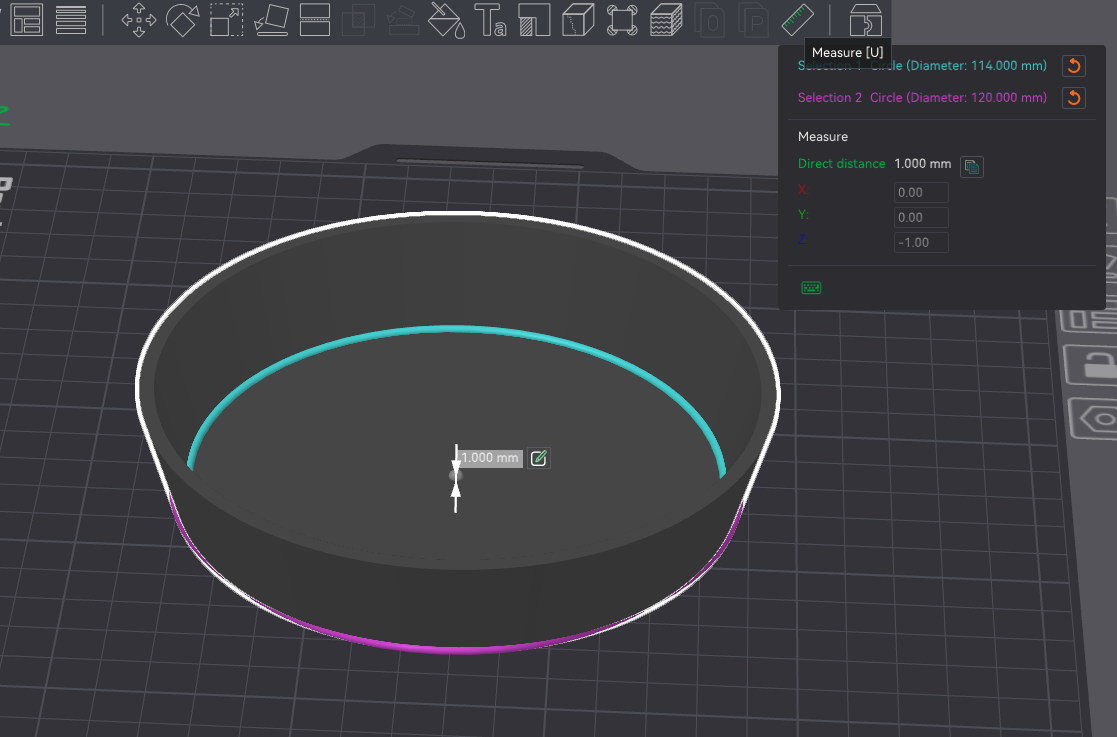
The absolute model size will also be bigger if the angle is greater than 0º. In the sample, the total model diameter at the external circle of the top layer is slightly over 133mm.
The angle is measured in relation to the Z axis (the vertical axis). After checking a few plates I have at home I've seen that they tend to be between 0º (90º in relation to the plate) and 20º (70º in relation to the plate). Adding a negative value will make the wall lean inwards, but it has to be. This value must be between -90º and 90º, otherwise the model won't render (impossible geometry). In order to have a safe angle for 3D printing I wouldn't recommend to get outside the -45º to 45º range.
In the sample model the angle is 15º, which makes a 75º angle between the wall and the plate.
The height includes the base thickness. For the sample, the height of the internal face is 24mm (25mm of total height minus 1mm of base thickness).
Is it water-tight?
TL;DR: Mine is. It'll depend on the settings/filament used. There doesn't seem to be a one-fits-all approach.
Making a 3D-printed part water tight is a bit complex. It's not just as easy as “use these settings and it'll be 100%”. I've upload the sample dish profile with a 0.16 layer height for PETG and 105% flow ratio. I've printed using eSUN's black PETG, put some water on it and left it for over 72 hours to see if it held the water and there were no signs of moisture underneath it. On a Real Life© scenario it should hold a few drops of water, not be filled to the rim, so as long as it's able to hold the water until it evaporates it should be fine.
DISCLAIMER: If you're putting a dish on a surface that could be damaged by water please test it in a controlled environment before putting it there. Also, avoid matte PLA, it seems to not be able to hold water.
It could also be possible to apply some clear plastic-specific varnish (or epoxy/putty) to the inside to add some extra water protection.