
Model of Marcel Duchamp's In Advance of the Broken Arm by williamCromar: Full Scale Edition
Obliczymy ostateczną cenę na podstawie wybranego pliku. Sprawdzisz ją i zaakceptujesz przed płatnością.
Zapisane na tym urządzeniu.
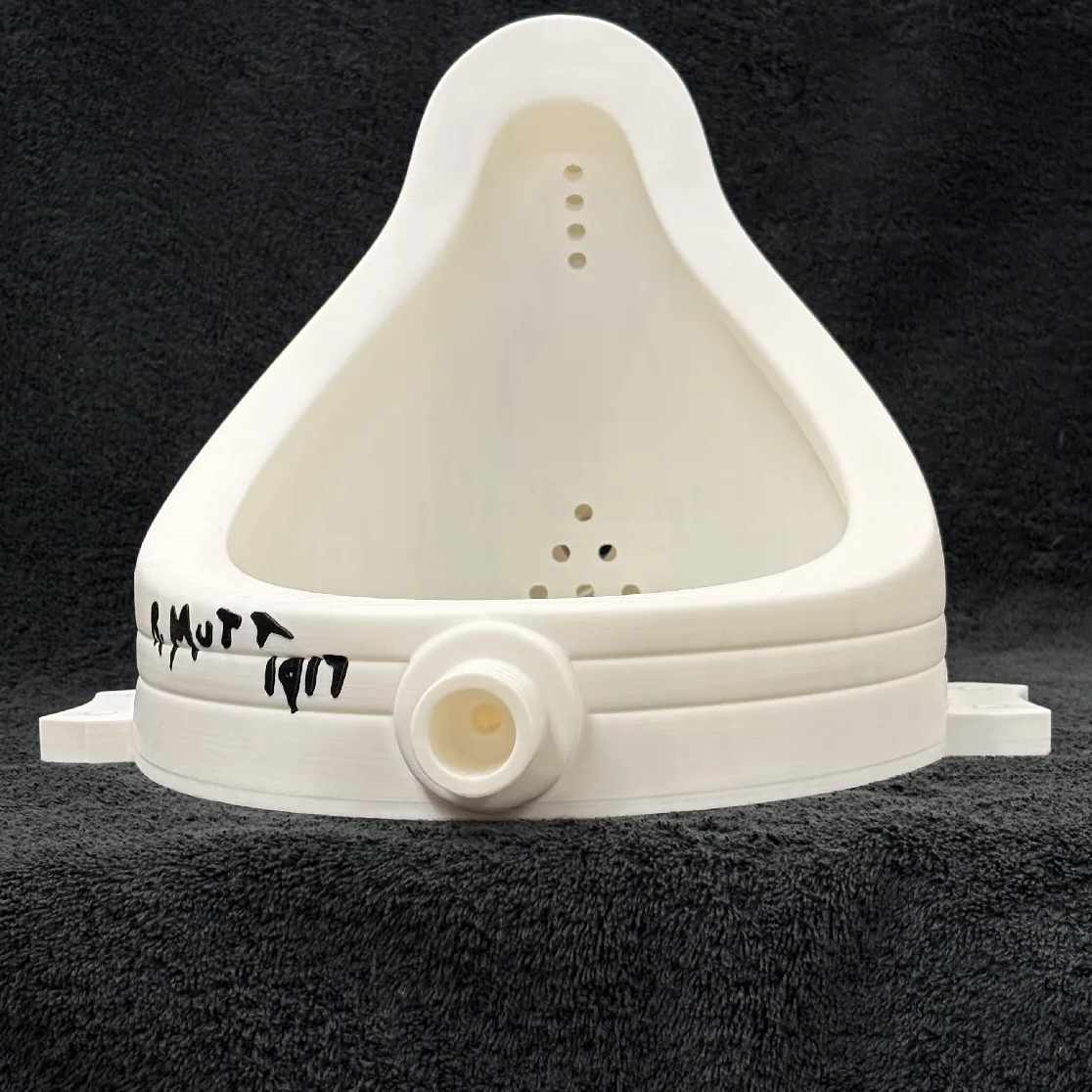
Full-scale plating of Model of Marcel Duchamp's In Advance of the Broken Arm by williamCromar. Club-exclusive critique.
- Ocena
- 0 / 5
- Polubienia
- 0
- Wydruki
- 0
- Wyświetlenia
- 7
- Oceny
- 0
Aktualizacja u źródła:
Informacje o modelu
- Źródło
- Printables
- Kategoria
- Sculptures
This digital asset is a refined, full-scale manifestation developed as part of an instructional research initiative supported by a faculty grant from Penn State Abington and the Abington MakerSpace. It expands upon the geometric parameters established in the public open-access reference collection Prêt à Faire: Printable Readymade Models.
For advanced modelers who wish to experiment with displacement textures found in this model, visit:
1 | Concept & Provenance
This asset is an autonomous work of conceptual art: a 1:1 scale digital study of the physical parameters underlying the famous 1915 In Advance of the Broken Arm (also known as Prelude to a Broken Arm) by Marcel Duchamp. The historical original work is lost; this model stands as an independent, transformative interpretation that cross-references the public dimensional layout documented by the historical 1964 Arturo Schwarz configuration.
This project explores the distributed accessibility of historical concepts by making the underlying structural geometry downloadable and reproducible through contemporary digital fabrication networks. While the physical print may resemble a familiar historical motif, the conceptual artwork resides in the publication and curation of the digital models themselves: the digital architecture, the distributed network framework, and the critical marketplace critique. The printed object is a physical manifestation, not the artwork proper.
Before fabricating, explore the historical context of the referent at:
Sample images of replicas:
 Yale University |  Moderna Museet, Stockholm |  MoMA |
The historical visual motifs analyzed here have been famously referenced, appropriated, or commented upon by contemporary practitioners, including Joseph Kosuth, Michael Schippling, and a collaboration between Astria Suparak and Frank Olive.
 Joseph Kosuth, One and Three Shovels [Ety.-Hist.], 1965 |  Astria Suparak and Frank Olive, In Advance of Snow, 2007 |  Michael Schippling, Prélude d'un Balconnet Cassé, 2014 |
2 | Scope & Scale
As a work of Post-Appropriation and remix praxis, this model is an independent digital manifestation optimized specifically for full-scale FDM fabrication, structural durability, and mechanical assembly. The geometry deliberately adapts historical visual motifs into a printable medium, celebrating the physical deviations required by the additive manufacturing process as part of the artwork's transformative expression.
This file is optimized explicitly to be printed at full historical scale. Altering the print scale is not recommended, as it will compromise mechanical tolerances, component alignment, and structural behavior. Most components require a large-format manufacturing bed (such as a Prusa XL).
A smaller, scalable open-access reference version is available at this link. Advanced project participants wishing to manipulate the untextured multi-body baseline geometry can access those specific files at this link.
3 | Printing Notes
3.1 | General Recommendations
Use the supplied 3MF files with preconfigured orientations and settings.
These settings were validated on a well-tuned Prusa XL using dehydrated filament.
STL and STEP files are provided for users who wish to experiment.
If creating your own build plates, print extra bolts and nuts.
File Formats
[Model_Name].3mf/.stl→ Best for quick printing. Pre-meshed at a high resolution, these files will slice exactly as they appear in the smooth website preview.[Model_Name].step→ Best for remixing and maximum quality. These files contain precise CAD data. Note: Ignore the blocky look in the online browser viewer; it will download and slice with perfectly smooth mathematical curves inside your slicer.
Designed Tolerances
Friction fit: ~0.1 mm
Tight glue joints: ~0.2 mm
Actual results depend on your printer calibration. Prototype fit-sensitive parts before committing to final prints. Our files worked well on a Prusa XL, but every printer is a bit different and may need fine-tuning. The best fine-tuning solution is to tweak the Extrusion Multiplier (a.k.a. flow rate) setting under the Filaments tab.
Observed Issues in Our Prototyping
No significant shrinkage was observed, but occasionally, tweaking Extrusion Multiplier values was necessary to achieve a proper fit.
Slower print speeds aid in success with both the tall blade and the textured wood. Frustrating, but high speeds aren't worth the drop-off in quality.
Brims are NOT recommended unless added as a modifier in the 3MF—note the use of helper disks in our plating.
When prototyping for fit, use the filament you intend to use for the final product. We found significant differences among the filaments we tested.
3.2 | Material Recommendations
For filament, consider the following:
Prusament Galaxy Silver PLA or Polymaker Panchroma Metallic Silver PLA for all steel parts
Hatchbox Copper PLA or Amoybaby Silk Red Copper PLA for the blade end
SUNLU Wood Fiber PLA or Amolen Wood Bamboo PLA for the shaft and handle
Amolen Silk Aged Brass PLA for the plaque
3.3 | Printing Statistics
Stats for a full-scale print:
Total material used: ~877 grams silver, ~115 grams copper, ~122 grams wood, ~2 grams brass
Total time: ~2 days, 16 hours
Total number of build plates in the 3MF: 6
4 | Assembly Notes
Follow these general guidelines:
The 3MF file shows the optimal orientation to print each piece.
It is necessary to incorporate a brim and/or supports on select pieces. At minimum, we recommend paint-on organic supports for the blade, and a brim for the “wood” handle and bolts. You can add custom brims and supports in the slicer as needed if plating your own.
Using Organic supports produces beautiful results with no support scarring at all on the blade.
Wood-grain effect: We used BumpMesh by CNC Kitchen to texture-map for wood elements. If you'd like to develop your own version of wood grain using the tool, we supply a blank handle and shaft for experimentation.
Start by gluing the blade parts together.
Glue the shaft parts together.
Glue the shaft into the blade slot, and glue the bolt and nut pieces in place.
Assemble the handle onto the shaft:
Glue bolts into the two lower holes on the handle bracket, and glue a handle bolt into the top hole. Repeat for the nuts on the second bracket. Use tape to secure and set aside until cured.
Glue one bracket onto one side of the shaft. Clamp or tape until cured.
Slip the washer onto the bolt, and apply a small amount of glue to the bolt.
Slip the handle onto the bolt, making sure it stays aligned while the glue sets. Hold it in place with tape if needed.
Slip the second washer onto the other handle bolt.
Apply glue to the bolt ends.
Attach the second bracket to the shaft while simultaneously threading the handle onto the handle nut. Tape or clamp until cured.
Finish by gluing the brass plaque and nuts in place.
4.1 | Adhesives & Tools
Adhesives
Use solvent (e.g., Gloop, Weld-On 16) or fresh gel CA
Clamp or compress until fully cured
Tools
Clamps, removable tape
Small brushes, trays for gluing
Needle or paper clip (for gluing small spaces)
#11 craft knife
Needle-nose pliers, tweezers
Safety
Standard PPE: Nitrile gloves, eye protection
Ventilation when using solvents
Remember, you are assuming all risk when using these materials and files, so stay safe!
5 | Presentation Notes
A core tenet of the Readymade concept is spatial displacement—positioning an everyday object so its original function becomes entirely obsolete. Historical records show Duchamp suspended the original shovel from his studio ceiling so that it hung vertically in mid-air. You can use a hook or monofilament line to suspend this fabricated manifestation in a similar manner. Because this work has been scaled and optimized specifically for layer-by-layer 3D printing, it functions purely as a digital art-historical reference, completely free from the constraints of physical utility. It is evidently NOT a shovel, no matter how one looks at it. One might therefore argue that we may display it however we wish, since we are not constrained by potential functionality.
6 | Support
Access to this file archive facilitates your active engagement with the project's broader marketplace critique. We provide direct technical support through the platform messenger to assist project participants with any advanced file manipulation, structural tolerances, or slicing inquiries. Thank you for participating in this distributed institutional inquiry.
7 | Change Log
3 AUG 2026: Uploaded photographic documentation of the fully assembled physical prototype fabrication to illustrate completed component fits, and completed minor text revisions.
15 JUL 2026: Added a reference link to the premium tier workspace for displacement texture experiments.
Disclaimer
Prêt à Faire is an autonomous artistic project, scholarly reference work, and institutional critique by williamCromar, supported by a faculty grant from Penn State Abington with fabrication assistance from the Abington MakerSpace. This project is entirely independent and maintains no formal affiliation, endorsement, or sponsorship with Association Marcel Duchamp, the Estate of Marcel Duchamp, ARS, ADAGP, or any curating museum. When referencing or sharing this work, users must maintain a clear distinction in authorship and nomenclature from the historical referent. Cite this asset as: Model of Marcel Duchamp’s [Object Name] by williamCromar. Basic models are available under a CC BY-NC-SA 4.0 license; premium tiers operate under a separate commercial framework. For full conceptual and legal text, visit https://sites.psu.edu/pretafaire/disclaimer-and-licensing/