
Model of Marcel Duchamp's Fountain by williamCromar: Refined Full Scale Plating
Obliczymy ostateczną cenę na podstawie wybranego pliku. Sprawdzisz ją i zaakceptujesz przed płatnością.
Zapisane na tym urządzeniu.
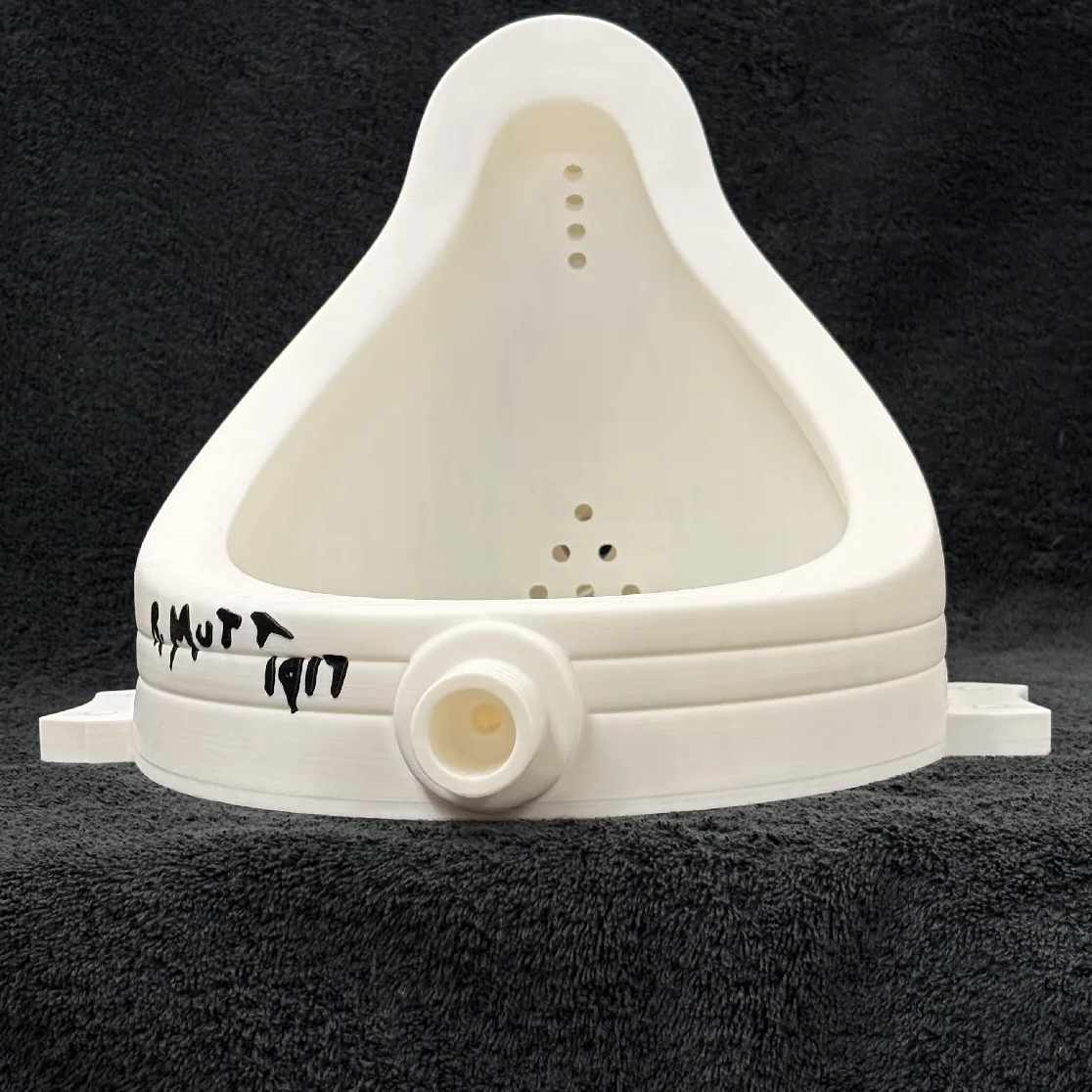
Full-scale plating of Model of Marcel Duchamp's Fountain by williamCromar. Club-exclusive critique. PSU-funded study.
- Ocena
- 0 / 5
- Polubienia
- 1
- Wydruki
- 0
- Wyświetlenia
- 26
- Oceny
- 0
Aktualizacja u źródła:
Informacje o modelu
- Źródło
- Printables
- Kategoria
- Sculptures
This digital asset is a refined, full-scale manifestation developed as part of an instructional research initiative supported by a faculty grant from Penn State Abington and the Abington MakerSpace. It expands upon the geometric parameters established in the public open-access reference collection Prêt à Faire: Printable Readymade Models
If you're fascinated by the infamous Fountain by Marcel Duchamp, signed by him under the pseudonym R. Mutt in 1917, AND you're ready for a major printing challenge, this is the print for you. I'll get right to the instructions here, so if you want to know more about Fountain, read about it at this link:
1 | Why this special edition?
From the beginning, my research objective was to execute a 1:1 structural manifestation at the true physical scale documented by historical catalog dimensions. Up to now, I have printed several scales, from a tiny 3-inch version up to a 75% giant that fit on a Prusa XL build plate. But 75% isn't full scale.
The first full-scale slice revealed something unexpected: scaling changed how the slicer interpreted the geometry. Features that had printed perfectly at smaller sizes suddenly developed odd artifacts.
The flat interior plane rendered as a series of subtle waves around the perimeter.
The mounting "ears" sliced asymmetrically, with noticeably different tapers around the holes.
These weren't modeling errors—they were slicing artifacts that only appeared at full scale.
1.1 | Adjustments for slicing at full scale
Since the model itself wasn't the problem, I made the corrections directly in the slicer.
To flatten the interior, I added and merged a cylinder that eliminated the waviness. For the mounting ears, I cut, duplicated, mirrored, and repositioned the geometry until both sides sliced identically. The final adjustment was surprisingly small: moving the ears just 0.15 mm in Z produced a symmetrical result.
1.2 | Cutting the quadrants
With the slicing issues solved, the next challenge was fitting the model onto the XL build plate. After considerable experimentation, I divided it into four quadrants using one X-axis and one Y-axis cut, intersecting at what I considered the work's visual center. The Y cut remained symmetrical, while the X cut aligned with the midpoint of the mounting ears. Descartes meets Duchamp, I suppose.
I also incorporated five dowel connectors for assembly alignment. In the clear now for a perfect print, or so I thought.
1.3 | Z-axis skew: a mechanical fix
Very tall prints can develop small amounts of Z-axis skew that normally may not be important. But here, it mattered.
To my horror, during assembly I found a 2 mm gap between my tallest sections—about a 1 mm lean over 13 inches, or roughly 0.2°. Research suggests that on the Prusa XL, a microscopic skew typically points to either a slightly bound bed carriage or uneven belt tension.
In my case, it was the belts. After tuning them with the Prusa XL Belt Tuning Guide and web app, the reprint assembled perfectly.
In summary: Printing at this scale exposed two different problems: slicer artifacts that could be corrected through modeling, and mechanical tolerances unique to my printer. My mechanical solution may not match your machine, so prototype, test, measure, and diagnose before committing to the final print.
2 | Printing Notes
2.1 | General Recommendations
Use the supplied 3MF files with preconfigured orientations, multi-material painting, and settings.
These settings were validated on a well-tuned Prusa XL using dehydrated filament.
STL files are provided for users who wish to experiment.
2.2 | Material Recommendations
For filament, consider the following:
Urinal: Polymaker Panchroma Silk White PLA
Lettering: Polymaker Panchroma Silk Black PLA
These provide a nice sheen that is evocative of porcelain, while at the same time this white is about as opaque as one can get. Be mindful that the shiny material is desirable for reasons I'll discuss below, but it also exposes every tiny printing flaw imaginable. Calibrate and dehydrate!
2.3 | Printing Statistics
Stats for this not-for-the-faint-of-heart full-size print:
Total material used: ~2300 grams white, ~20 grams black
Total time: ~5 days, 13 hours
Total number of built plates: 4
Though it's tempting, I don't recommend lowering the infill to reduce the white to reach a 2 kg roll limit. At 15% and using the 3D honeycomb pattern, you can achieve a good density for opacity. Anything less will compromise that.
3 | Assembly Notes
Keeping track of parts is straightforward, but the massive scale makes assembly challenging. I had good results in prototyping with both a slow-dry gel CA and Weld-On 16. The Weld-On makes for a better joint, but the piece is not under load, so the CA was my choice, since it was not as leggy as the Weld-On.
NOTE: I did NOT post-process the work to obscure the joints, which is why I was so fastidious about the Z-axis skew. There is a conceptual reason in my case: for exhibition purposes, I want it to be obvious that this is a printed model, not a hyper-realistic forgery. So the quality of the print right off the bed was paramount.
4 | Presentation Notes
Place the finished work on a pedestal at a comfortable viewing height. If desired, you can play around with other unusual placements. Duchamp himself suspended it from the ceiling, hung it over a door, and placed it in the "proper" orientation in his Box in a Valise multiple. Museums today have taken liberties with suspension as well.
5 | Support
Access to this file facilitates your active engagement with the project's broader marketplace critique. We provide technical support for any fabrication inquiries you encounter through the platform messenger. Thank you for participating in this distributed institutional inquiry!
6 | Change Log
Check in here for updates.
Disclaimer
Prêt à Faire is an autonomous artistic project, scholarly reference work, and institutional critique by williamCromar, supported by a faculty grant from Penn State Abington with fabrication assistance from the Abington MakerSpace. This project is entirely independent and maintains no formal affiliation, endorsement, or sponsorship with Association Marcel Duchamp, the Estate of Marcel Duchamp, ARS, ADAGP, or any curating museum. When referencing or sharing this work, users must maintain a clear distinction in authorship and nomenclature from the historical referent. Cite this asset as: Model of Marcel Duchamp’s Fountain by williamCromar. Basic models are available under a CC BY-NC-SA 4.0 license; premium tiers operate under a separate commercial framework. For full conceptual and legal text, visit https://sites.psu.edu/pretafaire/disclaimer-and-licensing/