
Convoluted hexagonal loops
Obliczymy ostateczną cenę na podstawie wybranego pliku. Sprawdzisz ją i zaakceptujesz przed płatnością.
Zapisane na tym urządzeniu.
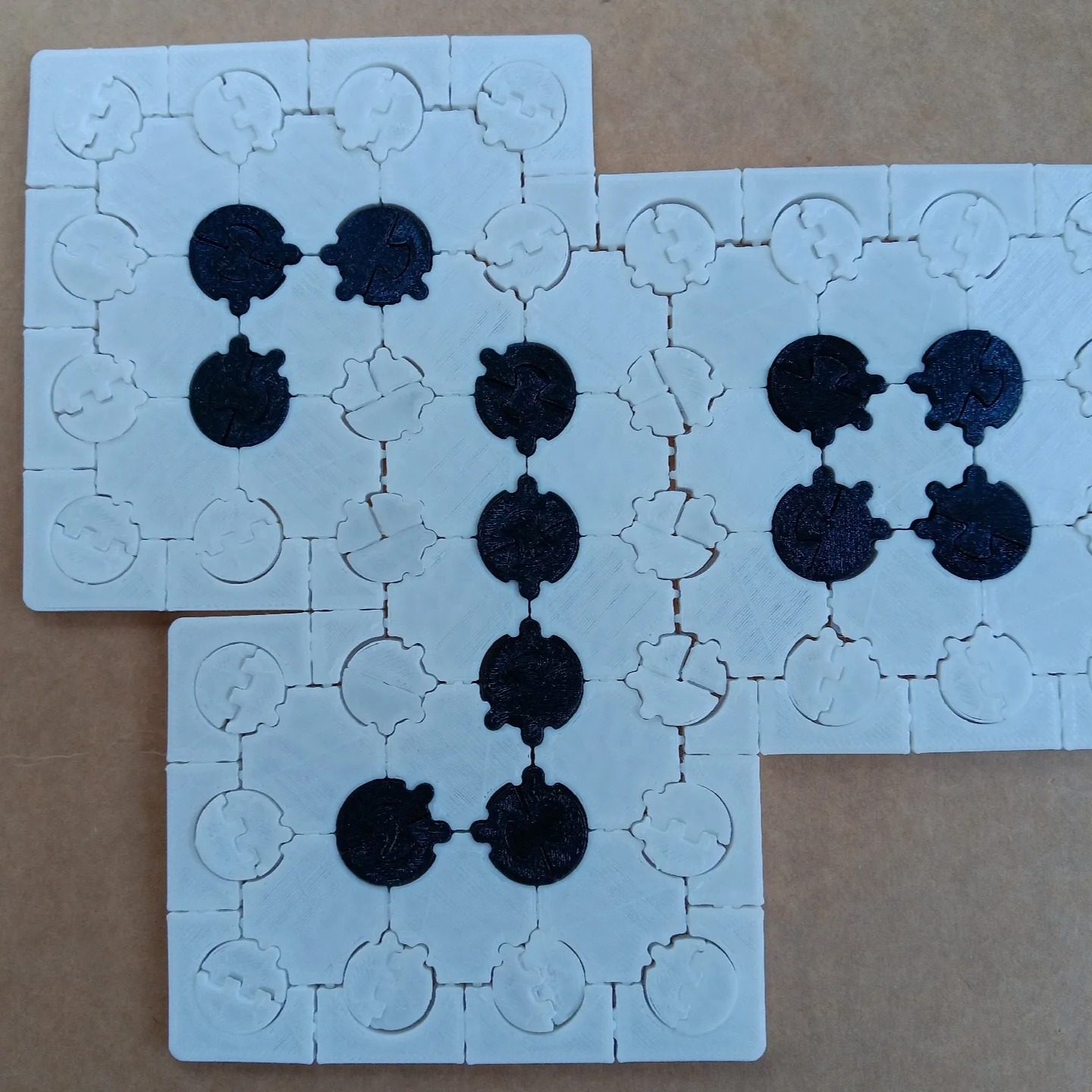
Convoluted hexagonal loops generated according to local constraints in a hex grid, required to form a single cycle.
- Ocena
- 0 / 5
- Polubienia
- 2
- Pobrania
- 5
- Wydruki
- 0
- Wyświetlenia
- 27
- Oceny
- 0
Aktualizacja u źródła:
Informacje o modelu
- Źródło
- Printables
- Kategoria
- Math
- Licencja
- Creative Commons — Attribution — Share Alike
This came out of a long effort to make a pattern resembling brain coral from a discrete process. The idea I settled on was to fill a hexagonal grid with cells such that:
Each filled cell has exactly two filled neighbors in the ring around it,
Filled neighbors are not adjacent in the ring.
No empty cell has three consecutive empty neighbors.
I added symmetry and wrapping conditions as well, and surrounded the pattern with a wall of live cells to determine the bounds.
It is easy to see that this forces the cells to form loops, since neither branching nor termination is possible. As a post-processing step, my code connects them into a single convoluted loop.
I have cautiously marked this as created with AI help, but actually the hex convolution code is all written in Python and can be run without any AI at all to create new figures. This code generates height maps that can be converted to STL models using a tool such as ImageToStl.
The Python code was generated by Claude over a long discussion, but the concept is mine.
To generate new images, you can run
python hex_regen.py hex_render_1.png --new-seedsas explained in the README, using hex_render_1.png supplied in the same repo. It contains all the metadata used to reconstruct it. The --new-seeds causes it to use a different random seed, so it does not produce an identical result.
Once the height map is done, you will need to convert it to a model.