
Deutsche Bundesform Chess Set
Obliczymy ostateczną cenę na podstawie wybranego pliku. Sprawdzisz ją i zaakceptujesz przed płatnością.
Zapisane na tym urządzeniu.

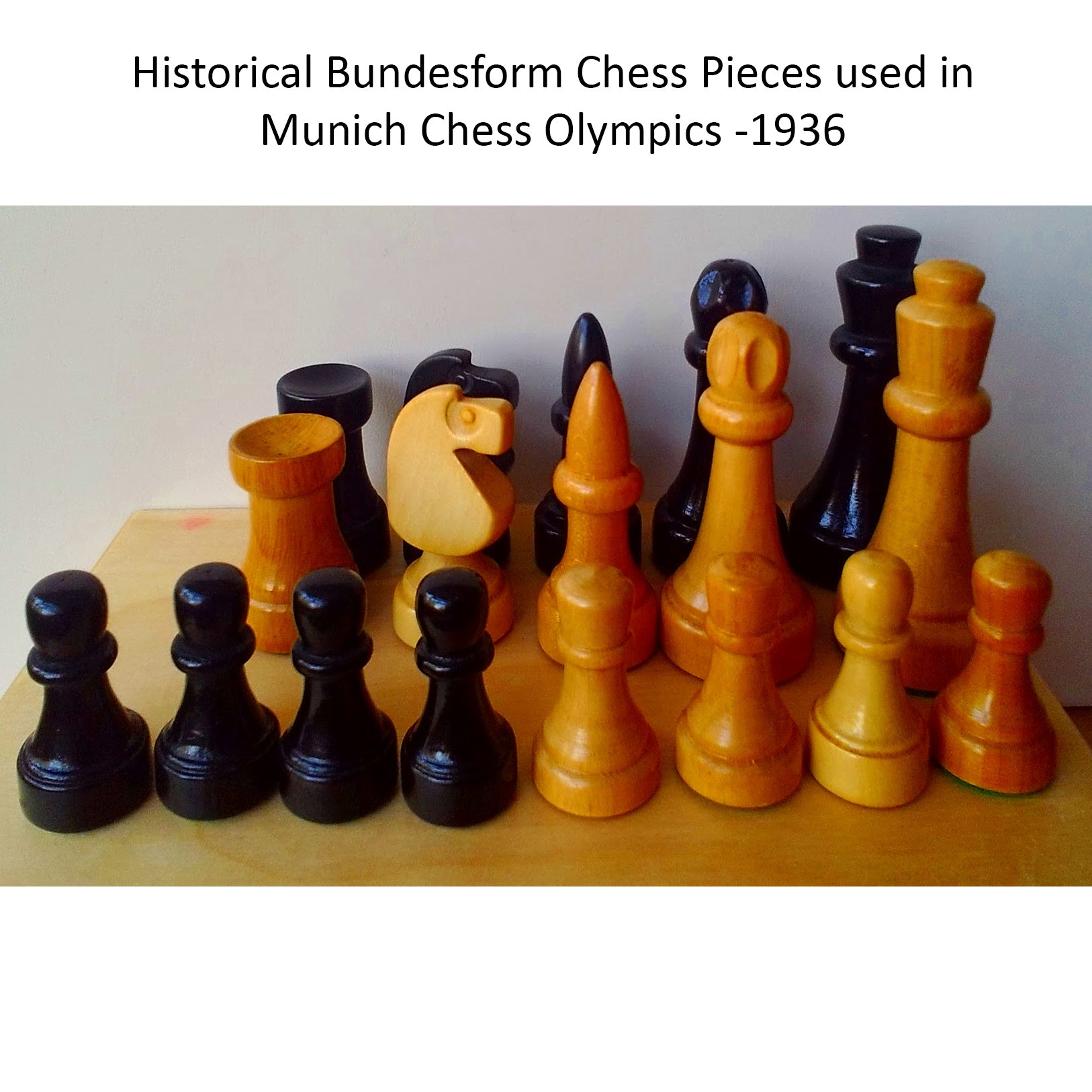
Deutsche Bundesform (German Federation Form) chess pieces used exclusively at the Munich Chess Olympiad in 1936.
- Ocena
- 5 / 5
- Polubienia
- 25
- Pobrania
- 180
- Wydruki
- 3
- Wyświetlenia
- 1365
- Oceny
- 3
Aktualizacja u źródła:
Informacje o modelu
- Źródło
- Printables
- Kategoria
- Board Games
- Licencja
- Creative Commons — Attribution — Noncommercial — NoDerivatives
The Historical Chess Set Series
#8 - Deutsche Bundesform Chess Set
Presumably, Ehrhardt Post designed the Deutsche Bundesform (German Federation Form) chess pieces around 1935. At that time, Post was the federal manager of the Greater German Chess Federation. The federation newspaper urgently recommended that German chess clubs adopt the Deutsche Bundesform pieces instead of foreign pieces (e.g., Staunton). Some historians suspect German manufacturers were instructed not to produce any Staunton, Regence, or Coffee House chess sets, adding to the pressure to use the new pieces.
Deutsche Bundesform sets were used exclusively at the Munich Chess Olympiad in 1936 and German club competitions after World War II. German and local Munich authorities wanted to spare no effort to make the Munich 1936 Olympiad a resounding success for the "New Germany" they were propagating. After World War II, manufacturers continued to make Deutsche Bundesform sets. The pieces are highly robust, easy to make, and accepted by players. In the GDR (German Democratic Republic, commonly known as East Germany), Deutsche Bundesform set production continued until the end of the state-owned company Grünhainichen in Borstendorf. Western manufacturers continued to make traditional Deutsche Bundesform versions into the late 1960s and early 1970s. Today, a modernized minimalistic Deutsche Bundesform chess set is available for purchase.
NOTES:
While researching this set, I found several variations of the Deutsche Bundesform chess pieces. The inspiration for this model comes from the version found in the image Bundesform Chess Pieces used in Munich Chess Olympics - 1936.
Size (height/base):
With a king height of 95 mm (3 ¾") when printed as modeled, this set is sized that of Staunton Scale 6 (St. 6) or FIDE Size 2.
- ♔ King: 95 mm / 39.4 mm
- ♕ Queen: 84.1 mm / 36.4 mm
- ♗ Bishop: 71.3 mm / 31.6 mm
- ♘ Knight: 61.8 mm / 32.4 mm
- ♖ Rook: 51.3 mm / 32.3 mm
- ♙ Pawn: 49.1 mm / 30 mm
Scaling:
Printing at the modeled size yields a FIDE / USCF Tournament sized King 95 mm (3 ¾") in height. However, the King height for Deutsche Bundesform pieces was traditionally 85 mm (3.35"). To print at the traditional size, scale the model by a factor of 0.895 (89.5%) before printing.
To resize this set to one of the following standard sizes, scale the model by the factor given before printing.
- FIDE Size 1 - St. 5 (King 87 mm): 0.92 (92%)
- Club Size - St. 9 (King 112 mm): 1.18 (118%)
REFERENCES:
- Habera ca. 1930 German Bundesform Chess Set
- Munich-36-pieces (Bundesform)
- Bundesform Chess Pieces used in Munich Chess Olympics - 1936
- German Chessmen
- Schachfiguren - Stile und Formen (German)
- The 1936 Munich Chess Olympiad
- Wikipedia - Bundesform (German)
ABOUT THE HISTORICAL CHESS SET SERIES:
Introducing a remarkable resource for chess lovers and history buffs – a collection of historical chess set printable models from around the world! Immerse yourself in the game's rich cultural history with designs ranging from the ancient world to modern times. Each set is a testament to the artistry and craftsmanship of its era that showcases the evolution of chess throughout the centuries, providing a stunning visual representation of the game's journey that will impress any chess enthusiast. Whether you're a seasoned player or a history buff, this collection has something to offer everyone. Join us on a journey through time and discover the beauty and intricacy of chess through these historical sets, which will captivate, inspire, and invite you to engage with the game in a whole new way.
CHESS SETS IN THIS SERIES:
- Man Ray 1945 Prototype Wood Chess Set - March 13, 2023
1945 Wood Chess Set prototype design by Man Ray, as illustrated in the book "Imagery of Chess, Revisited". - Austrian Biedermeier Coffeehouse Chess Set - March 19, 2023
An Austrian chess set in the Biedermeier Coffeehouse style made around the Biedermeier period between 1815 and 1850. - French Directoire Chess Set - March 26, 2023
A classic French chess set design, also called the French Revolutionary chess set, from the Directoire period 1795-1799. - English Rowbotham Chess Set - March 26, 2023
A stylized chess set commissioned by the Reverend Rowbotham from John Jaques of London and designed by Nathaniel Cook. - Soviet-Era Russian Poni Minimalist Chess Set - March 31, 2023
Russian chess set designed in the 1920s by Alexey Poni, a classic example of minimalistic style and functional design. - French Dierdot Chess Set - April 8, 2023
French chess set also known as the Encyclopédie Chess Set, an artifact of the 18th-century French Enlightenment period. - Leonardo Da Vinci's Chess Set - April 14, 2023
Leonardo Da Vinci's chess set design found in De Ludo Scachorum, written by Luca Pacioli, a Renaissance mathematician. - Duetsche Bundesform Chess Set - April 21, 2023
Deutsche Bundesform (German Federation Form) chess pieces used exclusively at the Munich Chess Olympiad in 1936. - Czechoslovakian Coffeehouse Chess Set - April 28, 2023
A vintage coffeehouse style chess set similar to those made in Czechoslovakia (Czech Republic) ca. 1950. - Romanian Bundesform Chess Set - May 7, 2023
Chess set originating in Romania in the early 20th century exhibiting the German Bundesform style of chess pieces. - Polish Coffeehouse Chess Set - May 15, 2023
A rare Polish coffeehouse design heavily influenced by Austrian aesthetics and the popular Regence style of 18th Century France. - Budapest/Hungarian Chess Set - May 19, 2023
This is a unique and elegant Staunton-inspired chess set made in Hungary ca. 1920's-1930's with a rare Knight shape. - Bulgarian Chess Set - May 26, 2023
A beautiful Bulgarian design chess set inspired by a handmade set made in Bulgaria/Eastern Europe ca. 1950s–1960s. - Soviet-era Latvian Chess Set - June 2, 2023
Chess set similar to the one seen in the final game between Beth and Vasily in the Netflix Series, "The Queen's Gambit". - Old Windsor Castle Chess Set - June 9, 2023
Rare souvenir set of chessmen made using the old oak from the St. George Chapel at Windsor Castle during the 1820s. - German Bohemia Chess Set - June 16, 2023
German Bohemia chess set with "chicken-head" Knight made circa 1970s and designed for the 1970 Siegen Chess Olympiad.
Look for future weekly releases, including rare and beautiful Yugoslavian, and Romanian chess sets. Send me a message if you have a particular chess set design that you would like to see as a 3D model. I am always open to new ideas. Although I have steered clear of the Staunton design, I am considering adding the more popular formats, like the 1959 Zagreb and the 1950 Dubrovnik sets. Let me know if you are interested in adding Staunton sets.
FAIR AND COMMERCIAL USE:
The models in the Historical Chess Set Series allow others to enjoy playing the game of chess with something other than standard Staunton chess pieces (see license below). These models are licensed for an individual's personal use. Individuals may print sets to give away, providing parties have no other value exchange. Any commercial printing or distribution is strictly prohibited. Please don't make me wake up my lawyer; she's grumpy when she doesn't get her beauty sleep, and you will suffer the consequences.
DISCLAIMER:
Please be advised that there is no intention that the models and representations provided herein are exact reproductions of their original counterparts. Instead, they should be regarded as artistic interpretations, reflecting the creativity and vision of the artisan.
The artisan has made every effort to ensure the accuracy and fidelity of these models. It is essential to recognize that they may contain variations, deviations, or artistic liberties the artisan took to enhance their aesthetic appeal or convey a particular message.
As such, we encourage users to appreciate these models for their artistic value and creative expression while acknowledging that they may not be precise replicas of the original subjects. Please enjoy these works with an open mind and a discerning eye, understanding that they represent a unique blend of historical inspiration and artistic interpretation.