
#0105 STRONG Split Key Ring - Meets the Demands of Everyday Use!
Obliczymy ostateczną cenę na podstawie wybranego pliku. Sprawdzisz ją i zaakceptujesz przed płatnością.
Zapisane na tym urządzeniu.

Rethinking the needs of a robust split ring design for your key chain and other uses. Tested to withstand daily uses.
- Ocena
- 5 / 5
- Polubienia
- 71
- Pobrania
- 567
- Wydruki
- 4
- Wyświetlenia
- 2060
- Oceny
- 4
Aktualizacja u źródła:
Informacje o modelu
- Źródło
- Printables
- Kategoria
- Other House Equipment
- Licencja
- Creative Commons — Attribution — Noncommercial
*** Thanks for checking out this model! ***
If you appreciate what I'm doing, please consider buying me a coffee, and check out my other models!

**********
What's the strongest split key ring out there, gram for gram?
*********************
THAT'S THE CHALLENGE TO MYSELF
Design a split key ring that is the strongest per unit weight that FDM printing can produce using a common material like ABS!
*********************
The qualities I wanted from these key rings:
- Strong but light weight - a high strength-to-weight ratio
- Easy to use
- Easy to print - just a single part, no supports
- Stays in shape while being side-loaded
- As strong and robust as possible for everyday use - not just for novelty!
- Pull tested and proven
Why did I take up this challenge? A key ring is such a common device that everyone takes it for granted and doesn't give much thought into how it works - there are plenty of key rings out there that look good but are not designed for strength,
Below, I'm comparing iterations of my key rings without locking features vs. ones that do (the Small size is shown). You can readily see that having the dovetail does a much better job under a much higher load!!

Coming up with these locking features increased the strength of the ring by over 850%
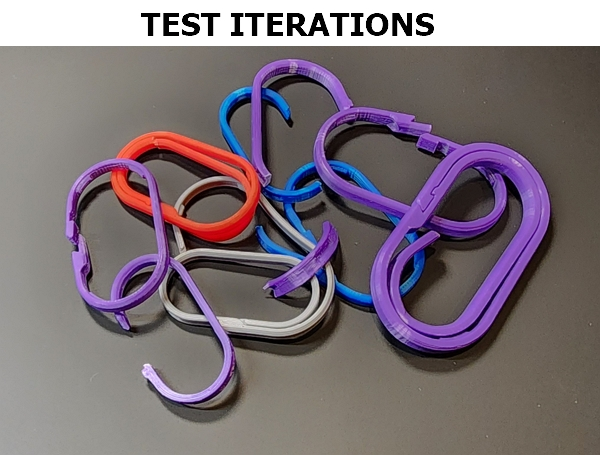
Below are the tested design that shows the iterative design process:
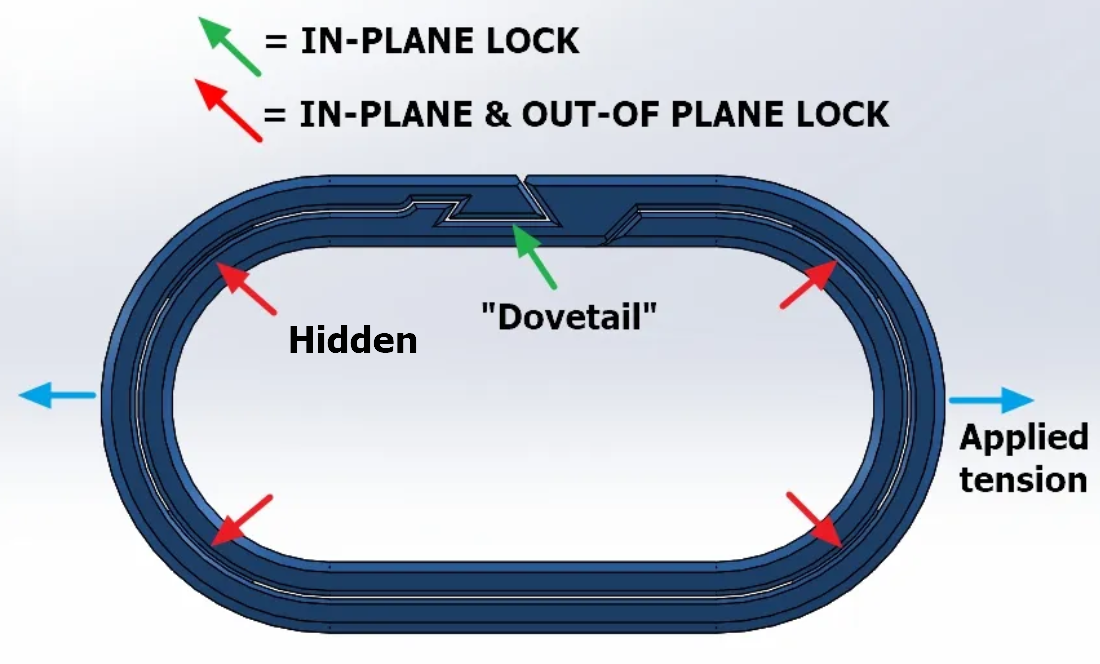
How it works:
- The 4 locking features hidden between the inner and outer ring prevents the ring from deforming while under load - they add a lot of strength.
- The 4 locking features also align the outer and inner rings together.
- The dovetail feature keeps that end from opening up to prevent premature failure - earlier iterations failed quickly when that end opened up.
How to Open and Close the ring: (also see GIF clip in deck of pics)
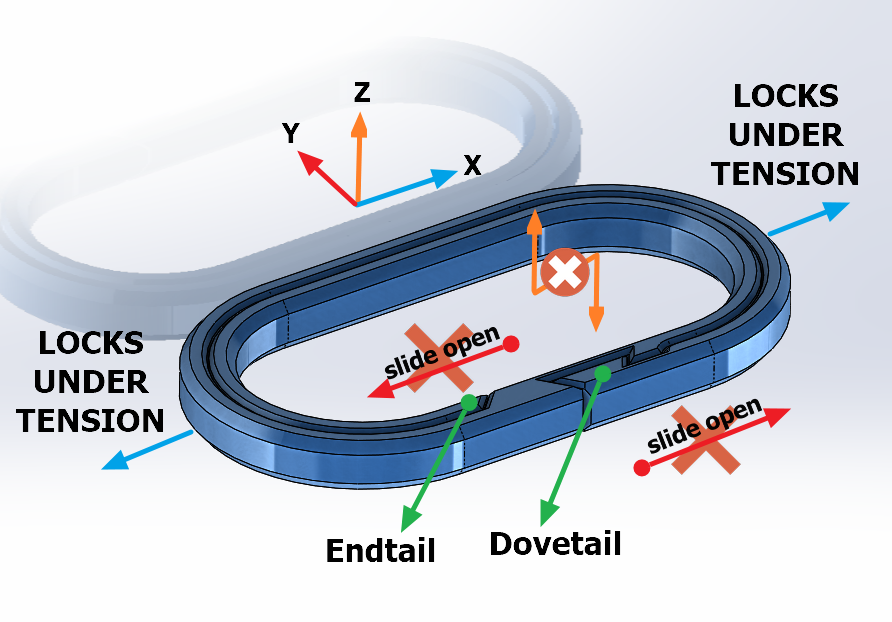

Step 1: To open, slide the Dovetail in the Z direction to release it.
Step 2: Open up the ring like a “Slinky” as shown above.
Step 3: Slide the key (or any object that fits) through the Dovetail or Endtail.
Step 4: To close, collapse the Dovetail end together FIRST, then collapse the inner and outer rings together.
I've pull tested each one and the results (if they are printed per the recommended settings) are below but your results may vary. Tested in Polymaker ABS.
Two clearances (0.18mm and 0.25mm) and 3 sizes are provided:
- The 0.18mm gap versions are for well calibrated printers - test results are based on these.
- Use the 0.25mm gap versions if the 0.18mm gap causes excessive gap welding for you.
- Small, 3g of ABS- used for key rings.
- Tested to: 61.6 lbs. [28 kg]
- Medium, 4g of ABS - used as central hub for other key rings, or for heavier uses
- Tested to: 101.6 lbs. [46.1 kg] and did not break!
- Large, 7g of ABS - any heavier duty uses you can think of!
- Tested to: TBD* but expected to be over ~120 lbs. [~54 kg]
*My force tester only goes up to 112 lbs. [500N or 51 kg] - I didn't want to ruin it so I haven't tested the Large size yet.
NOTE: the above numbers are for reference only, using Polymaker Polylite ABS. Results from your printer settings and material choice may vary.
Other variations also available:
Recommendations:
- Print in ABS/ASA/PC.
- Place (paint on) the seam away from the dovetail area - on the inside surface of the inner ring.
- 3 vertical walls, 5 top and 5 bottom layers, 20% infill.
- Avoid PLA - because normal everyday use means it will eventually end up inside a hot car somewhere…heat does not play nice with PLA.
- A slight bit of welding at the gaps are expected in some cases. Just twist and bend the ring a few times to break the welds loose in the gaps.
- Beware of using PETG - why? PETG has a tendency to weld strongly to itself, so for the parts with only a 0.15mm gap between the inner and outer rings, you will have a harder time breaking the welds loose if your printer is not that well calibrated. If you want to test your luck, give it a shot anyway! But you'll likely have more success printing with the 0.25mm clearance versions.
Do you want an EVEN STRONGER split ring in your collection? Well, here it is!
A WORD OF CAUTION AND DISCLAIMER: It should go without saying, but please use common sense - do not use any of these rings to carry the weight of precious cargo, like kids, pets, expensive camera equipment, or adults, for that matter. There are no guarantees made on their performance. By printing this model, you take full responsibility for its uses.
****************************
If you add this to your collection and/or download the model, please click the LIKE button and give it some STARS!
Remember, you can earn some Prusameters if you post a pic of your make! Plus, it would make my day to see it. ;-D
****************************
Happy Printing!