
Metric Universal Swivel 6-Point Socket Sets for Drills
Obliczymy ostateczną cenę na podstawie wybranego pliku. Sprawdzisz ją i zaakceptujesz przed płatnością.
Zapisane na tym urządzeniu.

10, 12, 13, 14, 15, 17mm Sockets that fit 1/2 inch chucks on drills. This includes shallows, mid-lengths and deeps.
- Ocena
- 0 / 5
- Polubienia
- 16
- Pobrania
- 125
- Wydruki
- 0
- Wyświetlenia
- 866
- Oceny
- 0
Aktualizacja u źródła:
Informacje o modelu
- Źródło
- Printables
- Kategoria
- Tools
- Licencja
- Creative Commons — Attribution
About
This is a shallow, mid-length and deep metric socket set designed for ½ drill chucks. These are universal sockets which are also referred to as swivels. This design allows for about a 20 degree pivot. You won't be passing these down to your grandchildren, but they do work.
The sockets are 10mm, 12mm, 13mm, 14mm, 15mm & 17mm. These are the most common sizes in the range that is possible with the material and pivot.
Although the shallows are printed in place, the socket does not permanently entrap the ball of the pivot. With a bit of force the socket can be detached and reconnected to to the ball. They pop together and remain as one unit.
There are also several extensions files that can extend the reach. Remember, the longer the extension the more flex and chance of breaking in the shaft. Extension sizes include 4, 6, 8, 10 & 12 inch.
*The ¼ inch square drive hasn't been tested yet.
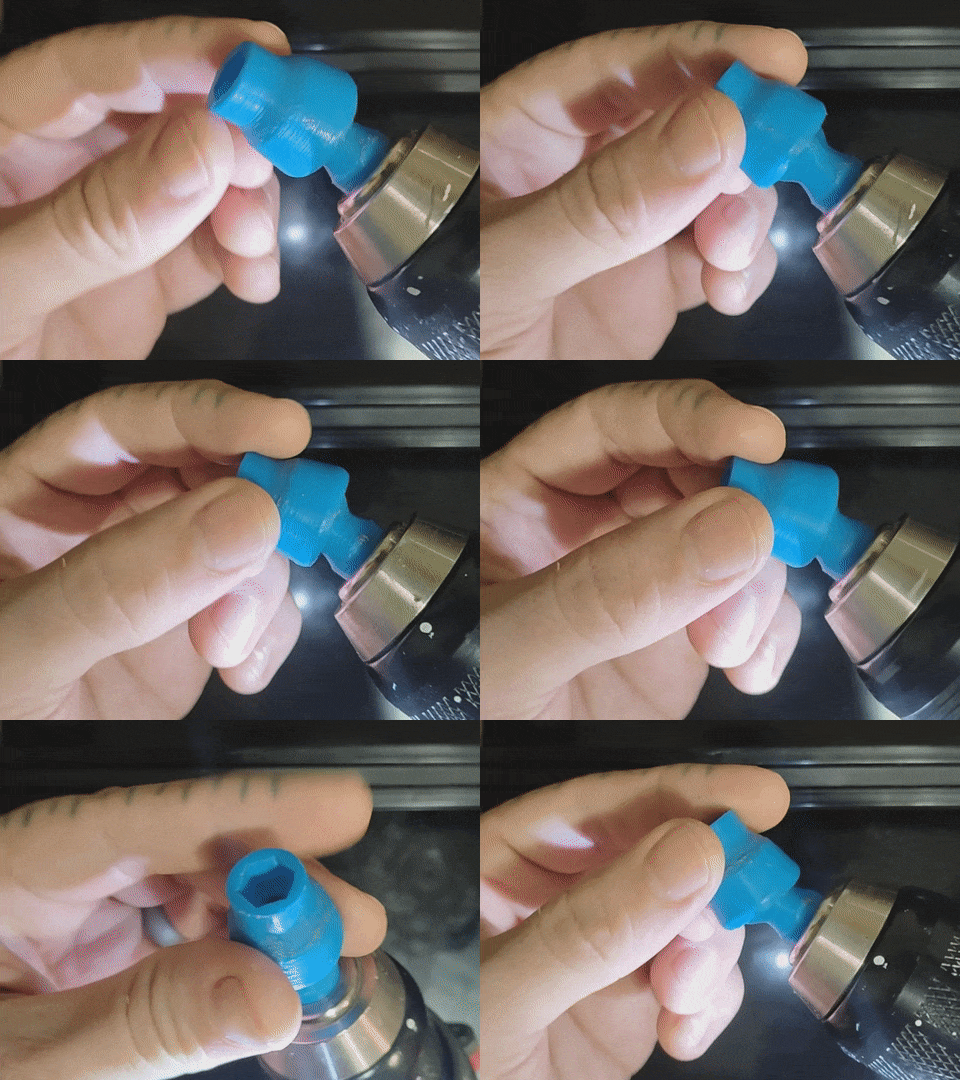
Mid-Lengths & Deeps
Mid-lengths and deeps do not print in place with the pivot ball. The pivot ball will need to be printed separately.
Extensions and Pivot Bit
The extensions and Pivot are designed to fit into a ½ inch chuck. They have 3 grooves for the chuck to lock on to.
The Pivot Ball is a square design. This square is 14mm (9/16) so it is not compatible with ½ inch or ¾ inch square drives even thought it looks like it could be.
The Pivot bit is designed as the weak point. This should break before the socket does. This is to allow you to re-print the Pivot Bit and reuse the socket. I have not confirmed with all combinations.
This Pivot design is most similar to Steelman's extensions. I highly recommend their ½ impact swivel extensions. They are low profile and work really well. https://amzn.to/3MIiAej They also have socketed extensions, which I don't own, but look amazing: https://amzn.to/3SJohMU
Slicing
They can be printed in place without support generation in the slicer. There is a support already placed for the shallows in the design that you will need to remove.
I recommend using a 0.4 harden nozzle with 0.15 layer height. Use extra walls and infill for strength.
Materials
The best material I've had success with is Nylon-CF so far. I assume Nylon will have similar strength and would recommend as well.
PLA+ did work pretty well; PETG failed quickest.
- Prusa Nylon CF: https://www.prusa3d.com/product/prusament-pa11-carbon-fiber-black-800g/
- Overture Easy Nylon: https://amzn.to/3ujukh3
- Overture Super PLA+: https://amzn.to/3stq65Z
Shallows Post Print Processing
There are two things you will need to do once you have successfully printed the shallows.
- You need to remove the inner support. Use long nose pliers to get as much as you can out. Then use a pick to get anything left.
- Lightly secure the socket side in a vise, wrench, or pliers. Then tap the other side with a hammer to break the ball lose. Do this in both X and Y directions. When securing these for this purpose, don't worry about tightening to keep the socket it straight. You only need 3 points to secure it is place for this task.
Usage
I recommend turning on your drill's clutch, so you don't apply full force of the drill. Be realistic, these are plastic and will not last very long. My drill on 90% strength saves the socket from damage, at 100% it will snap the Pivot Bit in half. Luckily with this design, you can quickly print a replacement Pivot Bit.
With the clutch turn down on your drill, your drill should be able to break lose and tighten smaller bolts. Although this is possible, you should break lose and tighten your bolts with a standard wrench or ratchet.
The best use of these is driving the bolts once lose or until tightening. This is the recommended practice with universal sockets in general. They should be used for threading not torquing.
Although I don't have nylon bolts, this probably is a great set for use on nylon bolts. These will be less likely to damage nylon bolts. Also won't leave witness marks on steel bolts.
Testing
I printed several versions of the 10mm to get it working right. The final version of the 10mm with Nylon-CF surprised me when it did break lose 10mm bolts on my car. I broke several sockets while testing, but it was very apparent to me the limits. I pressed them to see how far they would go.