
Print-in-Place 2 digit counter with built-in clicking mechanism.
Obliczymy ostateczną cenę na podstawie wybranego pliku. Sprawdzisz ją i zaakceptujesz przed płatnością.
Zapisane na tym urządzeniu.
A rather over-engineered take on a two digit counter. Prints in under an hour, no assembly required.
- Ocena
- 5 / 5
- Polubienia
- 22
- Pobrania
- 163
- Wydruki
- 4
- Wyświetlenia
- 1010
- Oceny
- 3
Aktualizacja u źródła:
Informacje o modelu
- Źródło
- Printables
- Kategoria
- Board Games
- Licencja
- Creative Commons — Attribution — Share Alike
Introduction
Hello, hope you like the design. It relies pretty heavily on overhangs and tight clearances to make it Print-In-Place, as you can see in the following picture of a cross-section. It could be challenging to print so beware!

Yep, that's a lot of overhangs.
Origin
This model is an evolution of the concept I made a while ago: https://www.printables.com/model/211634-print-in-place-3-digit-counter .
Although it was also a Print-In-Place design, it didnt have any way to keep the sections from moving during use. Which was a problem, as it relied only on tight clearances to create some friction, increasing the risk of the parts fusing together as it printed.
This new design incorporates a clicking mechanism that I originally planned to use for the joint figure contest, but I couldn't quite develop the idea in time. So when I saw the new contest theme I thought that perhaps I could combine it with my previous design ( as if it wasn't over-engineered enough) to keep the dials in place.
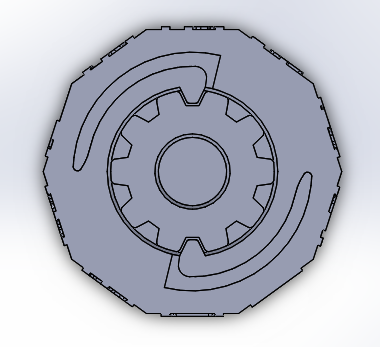
It could still be a bit challenging to print, but the clearances are slightly looser as they are no longer needed to keep the parts from moving. Once I have refined and fully tested the clicky mechanism I will try to see how loose and print-friendly it can be made.
Printing instructions
It's important to mantain the object orientation, so each section can develop individually from the bed plate.
I printed it in PETg, as the clicking mechanism needs some flexibility. PLA might work for a while, but is bound t o break in the long run.
I used 0.2mm layer resoulution, 15% infill. I also selected the option -print external perimeters first- so that the bridging element of the clicking mechanism is laid completly before it starts with the internal lines.
Edit 1/10/2024: Added a revised version. It prints more cleanly, detaches more easily and runs more smoothly in both directions.