
Optimized Bed Scraper XL
Obliczymy ostateczną cenę na podstawie wybranego pliku. Sprawdzisz ją i zaakceptujesz przed płatnością.
Orientacyjna cena wydruku pliku
2,16 € – 2,64 € netto (bez VAT)
Dla pliku: sheet of blades / a-lot-of-blades_04n_025mm_pla_mini_2h12m.bgcode
To wstępna wycena jednego pliku. Dokładną cenę poznasz przed zamówieniem.
Plik i założenia wyceny
Plik użyty do wyceny
Średnia wycena orientacyjna: 2,40 € netto (środek widełek).
- Masa podana przez autora
- 34 g
- Czas druku podany przez autora
- 2,21 godz.
- Materiał u źródła
- PLA
- Materiał wyceny
- PLA
- Drukarka wyceny
- Bambu Lab P1S - 0.4 nozzle
- Proces wyceny
- 0.20mm Standard
Orientacyjna wycena wyłącznie wybranego pliku, oparta na masie i czasie druku podanych przez autora. Warianty plików nie są sumowane. Ostateczna cena zostanie obliczona po analizie pliku.
Zapisane na tym urządzeniu.
XL version of my popular "Optimized Bed Scraper" with quick-change blades.
- Ocena
- 4,878 / 5
- Polubienia
- 16 183
- Pobrania
- 78 412
- Wydruki
- 1318
- Wyświetlenia
- 183 291
- Oceny
- 1155
Aktualizacja u źródła:
Informacje o modelu
- Źródło
- Printables
- Kategoria
- Accessories
- Licencja
- Standard Digital File License
News 2024-04-10: 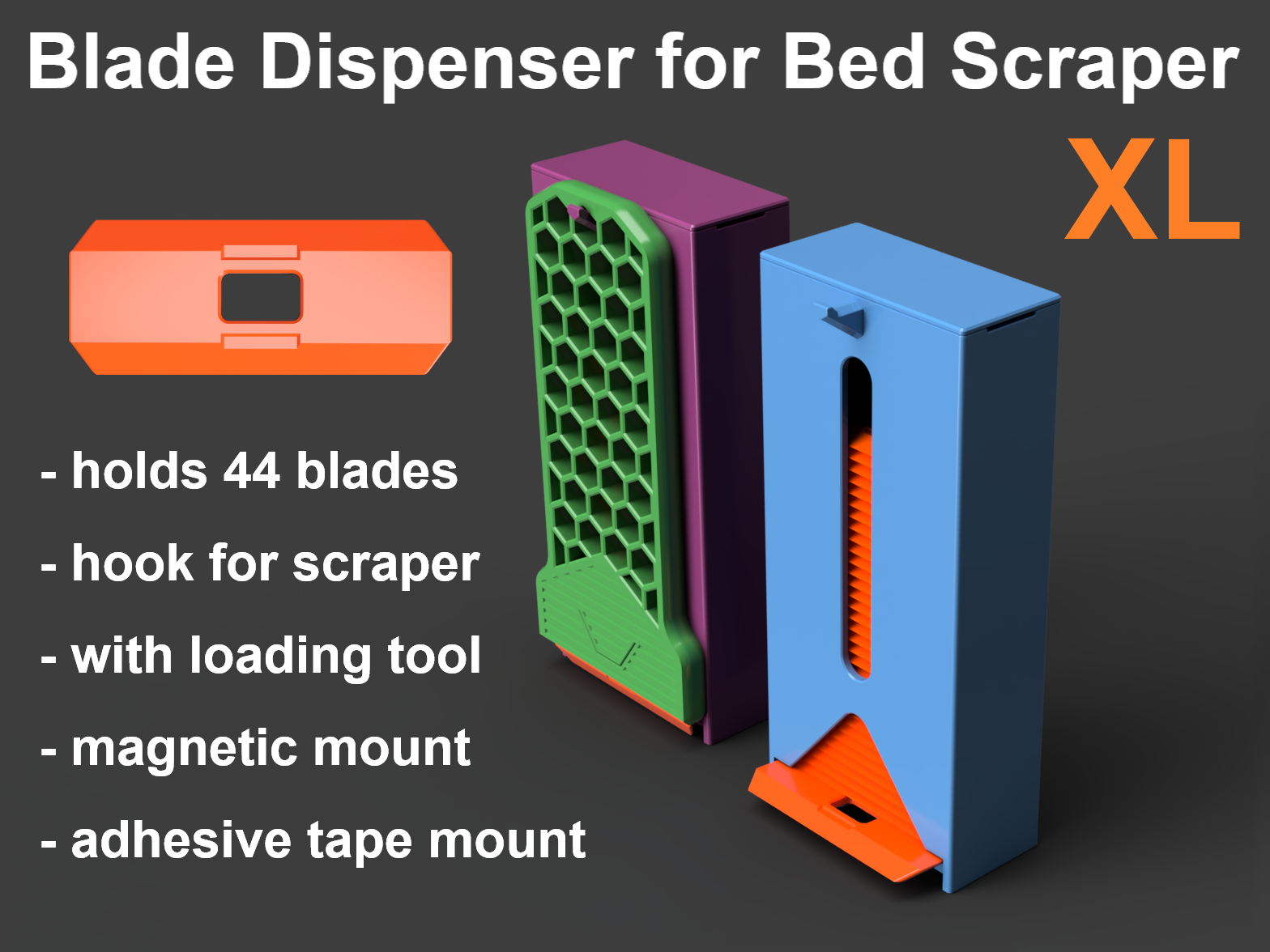 |
This is the XL version of my popular Optimized Bed Scraper with quick-change blades. The cutting edge of the blade is 45 mm, a full 30% longer!
Each blade weighs just 1.8 grams - and since each blade has two cutting edges, only 0.9 grams of filament is required per cutting edge. It couldn't be more economical, and you can now replace the blades more often without feeling guilty.
Print Settings:
This design has been optimized for printing with a layer height of 0.2mm and a line width of 0.4mm, so please do not use different values. However, the first layer of the blade should have a line width of at least 0.5mm. In order to get the sharpest possible blade, you should choose a smooth printing surface if possible.
The locking mechanism has been optimized for PLA, so I recommend this filament for the handle. You can also print the blades with PLA - as long as you don't scratch on a bed that's too hot for PLA. In this case, I would recommend a more heat-resistant filament, for example PETG.
Assembly:
That is very easy. Simply slide the blade into the handle. But be careful - the blades are sharp, so don't push them in with your finger, but insert them loosely and then push them all the way by pressing the blade on a solid surface.