
MARSUPIAL - An economical microscope slide and lab bench parametric organizer
Obliczymy ostateczną cenę na podstawie wybranego pliku. Sprawdzisz ją i zaakceptujesz przed płatnością.
Zapisane na tym urządzeniu.

Minimal filament interlocking storage for laboratory or microtomy bench glass slides, brushes, forceps and tools
- Ocena
- 0 / 5
- Polubienia
- 7
- Pobrania
- 31
- Wydruki
- 0
- Wyświetlenia
- 370
- Oceny
- 0
Aktualizacja u źródła:
Informacje o modelu
- Źródło
- Printables
- Kategoria
- Medical Tools
- Licencja
- Creative Commons — Public Domain
MARSUPIAL - The Economical Lab Organizer
Introduction
MARSUPIAL is an economical interlocking storage system for the laboratory and microtomy bench or workspace.
- Minimal-waste
- Adaptable
- Reconfigurable
- Stackable
- Universal
- Parametric
- Interlocking
- Accessible
- Laboratory
The system uses minimal filament for less waste and fast printing while maintaining function and customization.

The default box unit uses less than 15g of filament!
This project started as an effort to make a very low filament, fast printing storage solution for fresh glass slides at the microtomy bench and has grown into a parametric solution for other tools such as forceps, brushes and test tubes.
The system was inspired by the interlocking legs of cuddling kangaroos.

The problem
At a microtomy bench there is a need for rapid hassle-free access to blank slides, however some glass sides are distributed in packaging that makes removal laborious. In addition, tools like brushes and forceps can be misplaced if not adequately organised.
Interlocking organization box systems exist but tend to have excessively thick walls and joints - consuming a LOT of filament, increasing costs and print time.
The solution
The basic MARSUPIAL unit is a box of 56.4 x 26.4 x 50mm (length x width x height) internal area, capable of holding 50 scientific glass slides (such as Superfrost histology slides). Individual boxes connect via interlocking joints or ‘legs’; covers or lids can then mount over these for custom applications.
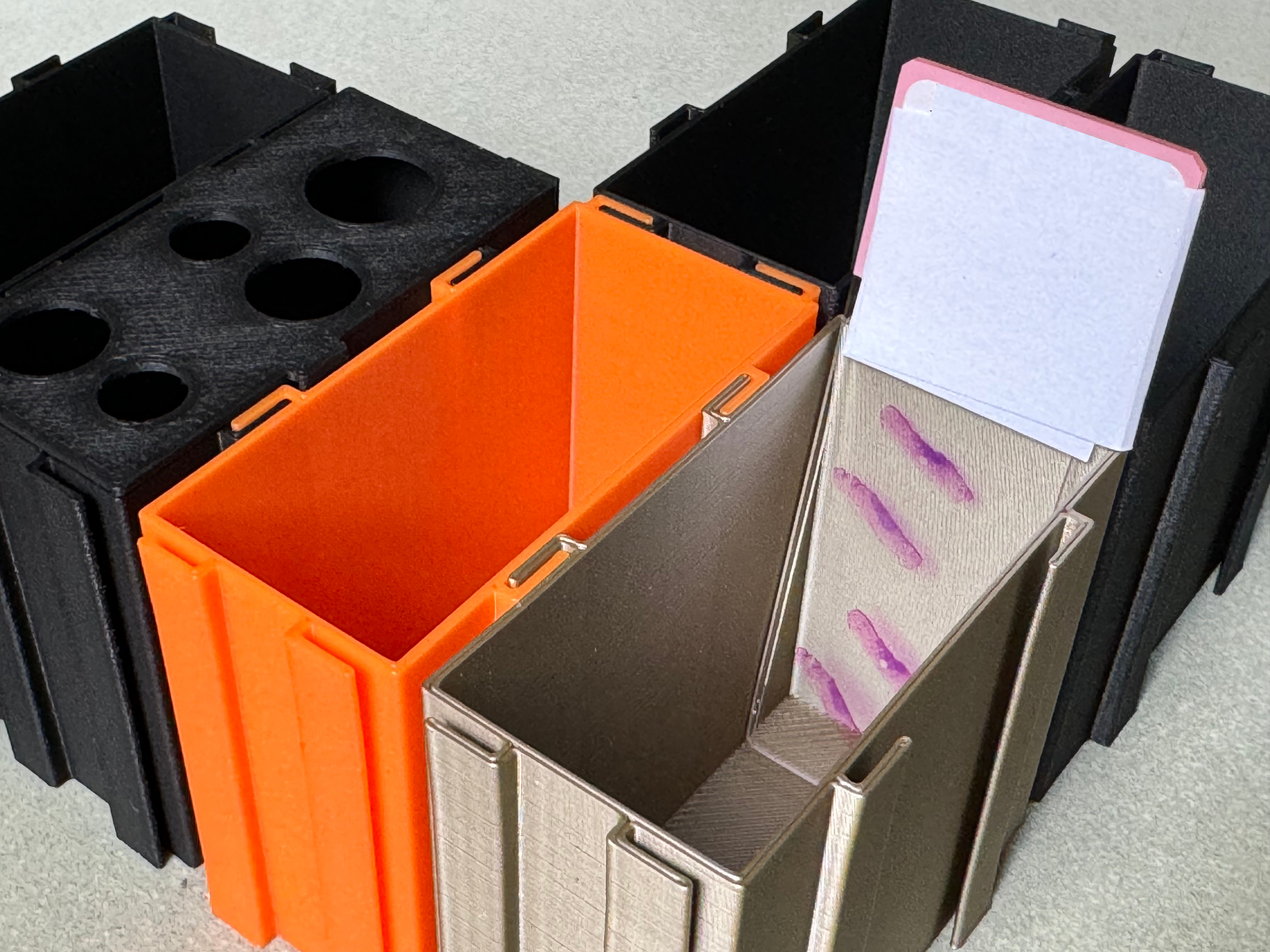
All basic walls and joints are 1mm thick and in the default embodiment, intended to be printed at 0.5mm extrusion width x 0.25mm height (ie a wall is two lines thick).
The model is parametric and will be uploaded as an OpenSCAD version once the script is ready.
The interlocking joints have a tapered profile for a secure friction fit. The default is an opening and closing gap of 1.2mm with a central “waist” of 1.1mm gap which spans 6mm height centrally (the narrowest point to sandwich the 1mm thick wall of the adjacent box).
On my printer this provides sufficient friction to enable picking up a daisy chain of boxes without them falling out of their holds.

In contrast, the initial lid or cover parts use a lower force friction locking mechanism for easy removal.