
A poor man's refractor telescopre
Obliczymy ostateczną cenę na podstawie wybranego pliku. Sprawdzisz ją i zaakceptujesz przed płatnością.
Zapisane na tym urządzeniu.

A 3d printable telescope (... ok, it's just a spyglass) that aim to be easy to print and assemble.
- Ocena
- 0 / 5
- Polubienia
- 18
- Pobrania
- 41
- Wydruki
- 0
- Wyświetlenia
- 680
- Oceny
- 0
Aktualizacja u źródła:
Informacje o modelu
- Źródło
- Printables
- Kategoria
- Physics & Astronomy
- Licencja
- Creative Commons — Attribution — Noncommercial
About the project
This telescope (well, it's actually a spyglass) is a compilation from a project that aim to provide you with a refractor telescope that is easy to print and easy to both assembly and disassembly.
View this telescope as an educational tool rather then a telescope that aims for perfection.
Introduction
There's something truly exciting about building your own telescope. Maybe it's the excitement of playing with optics and experience how the lens magnifies faraway objects. It's also an opportunity to understand the conditions that astronomers faced in the 15th century.
This description outlines how you can construct a telescope on par with the instruments that Galileo and Kepler built and used. Below are the the instruction how to assemble this telescope, followed by a brief explanation of how a telescope gathers light.
Building the telescope
All parts can be printed using PLA. 0,3 mm is recommended for layer height. Use a brim when printing the parts.
Print the parts the fits to the focal length of the objective lens:
| stl file | focal length (mm) |
|---|---|
| optical-tube_300.stl | 300 |
| optical-tube_400.stl | 400 |
| optical-tube_500.stl | 500 |
| stl file | focal length (mm) |
|---|---|
| focuser_300.stl | 300 |
| focuser_400.stl | 400 |
| focuser_500.stl | 500 |
This telescope consist of an objective that is connected to a optical tube and a focuser tube.

Print the lens enclosure that will fit your lens.
Put the lens inside the lens enclosure.
If the lens enclosure is slightly too small, than you can adjust it using a hair dryer. Use the hair dryer to heat up the PLA, that makes the PLA soft so that it can be stretched around the lens.
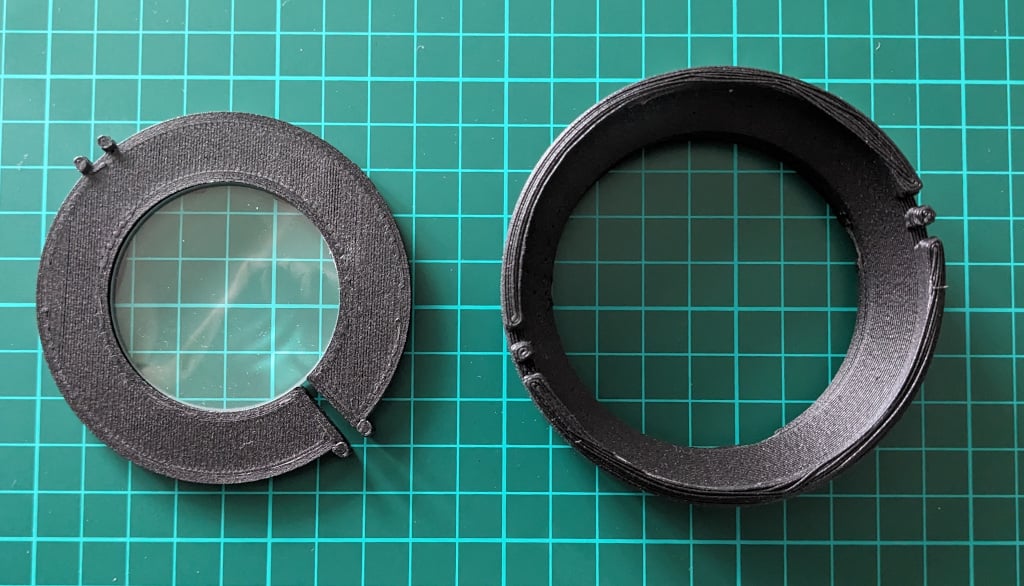
Push the lens enclosure on the objective.
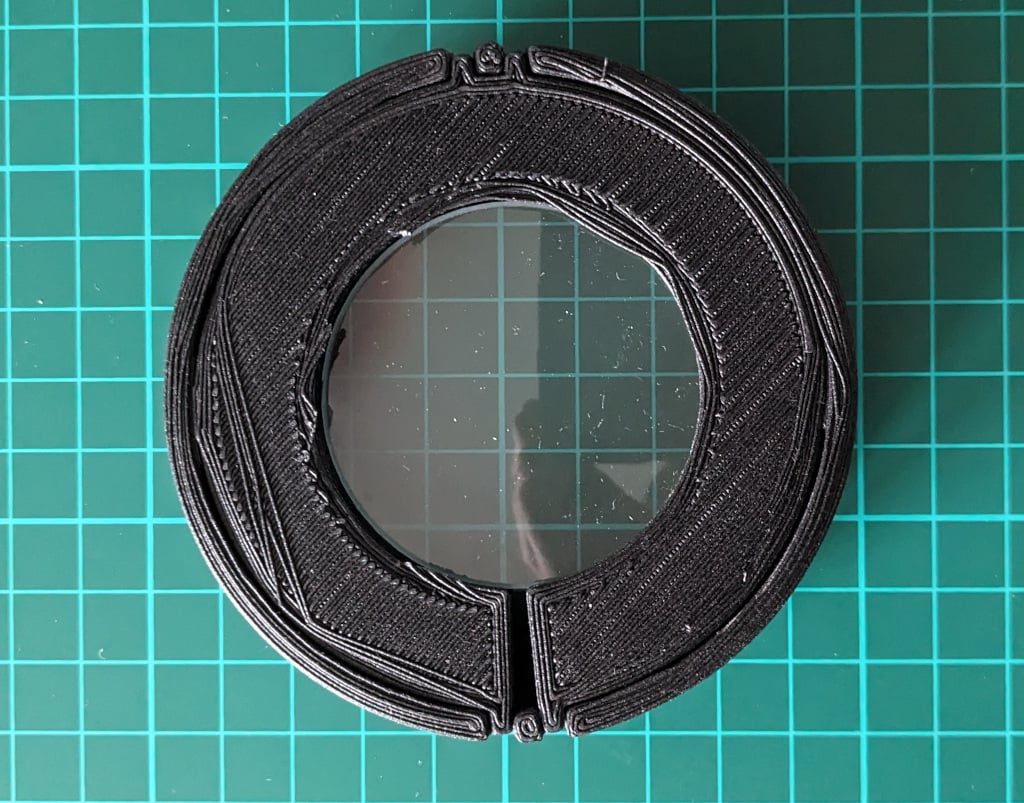
Put the focuser tube inside the optical tube.

Push the objective on to the focuser tube and rotate it so that it the objective locks in place.
Insert a 1.25-inch eyepiece into the focuser tube.

Now you have your own telescope. Put the eye piece inside the focuser tube.
This telescope is very basic in it's design. There is a more advanced version of this telescope that can be found on the projects github page: 3d-printable-telescop
(Send me a private message and I could post you two lenses, both an objective and eyepiece lens. I can do that for free as long as postage cost is not to high and if you aim to print the model. The lenses that I can spare is of lower quality, but they will be well suited for this model. So far, I only know that this model prints well on my own printer, but it would be nice to know if it also prints on other other printers with other brands on the PLA)
A telescope in it's simplest form
A telescope in it's simplest form is made up of two lenses. The light enters the telescope through a lens that is called the objective and than leaves the telescope through a lens that is called the eye piece.
Light is information
We can perceive the world around us thanks to the information that light carries from various objects. Our eyes act as sensors that decode this information carried by light. The eye receive an enormous amount of information from all sorts of objects around us. Information in the form of light hits the eye from various angles, but luckily, the eye has a flexible lens that can be adjusted to focus the incoming information so that we can observe specific objects.

It's the size of the pupil in the eye that determines how much information from light we can absorb. When it's dark, the pupil can expand to a diameter of 8 mm, providing an area of about 0.5 cm. If we had a larger pupil, it would enhance our ability to gather light, allowing us to see better in darkness.
What a telescope does is increase the amount of information an eye can capture while simultaneously magnifying the image that information represents. By focusing light from a large area onto a smaller one, the eye can receive more concentrated information.

A telescope with an objective lens that has a diameter of 5 cm has an area of approximately 19.6 cm². If all that light can be collected and presented to the pupil, it provides a collecting area that is approximately 39 times larger than gathering information solely with the pupil. It's the increased area of information gathered that enables us to view both fainter objects and more details from objects in the sky.
The interaction between the objective lens and the eyepiece creates the magnification. Magnification occurs when the objective lens refracts light with a angle that is lower than the refraction angle of the eyepiece. The following formula calculates a telescope's magnification:
Magnification = Focal length of the objective / Focal length of the eyepiece
The formula for magnification is straightforward. A basic course in optics can provide a deeper understanding of this relationship.
Materials Needed
Lens and an eyepiece
An optical lens is required for the objective, and a standard 1.25 inch eyepiece.
If you are from Sweden, than Alega has a cheap lens: https://alega.se/konvex-glaslins/A93548206
Try to find a lens with a diameter of 5 cm, and focal length 500 mm or 300 mm. On Amazone, you can use the search term d50f500 to search for a lens with diameter 50 mm and focal length 500 mm. However, it may be hard to find a cheap lens on Amazon.
The cheaper lenses are normally very thin with an edge thickness of around 2 mm and a diameter of 5 cm. You will need to create a lens enclosure that fits the lens that is intend to be used as an objective.
The following table shows some pre-generated setups for lens enclosure. Leave a comment if you would like to have any other dimensions generated, or open the free cad project to generate an enclosure after your own specification.
| stl file | lens diameter (mm) | lens edge thickness (mm) |
| lens-enclosure_508_18.stl | 50,8 | 1,8 |
| lens-enclosure_510_18.stl | 51,0 | 1,8 |
| lens-enclosure_511_18.stl | 51,1 | 1,8 |
| lens-enclosure_508_21.stl | 50,8 | 2,1 |
| lens-enclosure_510_21.stl | 51,0 | 2,1 |
| lens-enclosure_511_21.stl | 51,1 | 2,1 |
| lens-enclosure_508_33.stl | 50,8 | 3,3 |
| lens-enclosure_510_33.stl | 51,0 | 3,3 |
| lens-enclosure_511_33.stl | 51,1 | 3,3 |
| lens-enclosure_510_1101.stl | 51,0 | 11,01 |
| lens-enclosure_511_1101.st | 51,1 | 11,01 |
The diameter of the objective, the general quality of the lens and the focal length are all parameters that will decide if you are able to spot the craters on the moon.
You can build your own 1.25 inch eyepiece, or buy 1.25 inch eyepiece
The following project can be used to build your own eyepiece:
https://www.printables.com/model/741256-the-poor-mans-eyepiece
Disclaimer
NEVER POINT A TELESCOPE AT THE SUN OR ANY OTHER STRONGLY BRIGHT SOURCES. EVEN THE MOON CAN BECOME SO BRIGHT THAT IT CAN DAMAGE THE EYE IF THE OBJECTIVE LENS IS WIDE ENOUGH.