
Using Microelectronics to Visualise Stereochemistry and Explain Chirality: an Interactive Model of Tartartic Acid
We calculate the final price from your selected file. You review and accept it before payment.
Saved on this device.
Model information
- Source
- Printables
- Category
- Chemistry & Biology
- License
- Creative Commons — Attribution — Share Alike
There is now a smartphone-controlled version available:
https://www.printables.com/model/1044607-an-interactive-smartphone-controlled-molecular-mod
In this project, an interactive model of tartaric acid is presented (although other molecules are also possible).
This model was developed as part of a students Bachelors Thesis.
The initial idea for this project is depicted in the sketch below:
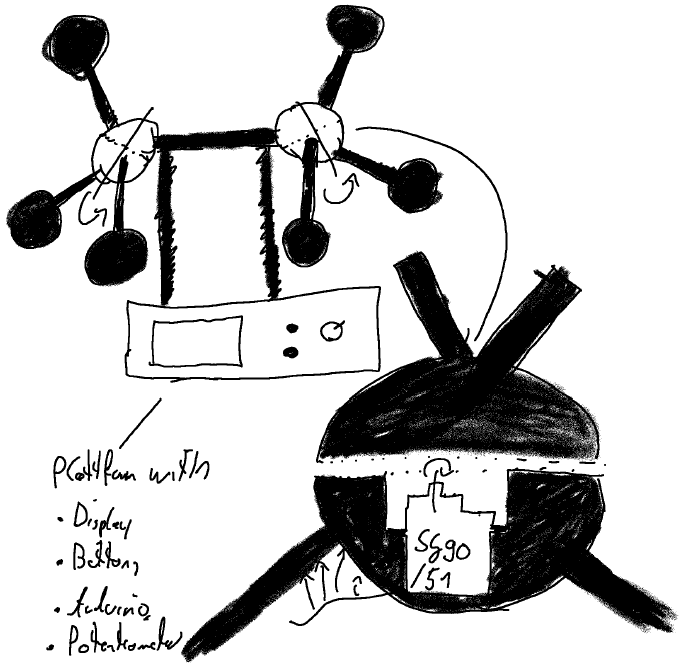
The crucial step in creating such a model was the conception of the chiral carbon atoms,
which needed to be able to change their configuration “by the push of a button”.
When working with molecular kits, any two of the substituents need to swap places to change
the stereo configuration. To achieve this, the atoms were split in half, and an out carving
was inserted into the middle in such a manner that a micro servo (SG51R; the smallest we could find) could be placed in one half, which could then spin the other half. For this to work, the cut needed to be perfectly centered so that two holes were on each half and the angles aligned in every configuration with the tetrahedral shape of the sp3 carbon atom.
An OLED Display reveals the current configuration of each chiral center (when a button is pressed on the IR remote). This encourages students to determine the configuration according to the CIP rules and then compare their findings with the display.
Also, the display shows physical properties of the respective isomer (melting point, density). The underlying arduino script can easily be modified for other molecules as well.
The different atoms (C, H, O) were created in Fusion360 on the basis of this video by Anthony Vorias:
Parts list:
- Arduino Uno board (or similar)
- 2 x SG51R servo (SG90 is too large!)
- IR Remote
- I2C OLED display
- cables and wires
- micro-usb breakout board (for power supply; optional)
- 3D-printed parts (PLA):
- base
- mount
- lid
- 14 x connector
- 2 x C-sp2 (black/grey)
- 2 x C-rotating_lower (black/grey)
- 2 x C-rotating_upper (black/grey)
- 4 x H-atom (white)
- 2 x O-atom (red)
- 2 x O-sp2 (red)
Building instructions:
… to be continued…
Future upgrades:
- control via smartphone (over Wi-Fi)
- smaller formfactor
- more rigit