
T7 DNA replisome
We calculate the final price from your selected file. You review and accept it before payment.
Estimated printing price per file
€2.88 – €3.53 net (excluding VAT)
For file: replisome_LagPol_F_some_deleted_0.2mm_PLA_ENDER5_3h56m.gcode
This is an estimate for one file. You’ll confirm the exact price before ordering.
File and estimate settings
File used for this estimate
Average indicative estimate: €3.21 excluding VAT (range midpoint).
- Weight reported by the author
- 25 g
- Print time reported by the author
- 3.93 hr
- Source material
- PLA
- Estimate material
- PLA
- Estimate printer
- Bambu Lab P1S - 0.4 nozzle
- Estimate process
- 0.20mm Standard
Indicative estimate for the selected file only, based on the author’s weight and print time. File variants are not added together. The final price is calculated after file analysis.
Saved on this device.
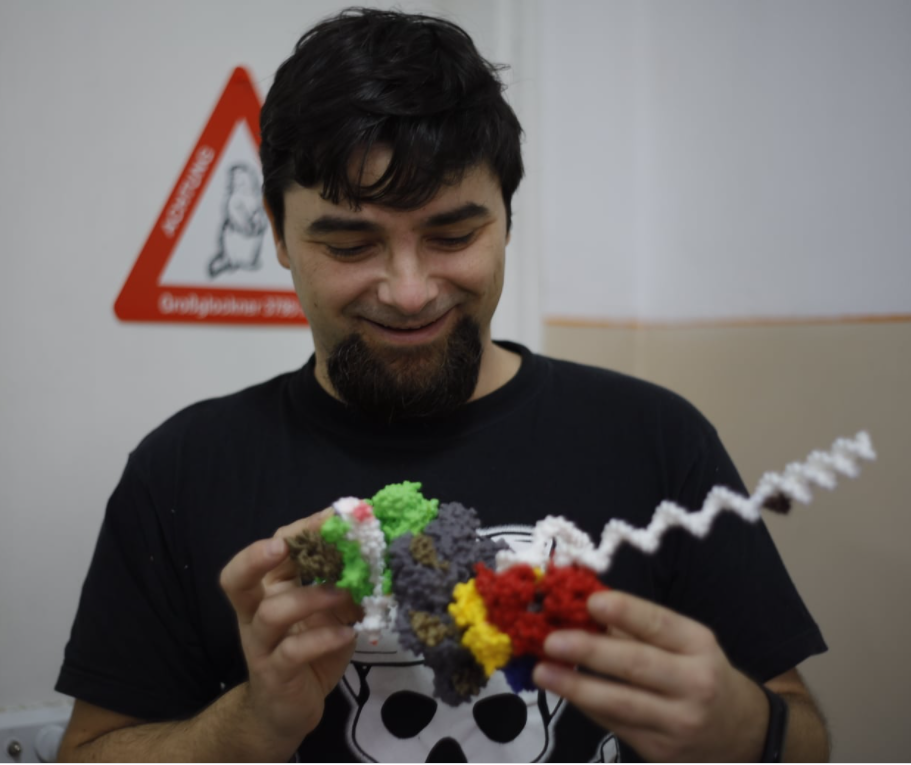
Surface model of the T7 replisome complex as described in Gao et al., Science 10.1126/science.aav7003 (2019).
- Rating
- 0 / 5
- Likes
- 34
- Downloads
- 107
- Makes
- 0
- Views
- 1,411
- Reviews
- 0
Updated at source:
Model information
- Source
- Printables
- Category
- Chemistry & Biology
- License
- Creative Commons — Attribution
Surface model of the T7 replisome complex as described in Gao et al., Science 10.1126/science.aav7003 (2019). All components were printed separately and glued. Proteins subunits were printed in PLA, while nucleic (DNA, RNA, and dTTP) in white TPU. The helicases complex from PDB ID 6N7V is printed in gray, leading strand polymerase from PDB ID 6N7w is printed in green and cooper, lagging strand pol from PDB ID 6N9V is printed in red, blue, and yellow. All nucleic acids and relevant ligands were printed in white. RNA was painted black and dTTP was painted blue. An artificial DNA double-helix was generated in Chimera, the two strands were printed separately and used to connect and assemble the subunits (including the lagging strand loop). The same artificial DNA double-helix was printed 2x more times and used to enlarge the template DNA, leading and lagging strands.
All printed files are provided as stl. A .py session file usable in Chimera is also provided to help the assembly. The model was created to help me teaching Biochemistry and Molecular Biology at the undergrad level.
Segmentation Software : Prusa Slicer
3D Modeling/CAD Software : Chimera
Model Origin : Hybrid: data + illustration
Printer Technology/Material : Polylactic Acid (PLA)/ Flexible
Printer Make/Model : Creality Ender 5 Pro
Print Units : mm
Scale At Given Print Units : 100x
Pre- and Postprocessing Instructions
Printed at 0.2 resolution with 2 wall lines and 5% infill. The printer was modified with a direct drive extruder in order to print TPU. Extensive supports are required but were rather easy to remove.