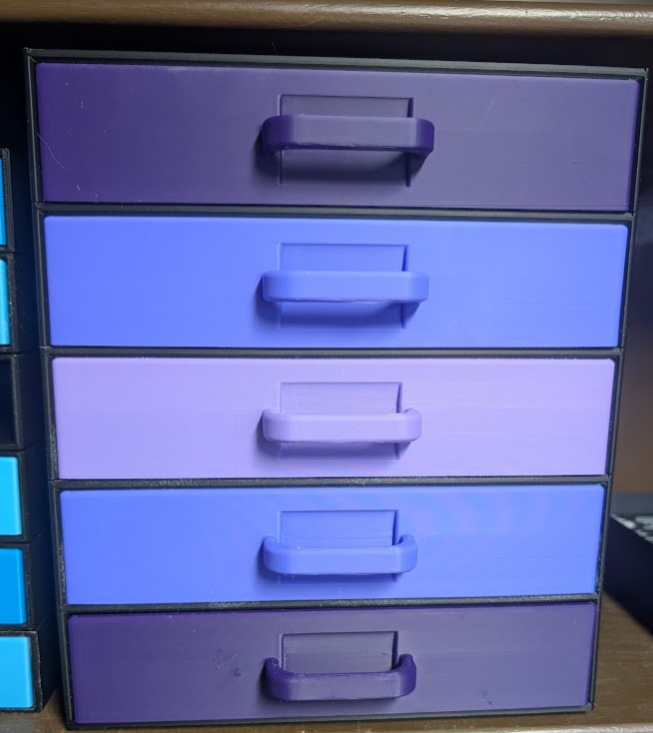
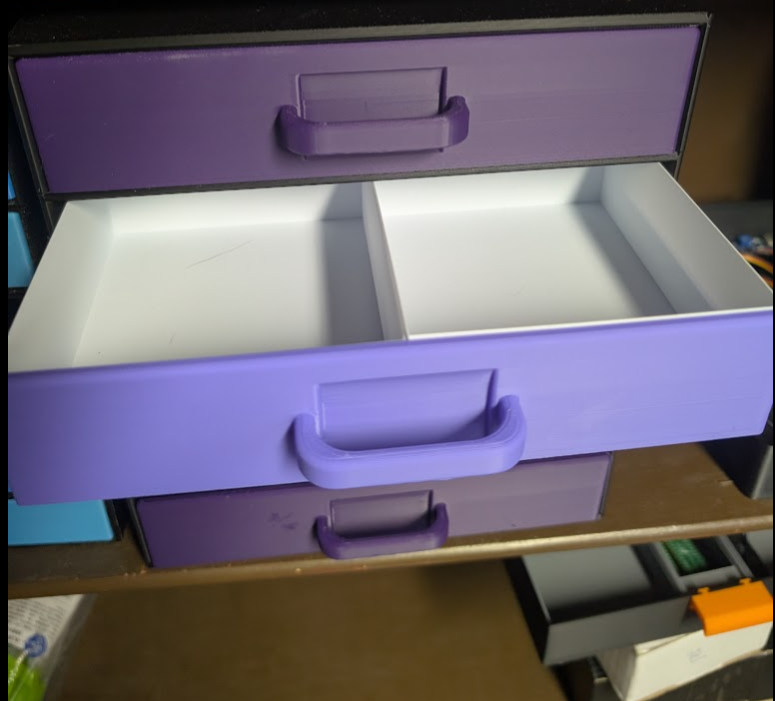
Deep Stackable Storage Trays / Organizers
We calculate the final price from your selected file. You review and accept it before payment.
Saved on this device.
Model information
- Source
- Printables
- Category
- Other House Equipment
- License
- Creative Commons — Attribution — Noncommercial
Overview
This is a modular, configurable storage system for small-to-medium-sized parts like screws, sensors, ESP32s, Raspberry Pis, etc.
The system consists of:
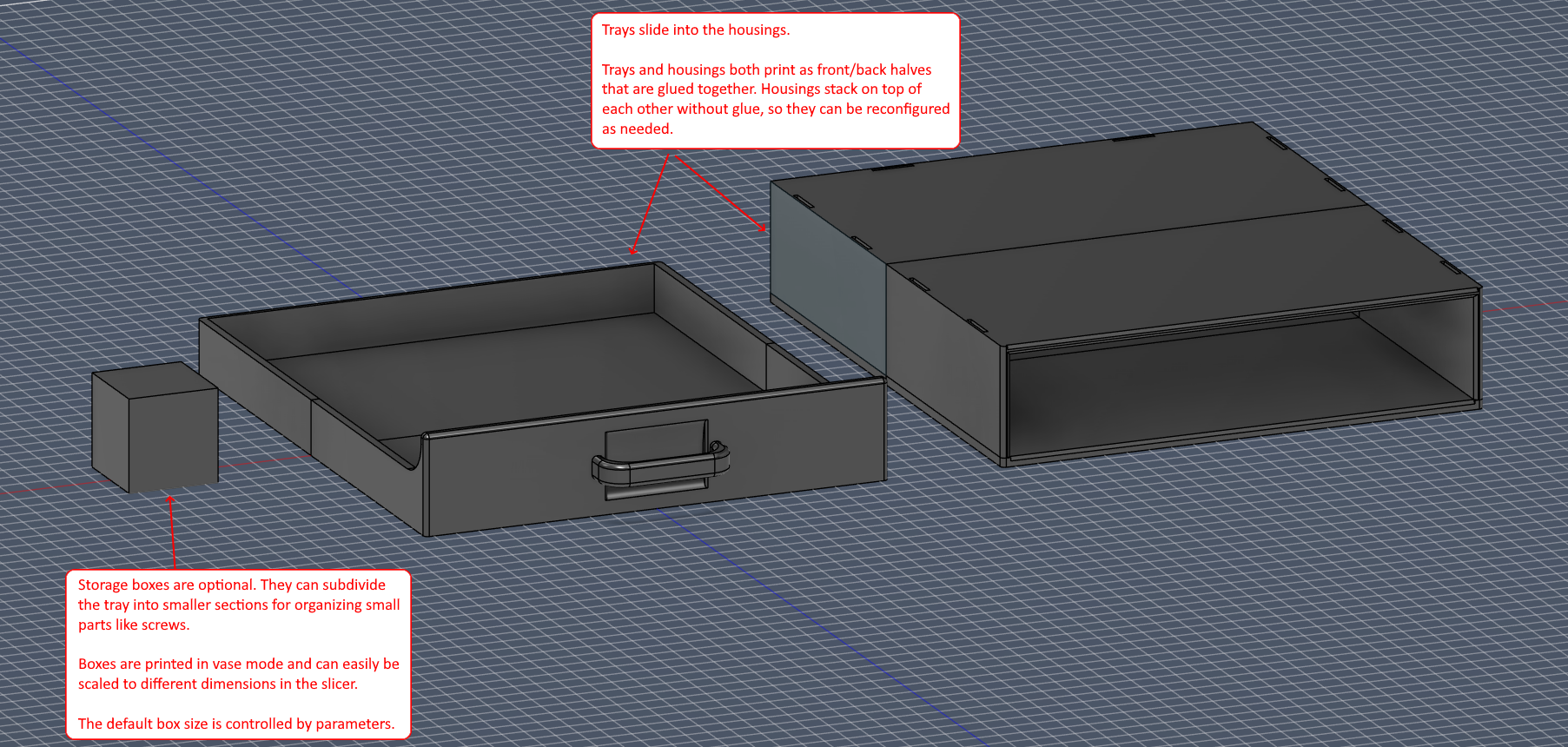
Storage trays that be sized to your needs. (Minimum 32mm high, max 2 print beds deep)
Optional boxes that go on the trays to subdivide the space (e.g. for storing screws). You can size these boxes however you like.
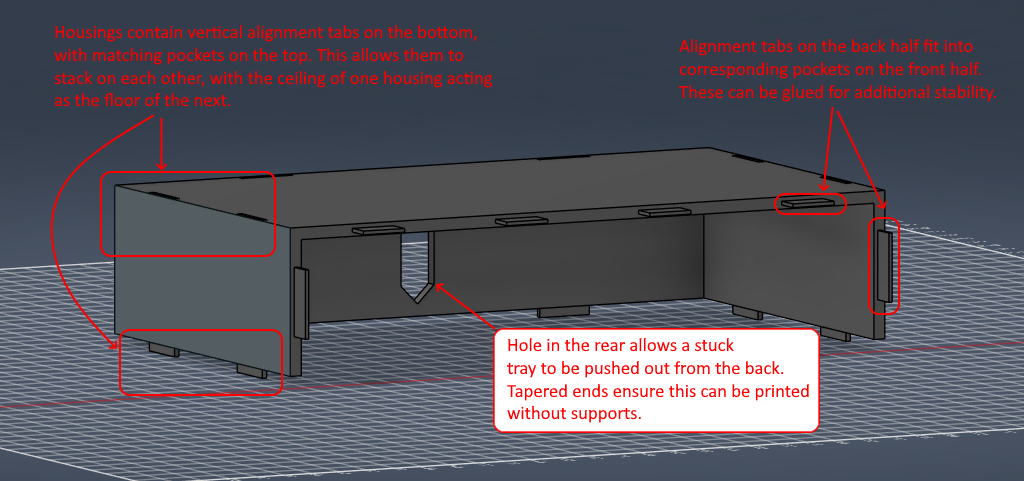
Stackable housings that the trays slide into.
Design highlights
My objectives when designing this were:
Fully parametric design in Fusion 360
Trays deep enough to maximize use of space on my shelves
Trays strong enough not to bend or break when loaded w/ screws and held by the front handle
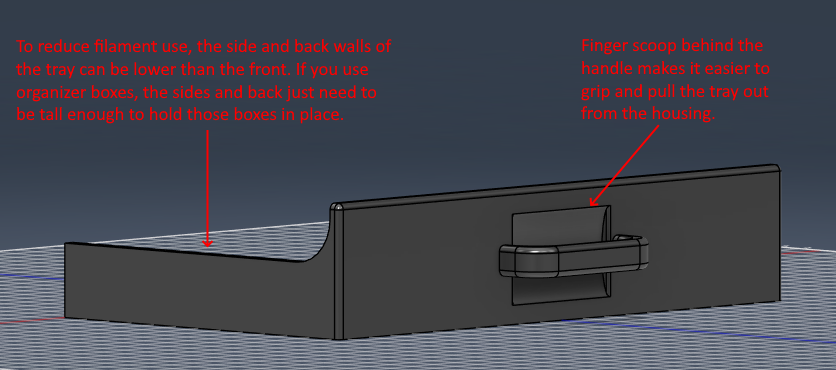
Minimize filament usage as much as possible
I played around with cutting holes into the side and back surfaces to reduce filament usage, but it didn't really work; in the end, large unbroken surfaces with low infill worked better than adding a bunch of perimeters around cutouts.
Default dimensions
The included .STL files are for a tray that is 246.6mm L x 208.10mm W x 44.2mm H.
The tray will hold a 6x5 grid of storage boxes that are 40mm x 40mm, but you can easily resize them.
I use them in stacks of 5 trays high and they are very stable.
Changing the parameters
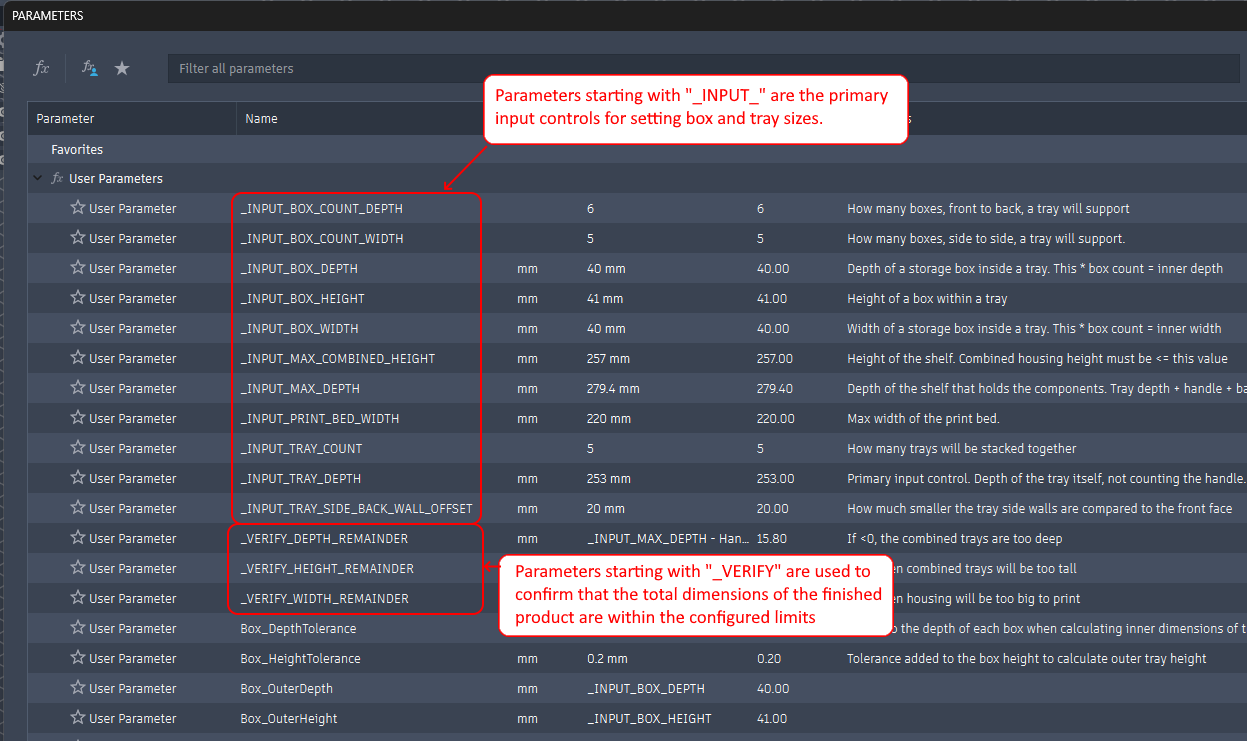
The Fusion 360 file is fully parametric. The key parameters for setting the tray dimensions are clearly indicated.
To configure a system, enter the size of your storage boxes and how many you want to support in a tray. The tray and housing dimensions will be sized accordingly.
Printing the files
I printed everything in PLA with 10% Gyroid infill. The trays seem very sturdy as-is, but if you're worried you could use your slicer to variably increase infill around the connecting surfaces.
I sized everything in Fusion. I don't know how well it will work if you scale parts in the slicer (except for the boxes, which are designed to be scaled in the slicer)
A few overhangs require supports. These are manually painted already in the included .3MF files.
I used standard print profiles in Orca Slicer; no special tricks were needed.
Print the boxes in spiral vase mode. They will end up very thin, but that's fine; they just need to serve as subdividers in the tray.
Assembling
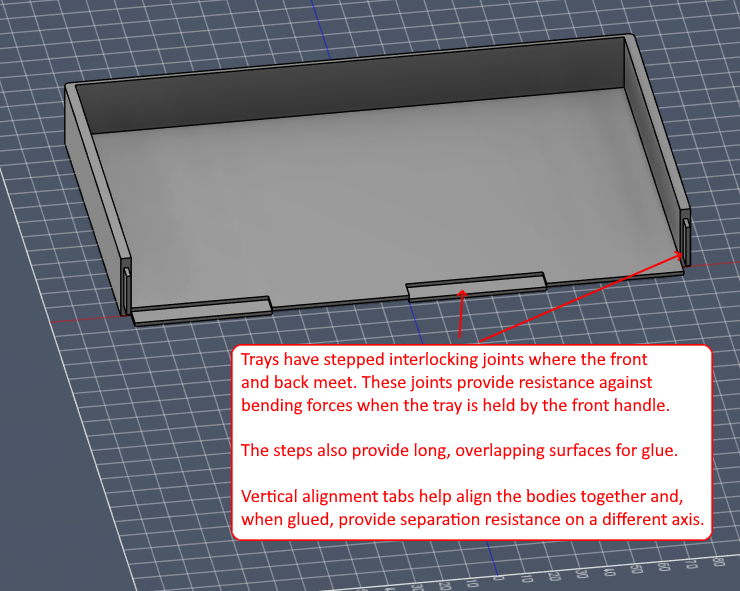
The tray halves are designed with interlocking geometry to provide strength, but they should still be glued together. Do not rely on press-fit friction alone.
The housings don't have to be glued together front-to-back, but I recommend it.
The housings do NOT need glued together top-to-bottom. Press-fit alignment is fine and makes it easy to reconfigure the housings if needed.
The storage boxes print in vase mode to minimize filament. They end up very thin, but that's fine; they just need to
Finished Product