
Model of Marcel Duchamp's Traveler's Folding Item by williamCromar: Full Scale Edition
We calculate the final price from your selected file. You review and accept it before payment.
Saved on this device.
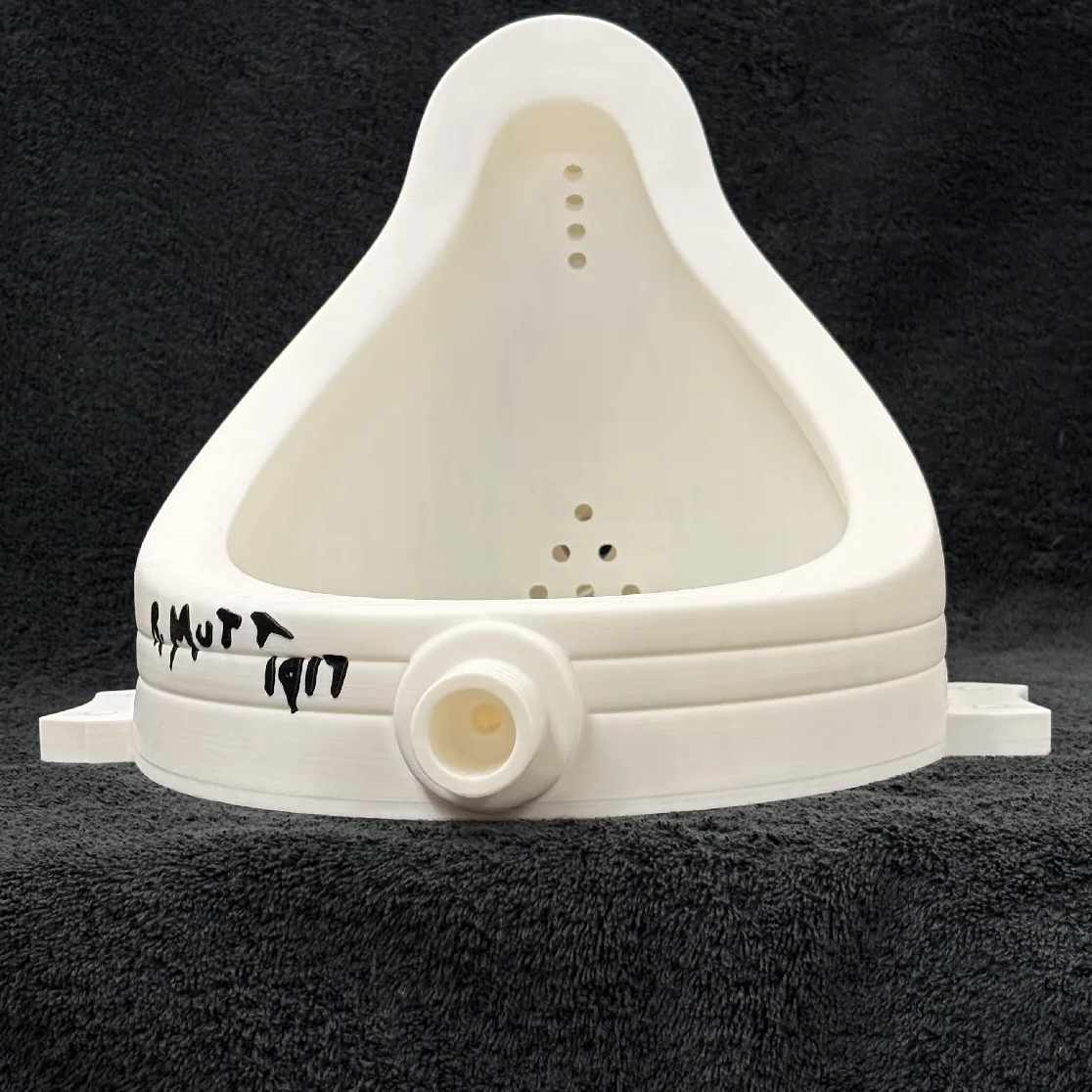
Full-scale plating of Model of Marcel Duchamp's Traveler's Folding Item by williamCromar in a Club-exclusive critique.
- Rating
- 0 / 5
- Likes
- 0
- Makes
- 0
- Views
- 7
- Reviews
- 0
Updated at source:
Model information
- Source
- Printables
- Category
- Sculptures
This digital asset is a refined, full-scale manifestation developed as part of an instructional research initiative supported by a faculty grant from Penn State Abington and the Abington MakerSpace. It expands upon the geometric parameters established in the public open-access reference collection Prêt à Faire: Printable Readymade Models.
1 | Concept & Material Behavior
This asset is an autonomous work of conceptual art: a 1:1 scale digital study of the physical parameters underlying the famous 1916 Traveler's Folding Item by Marcel Duchamp. The historical original typewriter cover was an ephemeral object that left behind no direct photographic record; its form is known entirely through subsequent mid-century museum duplicates, such as the 1964 Arturo Schwarz configuration, which serves as the public dimensional reference for this structural study.
Of all the full-scale models in this series, this layout represents the most complex fabrication challenge. Executing a 1:1 scale representation using flexible, multi-material TPU filaments requires navigating intense material constraints. While 3D-printed elastomer cannot fully duplicate the structural suppleness of vintage leather, over time the printed panels develop a highly satisfying, natural mechanical "droop," giving the finished physical manifestation a soft, organic visual presence that is remarkably responsive to touch.
Explore the historical research context of this study at:
 Stockholm Moderna Museet |  Centre Pompidou |  Box in a Valise |
The historical visual motifs analyzed here have been famously referenced or interpreted by contemporary practitioners, including Pierre Bismuth's capitalist critique, Greg Allen's take on authoritarianism, and Anja Bohnhof's reflection on time and memory.
 Pierre Bismuth, Gucci Traveler's Folding Item, 2012 |  Greg Allen, Protestor's Folding Item, 2014 |  Anja Bohnhof, Dans la nuit de temps, 2023 |
|---|
2 | Scope & Scale
As a work of Post-Appropriation and remix praxis, this model is an independent digital manifestation optimized specifically for full-scale flexible multi-material FDM fabrication, multi-body structural assembly, and display mechanics. The geometry deliberately adapts historical visual motifs into a printable, flexible medium, celebrating the physical deviations required by the additive manufacturing process as part of the artwork's transformative expression.
This model is optimized explicitly to be fabricated at full historical scale. Altering the print scale is not recommended, as it will compromise internal joint tolerances, mechanical clearances, and material behavior. Due to the expansive physical dimensions of the flattened panels, these components require a large-format manufacturing bed (such as a Prusa XL). A smaller, scalable open-access reference version is available at this link.
3 | Printing Notes
3.1 | General Recommendations
Use the supplied 3MF files with preconfigured orientations, multi-material painting, and settings.
These settings were validated on a well-tuned Prusa XL using dehydrated filament.
STL and STEP files are provided for users who wish to experiment.
The middle front multi-material TPU panel requires some babysitting to get a clean first layer, due to material stringiness.
File Formats
[Model_Name].3mf/.stl→ Best for quick printing. Pre-meshed at a high resolution, these files will slice exactly as they appear in the smooth website preview.[Model_Name].step→ Best for remixing and maximum quality. These files contain precise CAD data. Note: Ignore the blocky look in the online browser viewer; it will download and slice perfectly inside your slicer.
Observed Issues in Our Prototyping
No significant shrinkage was observed, but a bit of vertical play was found in the two shelf halves, making this a difficult glueing joint.
Slower print speeds aid in success with TPU. Frustrating, but high speeds aren't worth the dropoff in quality.
TPU is hard to load and manage on the XL. First layer issues include the following:
As it calibrates points on the build plate, the extruder may leave small dots of filament which can affect the quality of finish; these need to be removed before the print starts, and it's no easy feat.
As the extruder purges TPU for the lettering, it can leave a long unsightly string of material crossing the entire build plate from front to back, which must be removed before the print starts.
Painful though it may be, the entire first layer needs babysitting on all TPU parts. Plan your printing time accordingly. We find an approximate 20% failure rate on the first layer, which is intrinsic to printing large flat TPU sheets. Despite the LoadCell on the XL, a Live Adjust Z is often necessary for proper TPU adherence—scroll to the bottom of the link to find out more.
We used a Textured Powder-coated Print Sheet for all TPU printing on this project, providing a very satisfying finish on the large panels.
3.2 | Material Recommendations
For filament, consider the following:
Typewriter cover: SUNLU TPU Black
Underwood logo: Hatchbox TPU Tan (selected for historical tone accuracy)
Stand: Polymaker Panchroma Silk Black PLA
For adhesives:
TPU is notorious for assembly. PVC adhesive is said to work, but it is carcinogenic and hard to work with the necessary precision. We have successfully experimented with industrial-strength 3M Adhesive Transfer Tape. However, we can't vouch for archival durability. We constructed the final material prototype for this model in June 2026 and, as of this writing, it has maintained its integrity for four months. The smaller-scale versions that preceded this have successfully held together for over a year. TPU is a very experimental material for a model of this kind and not for the faint of heart. Use it at your own risk.
CA or Weld-On 16 gel will work for the stand.
3.3 | Printing Statistics
Stats for a full-scale print:
Typewriter cover:
Total material used: ~1100g black, ~5g tan (Note: don't get excited about missing the 1000 mark here: order 2kg of black—there WILL be tests and fails)
Total time: ~4 days, 4 hours
Total number of build plates in the 3MF: 7
Stand:
Total material used: 1015 grams (can be reduced to under 1000g by tweaking infill)
Total time: ~2 days
Total number of build plates in the 3MF: 2
4 | Assembly Notes
Follow these general guidelines:
The 3MF file shows the optimal orientation to print each piece.
Gluing the stand:
Glue the two shelf halves together, keeping them horizontal. Use tape to secure and set aside until cured.
Glue the pole to the base. After curing, glue the shelf to the top of the pole.
Assembling the cover:
Using the transfer tape, cover the entire area to be adhered on each piece, but leave the transfer tape covering on until ready to adhere. Press the transfer tape on with significant pressure and allow it to settle before assembly.
Start with the long front, top, and back panels. Each comes in three face parts, with a pair of lap joints connecting them. For the front panel, adhere the two front lap joints to the middle front, then adhere the left front and right front to the lap joints, creating one full panel. Repeat for the top and back.
Next, adhere the left and right side joint pieces to the left and right side panels.
Next, adhere the top front joint and top back joint to the top panel assembly.
With the outward face of the top panel assembly facing downward, adhere the two side panel assemblies to the top.
Adhere the back panel assembly to the top/side panel assembly.
Lastly, adhere the front panel assembly.
When complete, set the cover on the stand... don't glue it on!
It takes a while for the proper "drooping" effect to occur. TPU has a strong memory, so the cover assembly may appear a little stiff at first. Don't force it. Eventually, the TPU will begin to sag naturally, at which point the work is presentable. We built a version about six months before our exhibition in October 2026 to ensure that gravity had enough time to do its work.
5 | Presentation Notes
From Seekamp at Tout Fait:
Joselit explains, "This item, which Duchamp identifies with a feminine skirt, should be exhibited on a stand high enough to induce the onlooker to bend and see what is hidden by the cover" (90). In this way, this Readymade acts as an invitation to voyeurism. There is of course nothing actually underneath the skirt; the viewer's imagination must complete the artwork. As Duchamp always believed, "The onlookers are the ones who make the picture" (Moffitt 233)
To prompt this specific spatial interaction, display the finished fabrication on its custom stand, table, or pedestal at a height that encourages observers to actively lean down and peek underneath the hanging cover.
6 | Support
Access to this file archive facilitates your active engagement with the project's broader marketplace critique. We provide direct technical support through the platform messenger to assist project participants with any advanced flexible filament handling, multi-material slicing configurations, or tolerance adjustments. Thank you for participating in this distributed institutional inquiry.
7 | Change Log
3 AUG 2026: Uploaded photographic documentation of the fully assembled physical prototype fabrication to illustrate completed component fits and material droop behavior.
Disclaimer
Prêt à Faire is an autonomous artistic project, scholarly reference work, and institutional critique by williamCromar, supported by a faculty grant from Penn State Abington with fabrication assistance from the Abington MakerSpace. This project is entirely independent and maintains no formal affiliation, endorsement, or sponsorship with Association Marcel Duchamp, the Estate of Marcel Duchamp, ARS, ADAGP, or any curating museum. When referencing or sharing this work, users must maintain a clear distinction in authorship and nomenclature from the historical referent. Cite this asset as: Model of Marcel Duchamp’s Traveler's Folding Item by williamCromar. Basic models are available under a CC BY-NC-SA 4.0 license; premium tiers operate under a separate commercial framework. For full conceptual and legal text, visit https://sites.psu.edu/pretafaire/disclaimer-and-licensing/