
Models of Marcel Duchamp's Readymades by williamCromar: Experimental Texture Editions
We calculate the final price from your selected file. You review and accept it before payment.
Saved on this device.
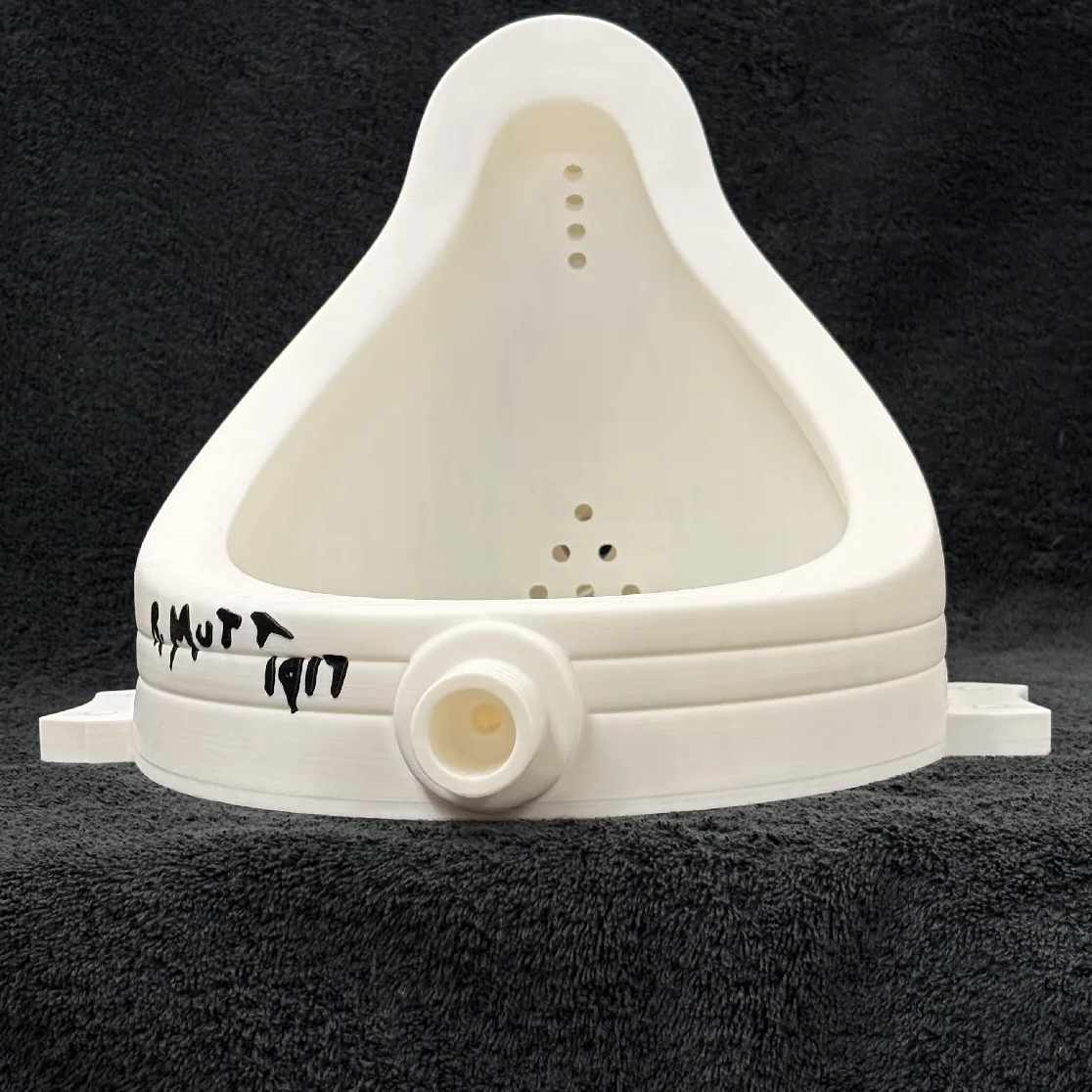
Club-exclusive experimental geometric variants from Prêt à Faire, supported by Penn State Abington. CC BY-NC-SA 4.0.
- Rating
- 0 / 5
- Likes
- 0
- Makes
- 0
- Views
- 5
- Reviews
- 0
Updated at source:
Model information
- Source
- Printables
- Category
- Sculptures
This premium component set features advanced geometric variations expanding upon the open-access reference collection Prêt à Faire: Printable Readymade Models. Accessible under a distinct commercial framework, these deluxe file configurations—alongside official Exhibition Master Proof prints—function as active components of the project's broader institutional and marketplace critique.
1 | Concept & Provenance
This collection compiles specialized, untextured geometric data sets engineered to facilitate displacement texturing and material analysis. The assets provide advanced reference frameworks for structural studies of public-domain source geometries, referencing historical visual motifs found across the Readymade canon, including:
To facilitate an instructional research initiative supported by a faculty grant from Penn State Abington, I forensically reconstructed these underlying geometries from the ground up utilizing public data points and historical archival documentation. This specialized release grants Club members access to the baseline, multi-faced architectural geometry specifically configured to manage directional material mapping and surface texturing constraints.
Structural Evolution & Slicing Methodology
The underlying architecture of these models originated within a CAD environment during late 2025. At that stage of the research, executing organic material representations (such as felt or wood grain) within a layer-by-layer additive manufacturing environment required highly complex slicing modifications, utilizing custom variables for localized surface deformation, ironing, and targeted modifiers. The legacy files preserved in this archive document the slicing gymnastics required to interpret specific material qualities within early FDM prototypes.
In mid-2026, the technical workflow was optimized through the integration of the BumpMesh utility—an open-access, browser-based deployment developed by researcher Stefan Hermann. This utility allows for efficient, high-fidelity algorithmic surface mapping directly onto CAD-generated geometries without requiring external poly-mesh deformation software.
People who read my articles know my broader research remains critical of automated, generative machine-learning tools within the digital fabrication space, but this specific open-source development represents a highly effective deployment of rapid software engineering by Stefan. Following the integration of this utility, the surface-textured variations across the Prêt à Faire series were fully updated. To allow advanced fabricators to experiment with custom algorithmic texturing, the underlying multi-body geometry—specifically partitioned to define boundary lines between textured faces and smooth mechanical tolerances—is distributed here as a premium framework for you, the project participants.
2 | How to use the files
Wood Grain Orientation: For primary geometric volumes, texturing parameters are straightforward: align the displacement vector maps relative to the element's longitudinal dimensions. All assets in this collection use this configuration, with the exception of Model of Marcel Duchamp's Peigne by williamCromar.
The Peigne Structural Configuration: In Model of Marcel Duchamp’s Peigne by williamCromar, the structural geometries representing the top and bottom casing are intentionally partitioned into separate architectural elements: a main plane, a pair of longitudinal side boundaries, and a pair of lateral side boundaries. This multi-body file organization directly resolves the coordinate mapping parameters of the BumpMesh utility. Because standard wrapping algorithms function in a planar fashion, partitioning the components mimics the structural logic of a physical assembly. This configuration allows fabricators to map the directional grain vectors precisely across separate faces before digital assembly. Once processed within the BumpMesh utility, the exported STL files can be imported into a slicing environment, precisely aligned within a 3MF multi-part layout, and merged into a unified mesh framework—matching the forensic digital workflow implemented to engineer the open-access reference model in the main Prêt à Faire collection.
Felt Material Representation: Textured elements representing felt parameters are incorporated into the Model of Marcel Duchamp’s Peigne by williamCromar architectural files. To interpret this non-directional material surface, a random Noise displacement map was utilized, bypassing the axis-alignment constraints required by grain texturing. To optimize localized boundary slicing, certain components—such as the base felt section—are organized into sub-bodies (including a baseline plane, a low boundary wall, and an upper structural wall). Following the digital application of the algorithmic surface texture, these individual components can be merged within the slicer environment to generate a stable, unified STL.
I really enjoyed working with BumpMesh, so much so that I wanted others to have an opportunity to play around with it! So this specialized collection is distributed to provide digital fabricators an opportunity to analyze, experiment with, and manipulate multi-body CAD geometry within open-source texturing environments. Comprehensive documentation regarding art-historical contexts, specific materials, and printing parameters is maintained across the respective open-access model listings.
3 | Support
Access to this file archive facilitates your active engagement with the project's broader marketplace critique. We provide direct technical support through the platform messenger to assist project participants with any advanced multi-body file manipulation or texturing inquiries. Thank you for participating in this distributed institutional inquiry!
4 | Change Log
4 AUG 2026: Updated cross-reference links across the collection text.
18 JULY 2026: Integrated separate experimental texturing file sets into a single unified archive to optimize project documentation and accessibility within the premium tier framework.
Disclaimer
Prêt à Faire is an autonomous artistic project, scholarly reference work, and institutional critique by williamCromar, supported by a faculty grant from Penn State Abington with fabrication assistance from the Abington MakerSpace. This project is entirely independent and maintains no formal affiliation, endorsement, or sponsorship with Association Marcel Duchamp, the Estate of Marcel Duchamp, ARS, ADAGP, or any curating museum. When referencing or sharing this work, users must maintain a clear distinction in authorship and nomenclature from the historical referent. Cite this asset as: Model of Marcel Duchamp’s [Object Name] by williamCromar. Basic models are available under a CC BY-NC-SA 4.0 license; premium tiers operate under a separate commercial framework. For full conceptual and legal text, visit https://sites.psu.edu/pretafaire/disclaimer-and-licensing/