
Canadian Robot Bowling
We calculate the final price from your selected file. You review and accept it before payment.
Saved on this device.

Canadian 5-Pin Bowlers' Association 1/4 scale pins for robot bowling (see description)
- Rating
- 0 / 5
- Likes
- 8
- Downloads
- 96
- Makes
- 0
- Views
- 639
- Reviews
- 0
Updated at source:
Model information
- Source
- Printables
- Category
- Indoor Sports
- License
- Creative Commons — Public Domain
This game involves robots and bowling. What could go wrong? At ¼ scale, the damage is contained so this game is safe for all ages.
Why Canadian 5-pin? I am Canadian but mostly I'm just lazy. Printing 10 pins is too much work.
This description will guide you through printing the pins. At the end I talk about the game but, spoiler-alert, anything involving robots and knocking over these pins qualifies as Canadian Robot Bowling.
The Pin Models
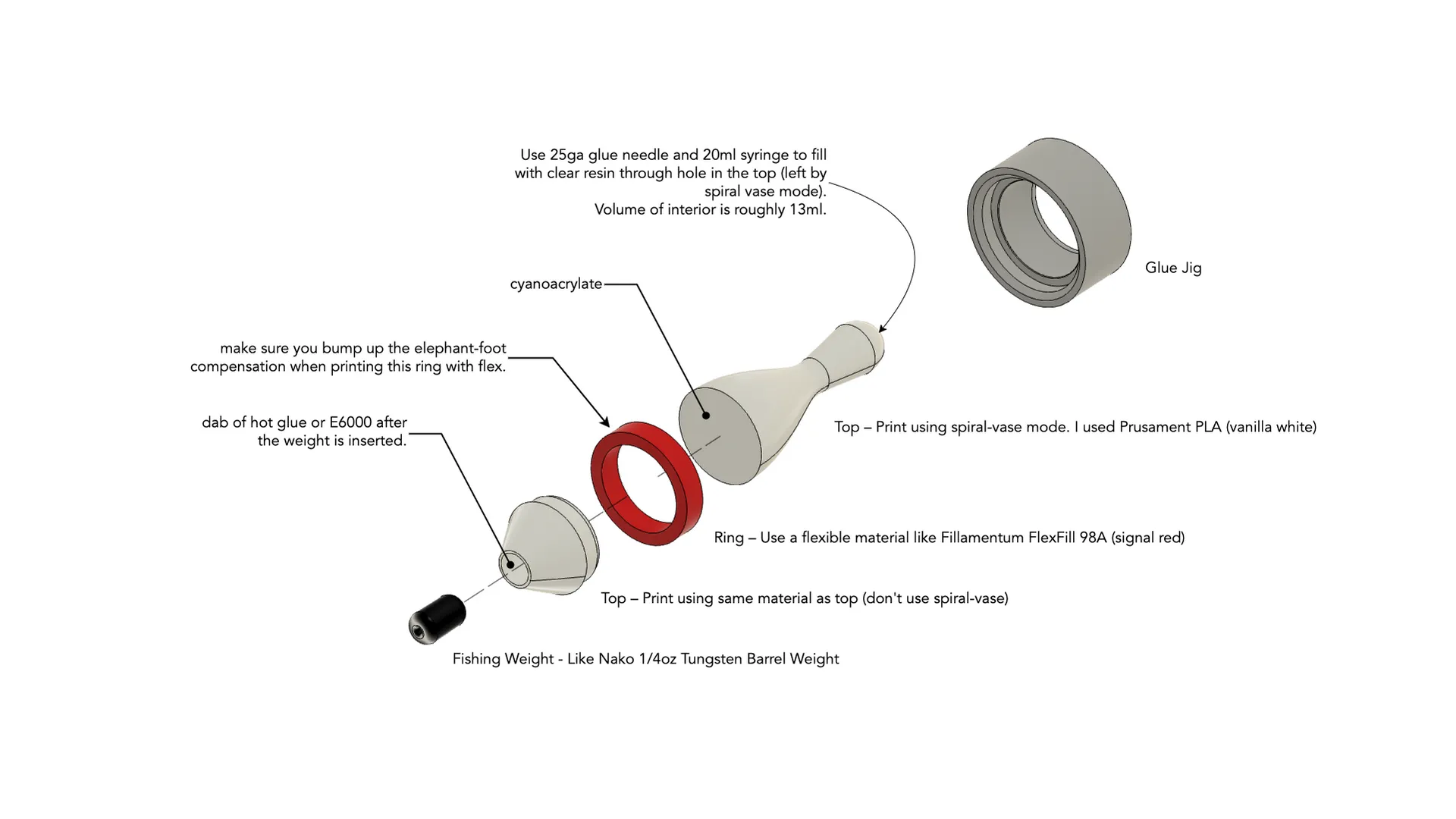
There are four ways to print the pins using three different versions of the model. The “pretty” version uses two filaments, three parts, one jig, glue, clear epoxy, a glue syringe, and tungsten weights but the result is a fairly authentic ¼ scale replica of a bowling pin. The other versions are much easier to print with the differences being about trading build complexity for a lower center of gravity. The lower the center of gravity the harder the pins are to knock over which is what you want for robot bowling. More on that later. First, let's talk about the builds…
Pretty Version
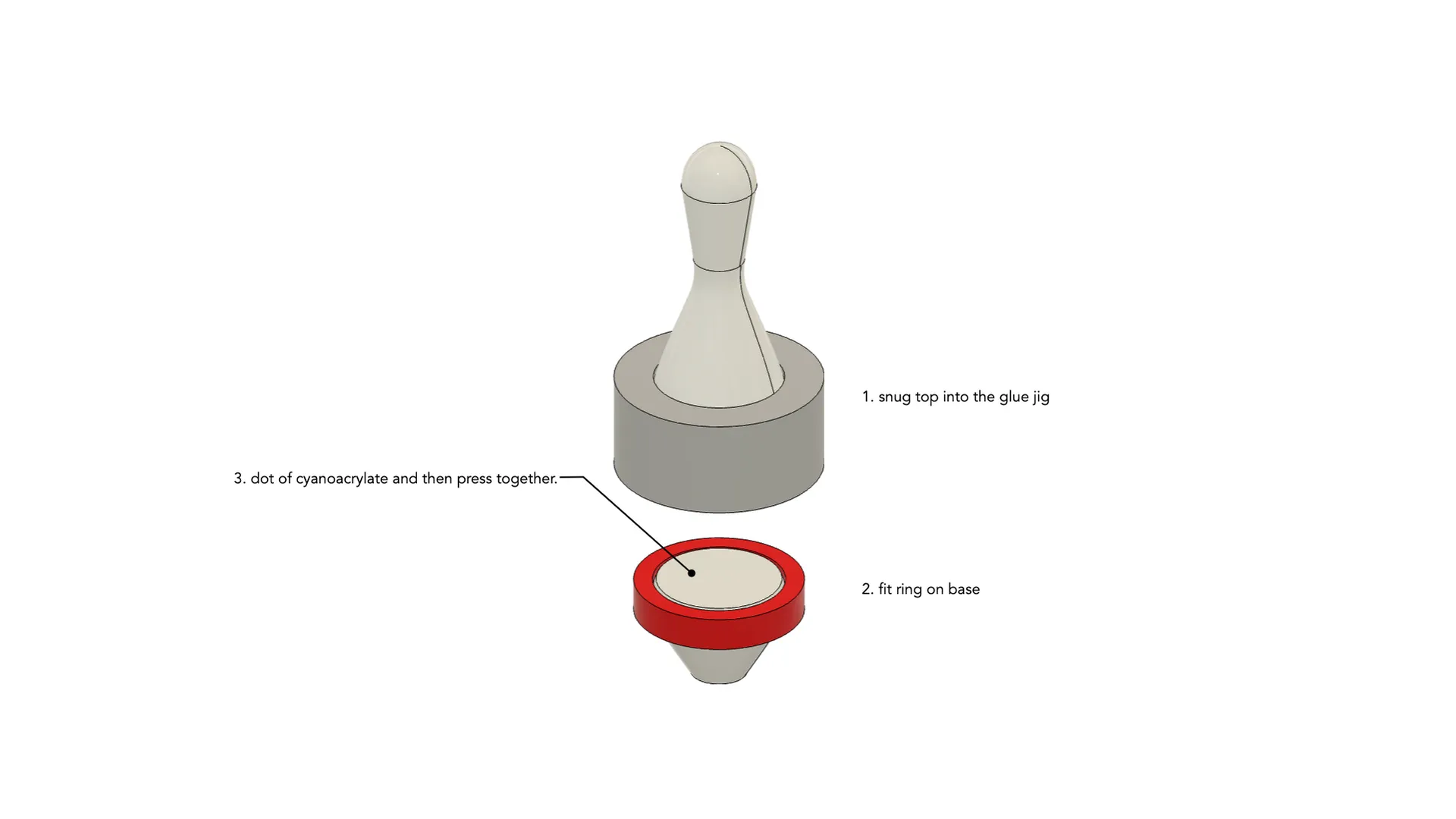
The diagrams say it all and the photos for this model show the results. I think they're pretty convincing and are surprisingly stable even on low-pile carpet. That said, this build is a bit of a commitment. Skip ahead if you just want some quick and dirty pins to throw yer 'bots at.
Simple Pin
The simple pin prints as-is; no assembly. You'll need to use a brim but otherwise you can print a single sheet of all 5 at once.
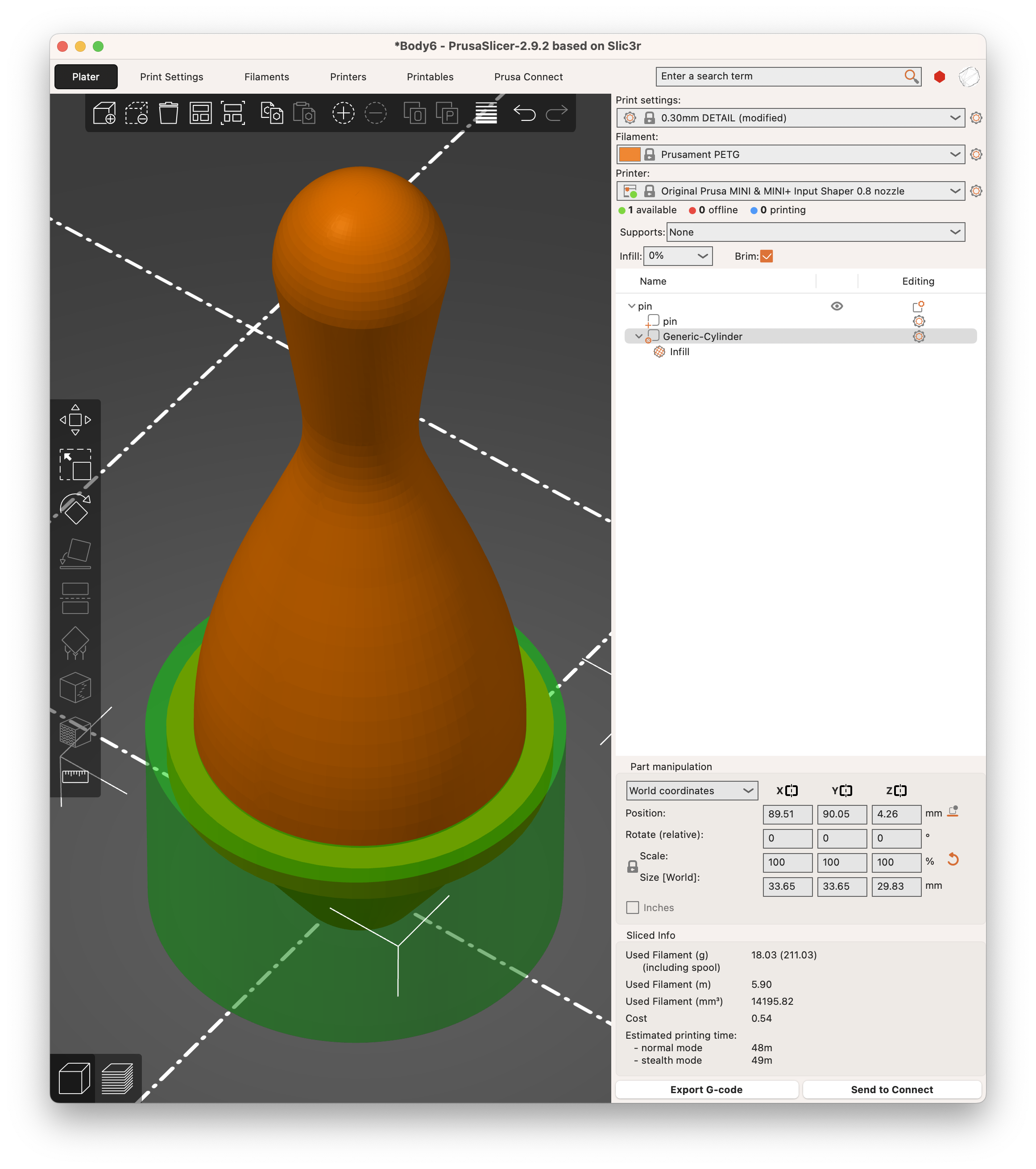
I would, however, recommend using a cylinder modifier that contains the base of the model up to the top of the ring, as shown in the screenshot below, and apply an infill modifier. Set the model infill to 0% and the modifier to 100%. This lowers the center of gravity and makes the pins more stable.
Two Part Simple
This model eliminates the need for annoying brims since you print the base upside down but you then need a dab of glue to assemble each pin. If you print out the jig model this becomes a simple process. It's up to you which is worse; removing brims or gluing plastic.
Two Part Simple with Spiral Vase
You can get a lower center of gravity if you print all the bases out with 100% infill then print each top using spiral vase mode. This takes a little longer since you can only print a single top at a time but having a nice, bottom-heavy pin makes them more stable and fun.
Robot Bowling
All right. You have your five pins, let's get bowling!
Attached to this model is a PDF template you can print out (using a old-tyme paper printer) to help you properly arrange the Canadian 5-Pin Bowlers' Association regulation 1/4 scale pins in a Canadian 5-Pin Bowlers' Association regulation 1/4 scale pattern. Find a nice flat and smooth surface to play on with a good lane to bowl down. Concrete works well as do finished wood floors. Now, bring on the bots!
I don't have any specific rules here and invite you to improvise and share your own experience. I ran a little game at my office using a Sphero Bolt which, being a sphere, is an obvious choice. The rules of my game were no motion > 30 degrees from down-lane (forward). The fewest maneuvers that knocks down the most pins wins with the least overshoot of the pins being a tie breaker. Contestants then had to eyeball distances and program one or more maneuvers to take a turn.
You might do something similar with small rover bots like sumo bots, or you could fly FPV drones at the pins, or throw tennis balls with a robot arm. As long as you are combining ¼ scale Canadian 5-pin bowling with robots you are doing it right.
❤▶🤖&🇨🇦