
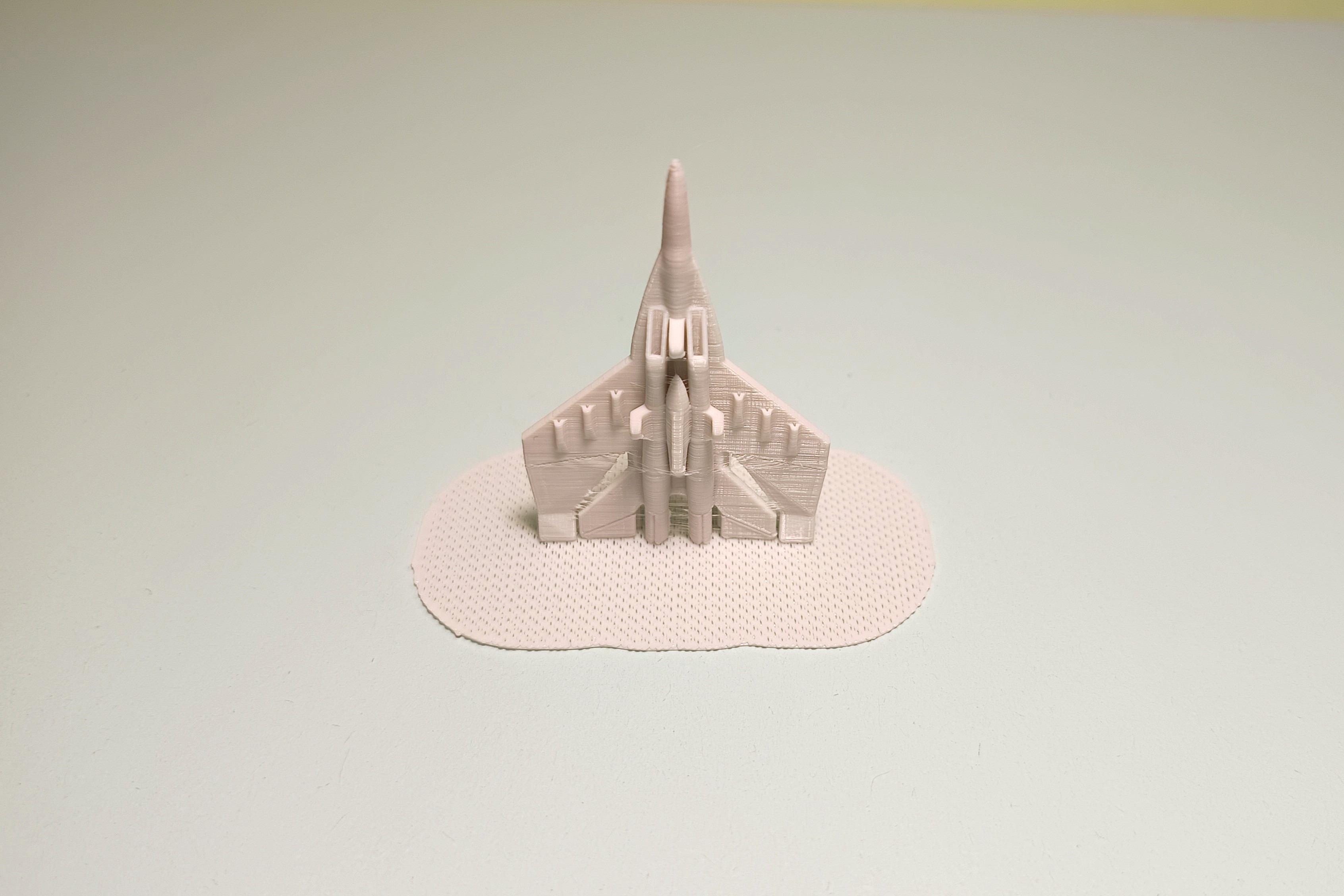
F-117 Nighthawk print-in-place micro stealth attack aircraft
Obliczymy ostateczną cenę na podstawie wybranego pliku. Sprawdzisz ją i zaakceptujesz przed płatnością.
Zapisane na tym urządzeniu.

A small, simple and easy to print 1/320 scale attack aircraft model.
- Ocena
- 4,833 / 5
- Polubienia
- 72
- Pobrania
- 743
- Wydruki
- 5
- Wyświetlenia
- 2038
- Oceny
- 6
Aktualizacja u źródła:
Informacje o modelu
- Źródło
- Printables
- Kategoria
- Vehicles
- Licencja
- Creative Commons — Attribution — Noncommercial — NoDerivatives
About the F-117 Nighthawk
The Lockheed F-117 Nighthawk is a retired American single-seat, subsonic, twin-engined, stealth attack aircraft developed by Lockheed's secretive Skunk Works division and operated by the United States Air Force. It was the first operational aircraft to be designed with stealth technology.
The aircraft's faceted shape (made from two-dimensional flat surfaces) heavily contributes to its relatively low radar cross-section of about 0.001 m2 (0.0108 sq ft). To minimize its infrared signature, it has a non-circular tail pipe that mixes hot exhaust with cool ambient air and lacks afterburners; it is also restricted to subsonic speeds as breaking the sound barrier would produce an obvious sonic boom that would increase both its acoustic and infrared footprints.
The F-117 is equipped with integrated sophisticated digital navigation and attack systems, targeting being achieved via a thermal imaging infrared system and a laser rangefinder/laser designator. It is aerodynamically unstable in all three aircraft principal axes and thus requires constant flight corrections via a fly-by-wire (FBW) flight system to maintain controlled flight.
Important
Due to the design of the Nighthawk wings and their backward sweep, the angle between the wings and the fixed support led me to reduce the gap size by 50%, but in the models section I used the old markings, so if someone has printed (for example) a 0.12mm version of another airplane with good results, this time they should also choose the 0.12mm model.
About the model itself
You can find hundreds of fighter models on the Internet.
Some of them are, however, a faithful reproduction of the machine itself, but such a model is not great to 3D print (because of the thin wings, complicated engines and landing gear, it needs tons of supports etc.).
On the other side there are simple models of aircraft that are easy to print, but no longer represent the original plane.
I tried my best to create something in between, a model that is both easy to print and looks like the real aircraft. I spent a lot of time to adjust the wing thickness, the acceptable landing gear design and the optimal way to get rid of default supports and to make the plane look so reliable that even a person not interested in aviation could tell the difference between several models.
Printing
- High quality settings, 0.12mm-0.15mm layer height (I am using 0.12mm)
- 0.4mm nozzle
- NO supports
- 100% infill
- I reccomend to use raft to ensure that the model will not peel off mid-printing.
- Printing (on my 3D printer) takes from 1h to 1h 40minutes depending on settings, printer efficiency and the size of a jet.
- I recommend NOT to scale down the model, because some parts (air intakes, engines, nose) might be deformed, or not even printed, because they will become too thin for the slicer and printer. I also do not guarantee good results when scaling up.
Cleaning the model
Here's a small instruction how to remove the unnecessary parts after printing.
The photos show a MIG-29, but the instructions apply to all models.
First, remove the raft with side cutters.

Then find the gaps in the wings (marked with red arrows). Don't forget about the engines and stabilizers.

CAREFULLY break the supports with pliers, I do not reccomend to use hands, because the wing may break along the layers, not where it should be.
Remember, that even if that happen, there is no need to print the model again. Sometimes it is enough to glue the wing with superglue.

You can also smooth the wings with a small file or sandpaper and burn the strings with a lighter.
Additional information
If you enjoy my micro jets please leave a nice comment. I am working on some new arcrafts I will be uploading soon. I would be grateful if you would share with me your ideas for new fighters or something completely different. I am open to your suggestions.
I would just like to point out that I am not a professional and I treat creating models for 3D printing as a hobby. Therefore, I am asking for your understanding towards my work.