
Model of Marcel Duchamp's Peigne (Comb) by williamCromar
Obliczymy ostateczną cenę na podstawie wybranego pliku. Sprawdzisz ją i zaakceptujesz przed płatnością.
Zapisane na tym urządzeniu.
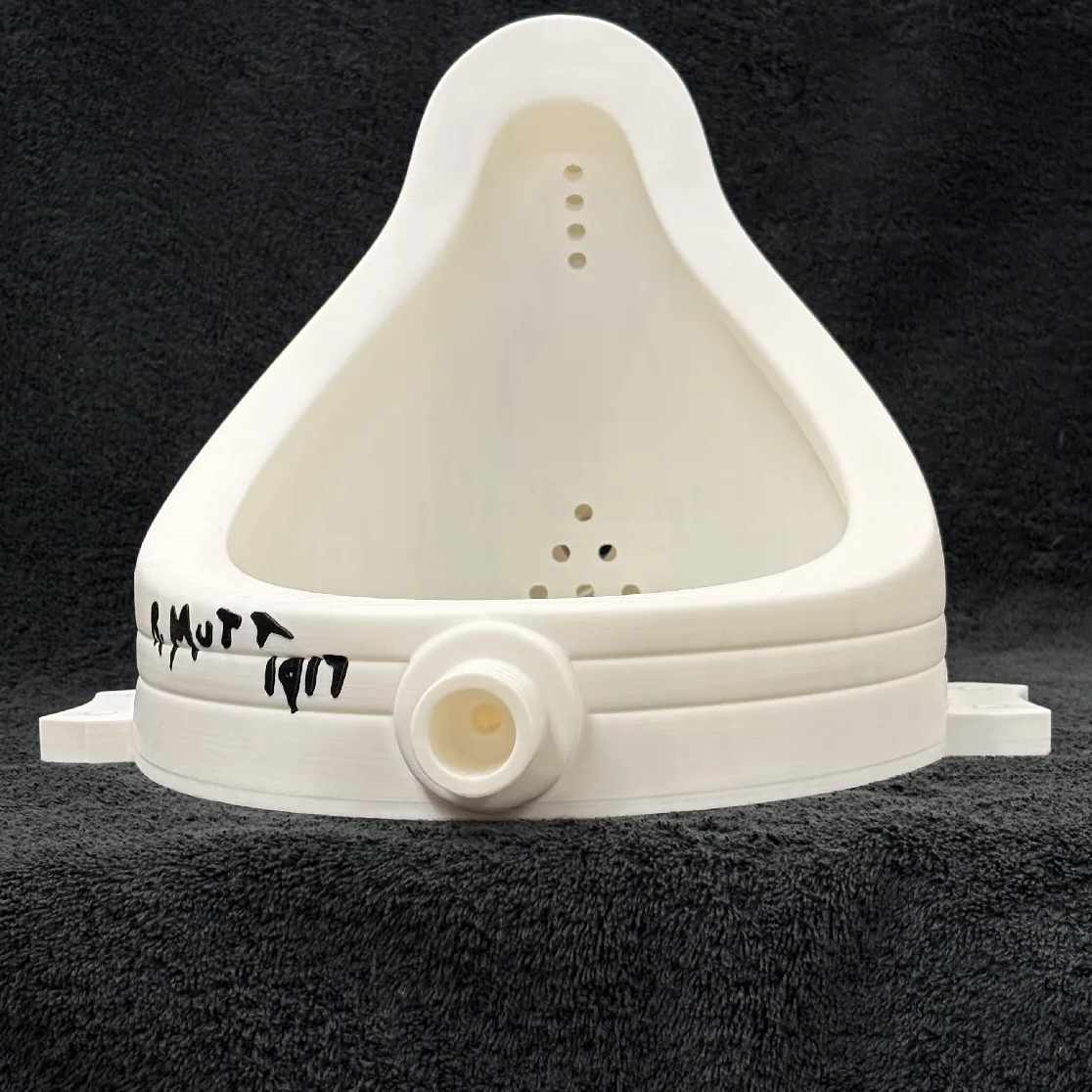
Part of Prêt à Faire, an independent transformative performance supported by Penn State Abington. CC BY-NC-SA 4.0.2
- Ocena
- 0 / 5
- Polubienia
- 2
- Pobrania
- 13
- Wydruki
- 0
- Wyświetlenia
- 91
- Oceny
- 0
Aktualizacja u źródła:
Informacje o modelu
- Źródło
- Printables
- Kategoria
- Sculptures
- Licencja
- Creative Commons — Attribution — Noncommercial — Share Alike
This open-access reference model is one of the collection Prêt à Faire: Printable Readymade Models. To explore the untextured, advanced geometric variants operating under a distinct commercial framework as part of this broader marketplace critique, view the premium tiers associated with this project:
1 | Concept & Provenance
This asset is an independent, transformative performance by williamCromar exploring distributed culture through the lens of public-domain source geometry. The historical referent—the 1916 "rectified" Readymade Peigne (Comb)—is famously tied to a precise timestamp of conceptual designation: 11 A.M. on February 17, 1916.
To facilitate an instructional research initiative supported by a faculty grant from Penn State Abington, I forensically reconstructed this structural geometry from the ground up utilizing public data points and historical archival documentation. While the historical 1916 original is preserved at the Philadelphia Museum of Art, this model archive independent study cross-references the public dimensional layouts of various mid-century editions, including the 1963 variation (Moderna Museet) and the 1964 Arturo Schwarz variant.
Explore the historical research context of this study at:
Historical references:
 Philadelphia Art Museum
|  Hirshorn Museum |
 Moderna Museet |  Private collection |
This project resolves complex material representation and mechanical tolerances within an additive manufacturing workflow, including the structural interaction between wood grain, polished metal surfaces, and felt elements. To achieve these surface characteristics, the baseline geometry implemented the BumpMesh utility. Material properties representing polished steel are achieved through precise localized ironing configurations mapped within the pre-configured 3MF files. The protective container housing also features a functional, print-in-place piano hinge mechanism, resolving complex print tolerances to investigate the intersection of digital fabrication and conceptual art objects.
Notably, art-historical research turns up no prominent or widely documented instances of contemporary artists directly appropriating the specific visual iconography of Peigne. This understated quality—where conceptual meaning stems primarily from text inscriptions and an attitude of aesthetic indifference rather than a resonant sculptural form—makes this Post-Appropriation digital study the first comprehensive critique of its kind.
2 | Scope & Scale
As a work of Post-Appropriation, this model is an independent digital manifestation optimized specifically for FDM fabrication, structural durability, and mechanical assembly. The geometry deliberately adapts historical visual motifs into a printable medium, celebrating the physical deviations required by the additive manufacturing process as part of the artwork's transformative expression:
It is designed to be printed at full historical scale.
Changing scale is not recommended, as it will compromise tolerances, bearing fits, and structural behavior.
As an intrinsically small work, this model architecture accommodates standard desktop manufacturing beds.
Advanced project participants wishing to experiment with the untextured multi-body baseline geometry can access these files via the separate commercial license framework of our premium subscription tiers.
3 | Printing Notes
File Formats
[Model_Name].3mf/.stl→ Best for quick printing. Pre-meshed at a high resolution, these files will slice exactly as they appear in the smooth website preview.[Model_Name].step→ Best for remixing and maximum quality. These files contain precise CAD data. Note: Ignore the blocky look in the online browser viewer; it will download and slice with perfectly smooth mathematical curves inside your slicer.
Printing Options
You have a couple of options: print the comb alone on a multi-material machine, or include the 1964 edition box.
For the comb geometry:
The 3MF version of the comb geometry contains a merged hidden box added in the slicer. The purpose of this box is to control the depth of the multi-material, which I found interfered with the incised lettering on the top.
For the best rendering of the comb geometry top, we print with the incised lettering DOWN, and iron the top layer, which will be the back of the comb geometry.
We selected the options for ONE perimeter at the top and bottom. This looks much better.
100% infill works well.
Playing with variable layer height may help with text legibility.
For the box:
Use a darker wood-based filament for the box top and bottom. Also set single perimeters for the top and bottom for a better look.
Use a brass color for the plaque, screw heads, and hinge elements. For the plaque, print the top infill with a Hilbert Curve and set ironing for the top layer only, which helps with text legibility. Set single perimeters for the top here.
All felt pieces are a saturated matte red.
Specify Organic support for the hinges. Don't say you haven't been warned.
Print assembly parts in the following quantities:
Plaque screws: Print 2
All other parts: Print 1 each
Recommended materials I used:
Prusament Galaxy Silver PLA or Polymaker Panchroma Metallic Silver PLA for the comb
Prusament Pearl White PLA blend for the comb lettering
Amolen Silk PLA Aged Brass for the plaque, screws, and piano hinge
SUNLU Bamboo Wood Fiber PLA for the box
SUNLU Matte Red PLA for the felt liner
My general settings:
Print Settings: 0.15mm Structural for a smooth perimeter finish on the comb, 0.2mm Structural elsewhere
Filament: Prusament PLA or Generic PLA
Supports: Paint-on as seen in the 3MF file
Infill: 15% for the box, 100% for the comb
Brim: None (they are pre-set for specific parts in the 3MF)
Stats for the print:
Total material used:
~17 grams silver
~3 grams white
~11 grams aged brass
~57 grams cherry wood
~78 grams matte red (due to the support necessary to achieve fuzzy skin)
Total time: ~20 hours
Total number of build plates: 4 (1 multi-material for the comb, 1 each for box materials)
4 | Assembly Notes
If you are making the box, use the exploded view rendering as a guide to assemble as follows:
Use super glue or Weld-On 16 gel for assembly. Be careful with glue quantity here: sloppy gluing will freeze the hinge or glue the box shut.
Insert the hinge axle into the piano hinge BEFORE assembly.
Glue the bottom hinge into its slot. The side felt assembly acts as a guide for this.
Glue the top hinge into its slot.
Place the screws into the plaque BEFORE gluing the plaque to the top, which in turn should be done BEFORE inserting the top felt.
5 | Presentation Notes
The box functions as a critical tactile threshold, prompting the spectator to pick up the physical work rather than perceive it as a traditional untouchable sculpture. Place the work on a pedestal or table environment that actively invites this haptic interaction, directly engaging with the historical philosophies of aesthetic indifference and anti-retinal art.
6 | Change Log
3 AUG 2026: Updated photographic documentation of the fully assembled physical prototype to illustrate completed component fits.
15 JUL 2026: Created a reference link to our untextured multi-body baseline geometric variations operating under a separate commercial license framework.
8 JUL 2026: Major architectural and file optimization updates:
Simplified the container housing architecture.
Replaced early slicing modifiers with an advanced, integrated displacement texturing path generated via the BumpMesh utility to optimize both the grain and material surface definitions.
Reconfigured all preconfigured 3MF plating layouts and advanced slicing parameters.
Revised technical documentation to align with these file optimizations.
24 NOV 2025: Revised project documentation for layout clarity and consistent formatting across the Prêt à Faire collection.
19 NOV 2025: Completed final multi-material fabrication tests:
Segmented the container housing lid to isolate the inscription plaque component, optimizing the application of grain texturing parameters across the primary container volumes.
Added a technical exploded-view diagram to document structural assembly pathways.
Integrated an advanced 3MF layout encoding precise coordinate positions, surface texturing boundaries, and customized ironing paths. This slicing profile maps single-material paths across distinct component layers to accommodate standard desktop configurations.
1 NOV 2025: Mechanical tolerance revisions: Engineered an alternate printed hinge axle component to resolve material deflection observed when utilizing raw filament stock as a hinge. The component maintains a 1.75 mm dimensional diameter to allow for mechanical substitution based on user setup constraints. Updated technical guidelines and uploaded photographic documentation of baseline structural fit tests fabricated in white PLA.
26 OCT 2025: Architectural refinements following physical prototyping:
Redesigned the integrated hinge geometry based on mechanical profiles validated during the development of Model of Marcel Duchamp’s Fresh Widow by williamCromar.
Recalibrated clearance thresholds on the container base and lid interfaces to clear the updated hinge assembly.
Swapped the historical plaque typography for an optimized sans-serif profile to ensure legibility during layer-by-layer deposition, implementing a targeted top-layer ironing path.
Resized structural screw heads to 1.5X scale to ensure slicing stability, and increased the vertical thickness of the material boundary layers representing felt elements to maintain structural integrity.
19 OCT 2025: The felt-lined box is now included. It has not been print prototyped yet but I will be doing so later this week and will report on this, including preferred print settings (for example, printing all visible felt surfaces with fuzzy skin…).
4 OCT 2025: Tested new slicing adjustments to make the small text more readable. I got great results by switching the top and bottom infill to the Hilbert Curve pattern. It takes a lot longer to print but leaves a really interesting texture, especially when paired with a tuned ironing pass on the top layer.
18 AUG 2025: Ran the first test prints on a Prusa XL 5T and uploaded the photos. The fits are good, but the overall look isn't as clean as I'd like due to the low-quality filament I had on hand. I’ll be testing different brands, infill patterns, and ironing settings to dial in the look.
Disclaimer
Prêt à Faire is an autonomous artistic project, scholarly reference work, and institutional critique by williamCromar, supported by a faculty grant from Penn State Abington with fabrication assistance from the Abington MakerSpace. This project is entirely independent and maintains no formal affiliation, endorsement, or sponsorship with Association Marcel Duchamp, the Estate of Marcel Duchamp, ARS, ADAGP, or any curating museum. When referencing or sharing this work, users must maintain a clear distinction in authorship and nomenclature from the historical referent. Cite this asset as: Model of Marcel Duchamp’s [Object Name] by williamCromar. Basic models are available under a CC BY-NC-SA 4.0 license; premium tiers operate under a separate commercial framework. For full conceptual and legal text, visit https://sites.psu.edu/pretafaire/disclaimer-and-licensing/