
Model of Marcel Duchamp's Trebuchet (Trap) by williamCromar
Obliczymy ostateczną cenę na podstawie wybranego pliku. Sprawdzisz ją i zaakceptujesz przed płatnością.
Zapisane na tym urządzeniu.
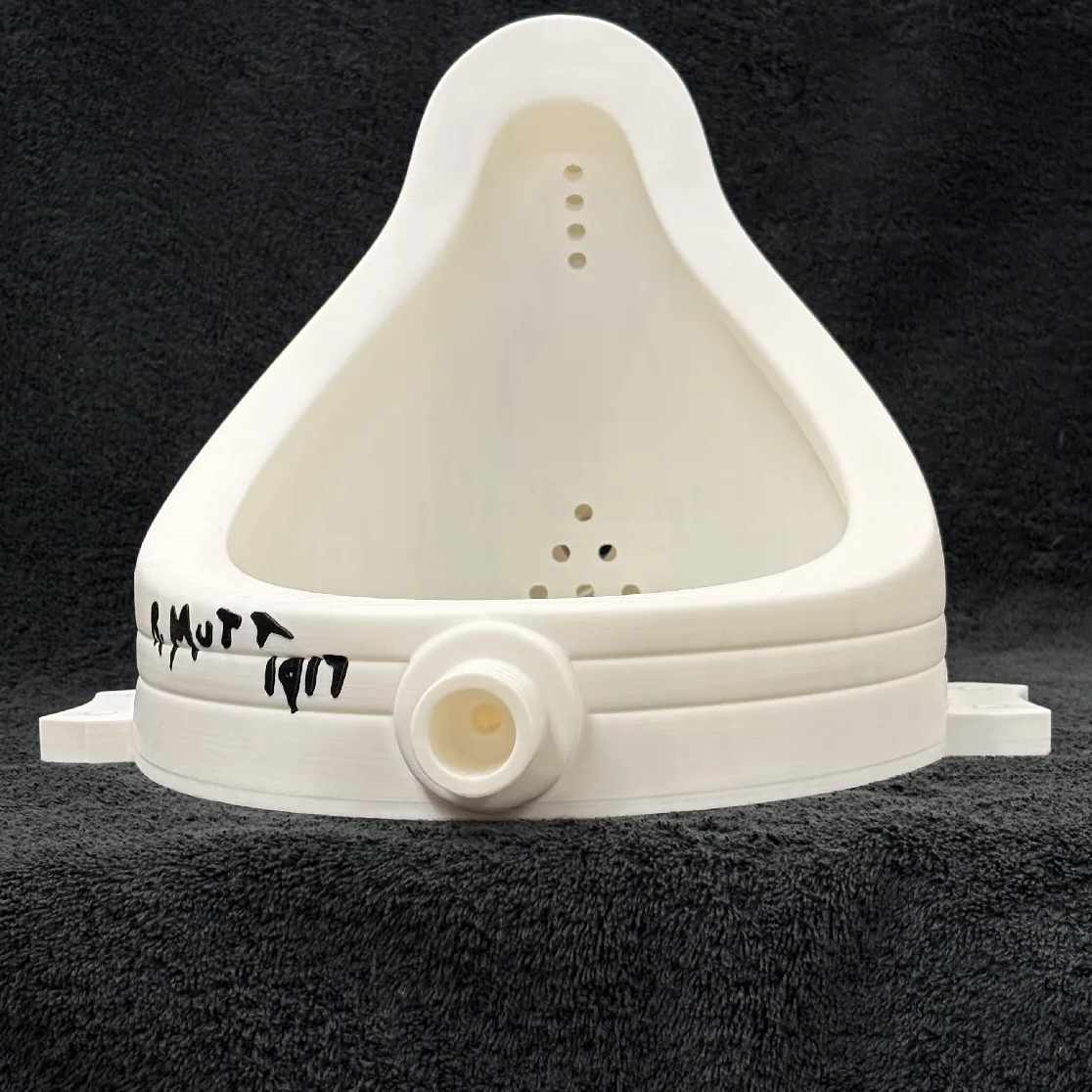
Part of Prêt à Faire, an independent transformative performance supported by Penn State Abington. CC BY-NC-SA 4.0.
- Ocena
- 0 / 5
- Polubienia
- 3
- Pobrania
- 11
- Wydruki
- 0
- Wyświetlenia
- 115
- Oceny
- 0
Aktualizacja u źródła:
Informacje o modelu
- Źródło
- Printables
- Kategoria
- Sculptures
- Licencja
- Creative Commons — Attribution — Noncommercial — Share Alike
This open-access reference model is one in the collection Prêt à Faire: Printable Readymade Models. To explore the untextured, advanced geometric variants operating under a separate commercial license framework as part of this broader marketplace critique, view the premium tiers associated with this project:
1 | Concept & Provenance
This asset is an independent, transformative performance by williamCromar exploring distributed culture through the lens of public-domain source geometry. The historical referent—the 1917 Readymade Trebuchet (also known as Trap)—consisted of a common coat rack fixed to a studio floor. The title directly references a chess strategy, a game Duchamp played obsessively.
To support an instructional research initiative funded by a faculty grant from Penn State Abington, I modeled this geometry from the ground up using public historical data and architectural research. Because the 1917 original was lost, subsequent mid-century museum editions utilized highly abstracted hook shapes that look stamped rather than cast. However, my research into era-appropriate architectural salvage revealed that the original hook was a very common casting. For this digital study, I chose to forensically model my geometry based on those common public-domain salvage forms rather than copying the later mid-century museum reproductions.
Explore the historical research context of this study at:
 Detail of a photo of Marcel Duchamp's NYC studio, 1917  Image enhancement by Rhonda Roland Shearer |  Paris, Pompidou Center, 1964 edition |  Salvage hardware from the same era as the original |
2 | Printing Notes
Printing this model is a straightforward process. You can check the uploaded images for my recommended printing orientations. The hooks will need slicing supports, and I highly recommend using organic style supports.
The models are drawn at full historical size and can be scaled down in your slicer. On a large-format bed like the Prusa XL, you can print anywhere from 100% full scale down to 50%. For standard desktop printers (MK3/MK4), it can be scaled as small as 25%, though I don't recommend going any smaller than that to protect the tolerances.
For the full-size print featured in the photos, I used a clever slicing trick: I split the wood board element right in the slicer to hide the interlocking inverse dovetail joint directly behind the mounted hooks. In this current file version, I used the open-source BumpMesh utility by CNC Kitchen to apply a clean wood texture map, replacing my older manual slicing modifiers. The legacy untextured file configurations are preserved for Club members researching custom material texturing workflows.
Recommended materials:
SUNLU Wood Fiber PLA for the board
Prusament Galaxy Black PLA for the hooks
My general settings:
Print Settings: 0.2mm Structural
Filament: Generic PLA or Prusament PLA as appropriate
Printer: Prusa MK4 or Prusa XL as appropriate
Supports: Everywhere (for the hooks)
Infill: 10% for the wood, 100% for the hooks
Brim: None
Advanced settings:
Layers and perimeters: all defaults
Infill: Gyroid fill pattern, Concentric top and bottom fill pattern
Support material: Organic
Stats for the full-scale print:
Total material used:
~221 grams for wood
~64 grams for black
Total time: ~17 hours 30 minutes
Total number of build plates: 2
3 | Assembly Notes
If using the hidden seam board model as described above, give the joint a careful, level sanding, then bind together with adhesive.
Align the slots on the rear of each hook with the tabs on the board, affixing with a fast-drying super glue.
4 | Presentation Notes
With the Readymades, context is everything. The historical referent was famously fastened directly to the floor to disrupt its original everyday function. For a full-scale print, a similar floor placement is perfect. If you print a smaller-scale version, just be careful nobody steps on it! Either way, the work should be oriented so the hooks lift out of a flat, horizontal board in a way that definitely doesn't suggest hanging up a coat.
5 | Change Log
3 AUG 2026: Added images of the fully assembled final print.
25 JUL 2026: Fixed a minor geometry bug in the hook STEP file.
15 JUL 2026: Major file updates:
Higher resolution STL and STEP files
Remodeled wood base using the BumpMesh texture path
Improved the preconfigured 3MF plating layout
Added a reference link to the untextured files in our commercial critique tier
Text formatting and revision
17 DEC 2025: Added a specialized 3MF file with a split board layout to create a hidden assembly seam for full-scale prints.
9 DEC 2025: Cleaned up the description text for better formatting across the Prêt à Faire collection and added photos of a full-size prototype using manual wood modifiers.
8 OCT 2025: Ran initial test prints in white PLA to check the component fits, and the tolerances look great. Added a photo of the test print.
Disclaimer
Prêt à Faire is an autonomous artistic project, scholarly reference work, and institutional critique by williamCromar, supported by a faculty grant from Penn State Abington with fabrication assistance from the Abington MakerSpace. This project is entirely independent and maintains no formal affiliation, endorsement, or sponsorship with Association Marcel Duchamp, the Estate of Marcel Duchamp, ARS, ADAGP, or any curating museum. When referencing or sharing this work, users must maintain a clear distinction in authorship and nomenclature from the historical referent. Cite this asset as: Model of Marcel Duchamp’s [Object Name] by williamCromar. Basic models are available under a CC BY-NC-SA 4.0 license; premium tiers operate under a separate commercial framework. For full conceptual and legal text, visit https://sites.psu.edu/pretafaire/disclaimer-and-licensing/