
Full Size Acoustic Violin
Obliczymy ostateczną cenę na podstawie wybranego pliku. Sprawdzisz ją i zaakceptujesz przed płatnością.
Zapisane na tym urządzeniu.
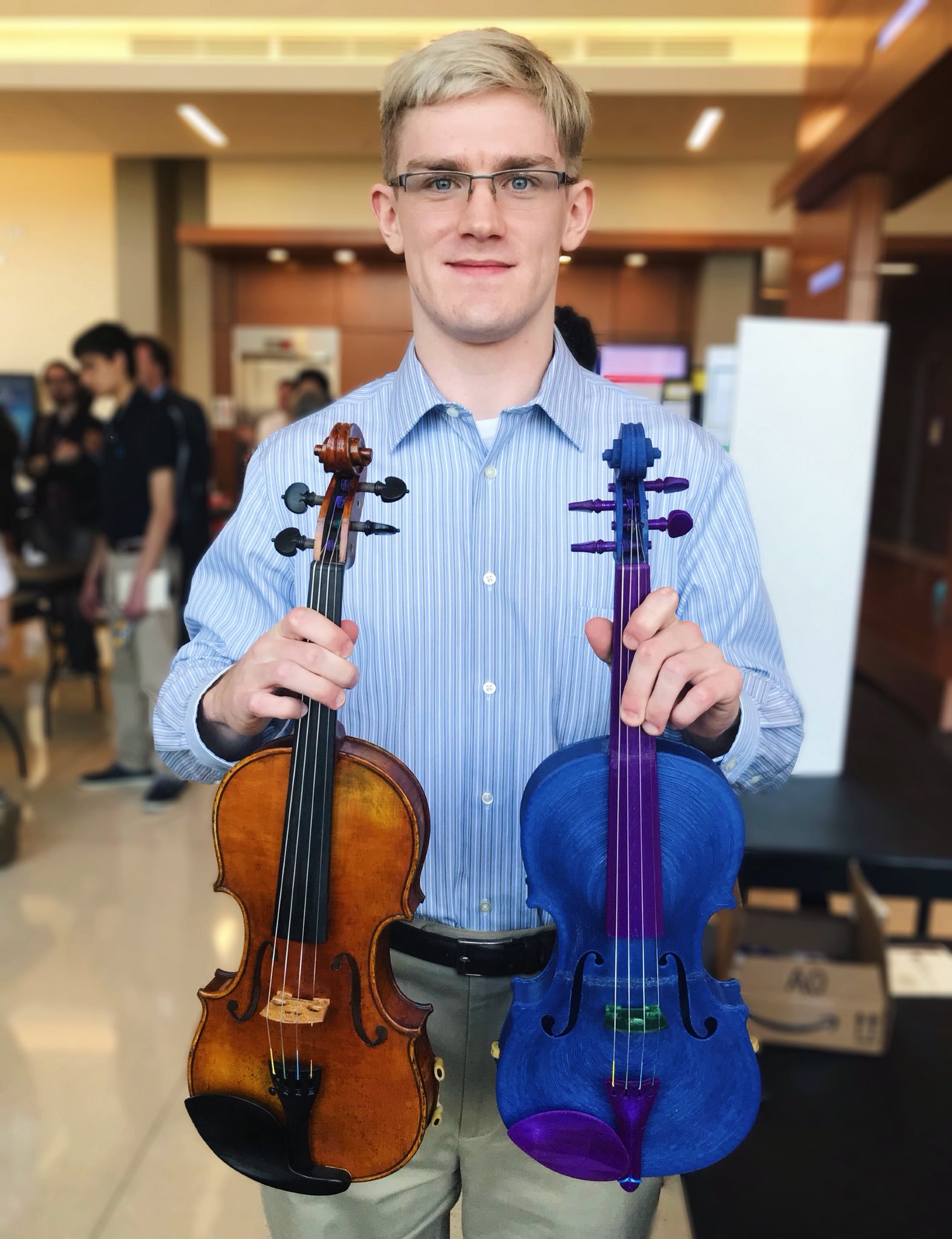
Notice: Please read this text carefully this is not a simple project, and it is possible to hurt yourself making this.…
- Ocena
- 0 / 5
- Polubienia
- 150
- Pobrania
- 806
- Wydruki
- 0
- Wyświetlenia
- 5869
- Oceny
- 0
Aktualizacja u źródła:
Informacje o modelu
- Źródło
- Printables
- Kategoria
- Music
- Licencja
- Creative Commons — Attribution — Share Alike
Notice: Please read this text carefully this is not a simple project, and it is possible to hurt yourself making this. Please wear safety goggles while tightening and tuning for the first time, or do not hold the violin up by your face. A mouth guard wouldn't hurt either. While I personally haven't encountered problems, we all know 3D printed parts are not 100% reliable. Even though probably nothing will happen, if something does, you'll wish you had taken precaution. Violin strings can hold around 80 lbs of force. If the neck were to snap, it will hit pretty hard.
Read about its construction and material analysis here
The link from the source/remix to original files has been broken. For the sake of preserving history, I'll relink the original source.
Added back unsplit neck and scroll after requests.
The scale between these files and their originals is 18500%
I've turned off the "work in progress" since everything I can think of is done, but I still might make minor changes. I'll have a longer video ~~in a few months~~eventually going into more depth about the violin. Maybe I'll make improvements to this a summer project.
Added a sound-post and bass-board. Used real strings. Bridge was thickened and shrunk to accommodate the neck height. Tail Piece needs thickening. Other pieces have been modified to accommodate stresses or proportions.
Used roughly 1.5 kg of plastic, although I don't know the total weight. Some parts like the sound-post and bridge may need scaling in one direction depending on how your violin turns out. I wish things could be more exact and repeatable, but this isn't a perfect violin. I don't recommend wood-fill, silk, or other irregular plastics. They usually have weaker mechanical properties, although they may still work.
Print Settings
Printer Brand:
Prusa
Printer:
i3 MK2S
Rafts:
No
Supports:
Yes
Resolution:
0.15 mm layer heights
Infill:
20%
Filament: Maker Geeks PLA
Notes:
I would guess that softer plastics like ABS would cause more sound dampening. A lighter and stiffer a material is, it is likely to sound better. Although less material is better, violins are under 50-80 lbs of stress from the strings, so it's a tough trade-off.
I print my PLA at 230 C.
Took about 3 days worth of print time, and 1 full day to assemble.
If you can, print the body-plates vertically. The current orientation is stronger, but also is worse for vibration.
Post-Printing
This is the method I originally used, although I do not believe it is the best. I put pieces into position with super-glue and clamps, then welded parts together with a soldering iron for stronger bonds. I would use extra lines of filament as needed. Better to have too much that have a snap.Beware of toxic gases when burning super-glue, it will burn your eyes and lungs. Use a respirator and sealed goggles. Tuning pegs were drilled to put the string through. I need to go see what size I used, and approximately where to drill. If you look up pictures online, you can get a pretty good rough guess.
I now believe it would be better to skip the super glue. There are better adhesives in the form of solvents. Things like Weld-On 3/4, or 3D Gloop will give cleaner and stronger bonds (Almost pure PLA). Melting with an ironmay not be necessary anymore, but I haven't actually verified this.
The tail piece has a hole drilled through it and uses a copper wire to stay on the nipple.
Category: Music