
Interlocking Penrose Voronoi Cobblestones
Obliczymy ostateczną cenę na podstawie wybranego pliku. Sprawdzisz ją i zaakceptujesz przed płatnością.
Zapisane na tym urządzeniu.
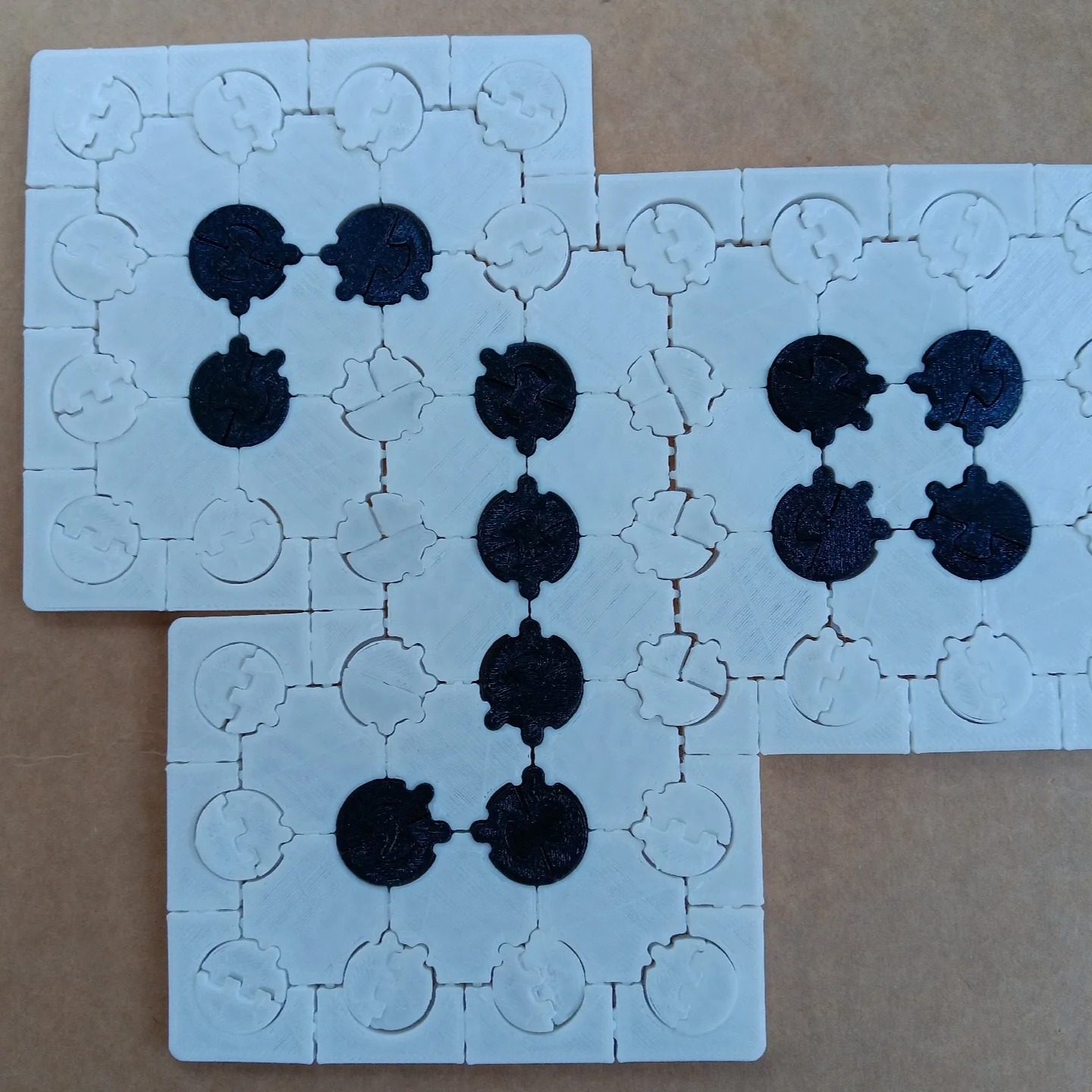
A set of seven interlocking tiles with filleted edges to assemble into aperiodic designs resembling a stone patio.
- Ocena
- 0 / 5
- Polubienia
- 7
- Pobrania
- 11
- Wydruki
- 0
- Wyświetlenia
- 116
- Oceny
- 0
Aktualizacja u źródła:
Informacje o modelu
- Źródło
- Printables
- Kategoria
- Math
- Licencja
- Creative Commons — Attribution — Share Alike
These tiles are based on the seven unique polygon cells of the Voronoi diagram of a Penrose rhomb tiling. See my previous design for more explanation.
My goal is not primarily a mathematical puzzle, but a fun (I hope) way to plan decorative designs. You could scale these up to patio blocks and produce an attractive design without anyone necessarily caring how you came up with the shapes for the blocks. Voronoi cells already give it an organic look, suggesting an aperiodic honeycomb.
The tiles fit together with T-shaped shaped tabs. I made no attempt to enforce Penrose aperiodicity. There are only two slotted pieces corresponding to the placement of kites and darts. All other pieces must connect around them. The tops are filleted to give the appearance of a decorative tiling.
The large pieces are roughly 2cm in width, 4.4mm in height. They have 0.2mm margins around tabs and slots, which should be enough for most filaments. These turned out fairly loose in the filament I was using, so I added an interior layer on slots without the margin for a snap fit.
There are both "snap" and "loose" variants. A loose assembly will hold together on a table top but is not liftable, and it can be frustrating when you have to slip new tiles under ones already place. The PLA filament I used for the initial design was eSun PLA basic white, which had an especially loose fit. You may need to experiment.
The scaled down (small) set is 2.8mm in height. It is not reduced uniformly. The layers are adjusted to fit 0.2mm increments for predictable 3D printing. This preview from Flashprint may help to illustrate. The large pieces are 22 layers with a 2 layer snap fit, and the small ones are 14 layers with a 1 layer snap fit.

Here's an illustration of how these shapes result from a Penrose tiling:
