
7-color satellite world map - lithophane lamp
Obliczymy ostateczną cenę na podstawie wybranego pliku. Sprawdzisz ją i zaakceptujesz przed płatnością.
Zapisane na tym urządzeniu.

A 7-color spherical lithophane of a satellite world map, specifically designed for Bondtech INDX.
- Ocena
- 0 / 5
- Polubienia
- 20
- Pobrania
- 23
- Wydruki
- 0
- Wyświetlenia
- 281
- Oceny
- 0
Aktualizacja u źródła:
Informacje o modelu
- Źródło
- Printables
- Kategoria
- Physics & Astronomy
- Licencja
- Creative Commons — Attribution
A 7-color spherical lithophane of a satellite world map, specifically designed for Bondtech INDX. Thickness encodes topographic shading, while filament color separates satellite image colors. These files are generated using original Python code.

Disclaimer
This is an experimental model. I have not printed it myself yet, as I do not currently own an INDX printer. However, the model has been successfully printed by Tommy from Prusa, so the geometry is printable. The second image is a photo of the print, provided by Tommy.
Thickness and print settings
Filament translucency varies significantly between colors, materials, and manufacturers. I tested 35 different Prusament PLA and Buddy PLA filaments using calibration panels. I attached a PDF containing the recommended thickness range for each tested filament.

I found four ranges to work well with most filaments:
0.6–2.0 mm
0.8–2.4 mm
0.8–2.8 mm
1.0–3.2 mm
The 7-color satellite world map is available in each of those thickness ranges. For each filament, choose a range where the thinnest areas appear very bright with your intended lamp, while the thickest areas block most of the light and appear nearly black. Different thickness versions can be combined within one print, so each color can use the range that works best for that specific filament.
Recommended colors are: cyan and dark blue for the sea, green and dark green for humid areas, sand brown and dark brown to olive green for arid areas and white for poles and glaciers
I strongly recommend printing a calibration panel for every color before starting the full model. You can also print the flat 7-color test model to preview the final color and brightness balance. There is no specific test model for the satellite world map (yet). Instead, you can use the flat test print intended for the satellite world map.
Recommended print settings:
Print in PLA or PLA+
Recommended layer height: 0.15 mm - 0.20 mm
Use the Arachne Perimeter Generator for more precise perimeter widths
If you use Arachne, set the minimum line width to 75% to avoid holes!
Set wall count to >15 to obtain a solid lamp
Set number of top layers to 10
Set seam position to aligned
Use an outer brim with a width of at least 10mm for both, print and prime tower
No Support required! The lamps print perfectly fine without support. Since you have one additional toolhead available, it may be a good idea to experiment with PETG supports, though.
This is a long multi-material print with many filament changes. Clean the build plate carefully, use a high-adhesion build surface, and apply adhesive if needed.
This is not a SpeedBoatRace print! Use conservative print speed settings to avoid artefacts! It's totally fine if your print takes one or two days to finish.
Lamp bases
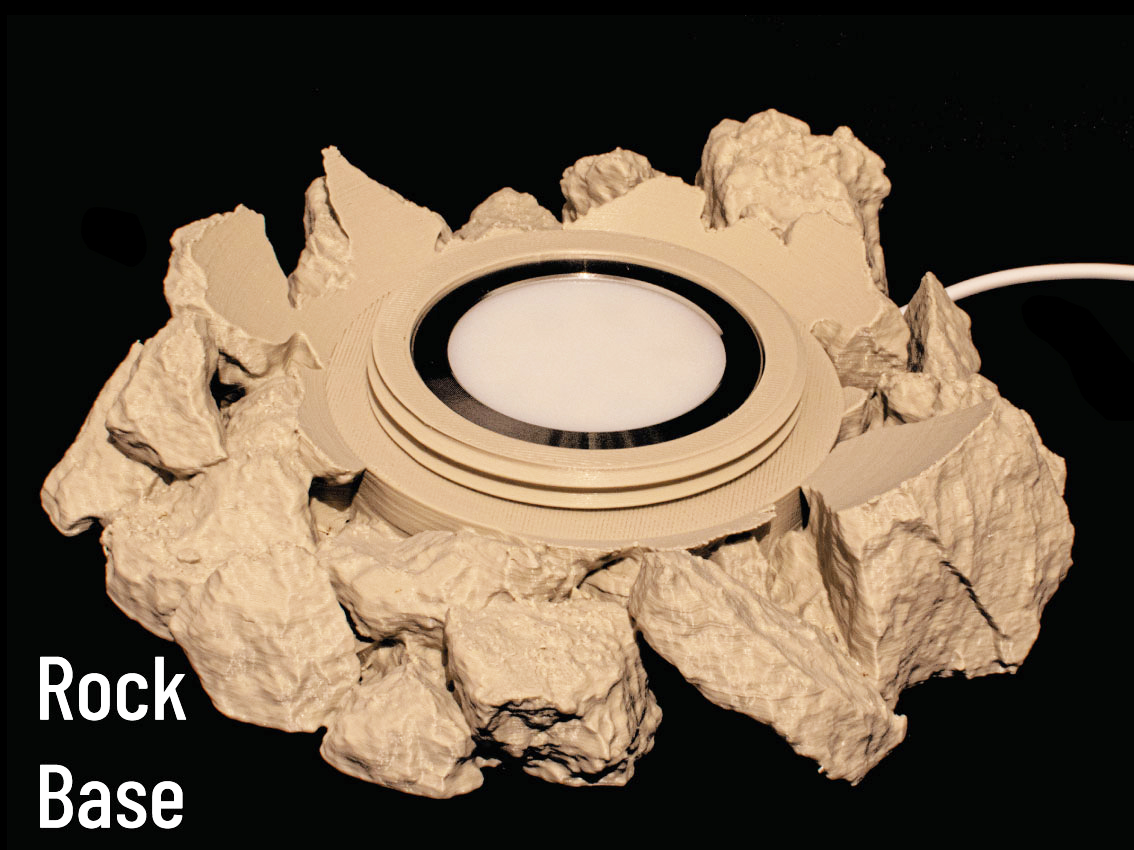
After printing your multi-color lithophane, you'll also need a Lamp Base to illuminate it. I am providing several different Lamp Bases, all with a M75x4 thread .

Some lamp bases may use snap-off support. The supports look like small ring segments, tabs or cylinders that should be removable with very little force and should leave you with a good surface. They are only tested with PLA/PLA+ filament. Using other filaments may make support removal more difficult. Also your layer height should not exceed 0.2mm as this is the separation distance of the support objects.
E14/E27 Puck Base | |||||||||||||||||||||
 |  | ||||||||||||||||||||
A
| |||||||||||||||||||||




Remixing and code sharing
Remixes are always welcome, I'm happy to provide additional resources if needed, just message me. The current version of the python code used to create these lamps is a hot mess which is why it is not (yet) published. Upon request, I'm also happy to share my code.
Acknowledgements
Tommy from Prusa3D for printing the first prototype
ratmole for their 3DSolarLithophane code I partly used as a basis for my own code
The QuickSilver for the idea to add a thread to the spherical lithophane lamps
The NASA earth observatory program for providing the images I used for the lithophane creation
Other models
If you are interested in Lithophane lamps, consider checking out my other models. Click the links below for the respective models or check my profile.


