
2 DOF Fully Compliant Space Pointing Mechanism
Obliczymy ostateczną cenę na podstawie wybranego pliku. Sprawdzisz ją i zaakceptujesz przed płatnością.
Zapisane na tym urządzeniu.

This two degree-of-freedom pointer device uses compliant mechanism technology to obtain its motion.
- Ocena
- 5 / 5
- Polubienia
- 105
- Pobrania
- 704
- Wydruki
- 5
- Wyświetlenia
- 5136
- Oceny
- 4
Aktualizacja u źródła:
Informacje o modelu
- Źródło
- Printables
- Kategoria
- Engineering
- Licencja
- Creative Commons — Attribution
Summary
This two degree-of-freedom pointer device uses compliant mechanism technology to obtain its motion. It was developed by the BYU Compliant Mechanisms Research group (compliantmechanisms.byu.edu), under a grant from NASA.
3 versions of the device are included: the original file used in the metal prototype, and two modified versions for FDM printing with an improved output connection (one has thicker flexures for easier printing). The improved output connection measures 0.55x0.6" and has a 0.25" hole. This hole fits a 1/4"-20 bolt nicely (this is the same bolt used for tripod mounts), including a hex indentation on the bottom of the device. The adjuster knobs are 0.25" hexagons, measured across to the other parallel side.
Printing
This mechanism was designed to be manufactured on a metal laser sintering 3D printer. We have made slight modifications to the STL files so that they are more suitable for fused-deposition and stereolithography 3D printers.
Because the flexures are long and thin, we've had some issues getting all of them to print correctly. The best settings we've found are 0.20mm layer height and default supports. If you find a method (supports, brim, etc) that consistently works well, leave a comment below and we'll update this section.
Applications
The motion comes from the deflection of 2 main flexure types: cross-axis flexural pivots and a split-tube flexure.
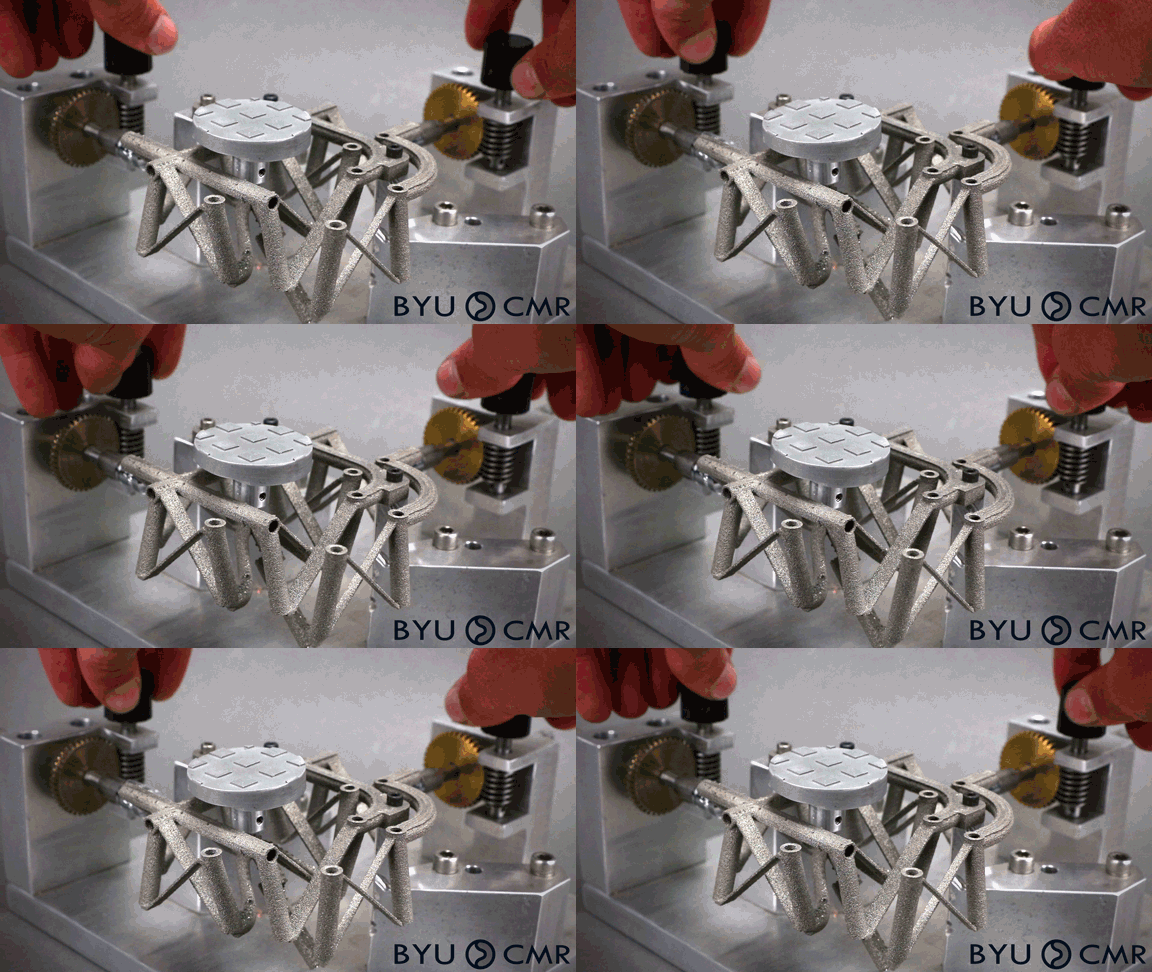
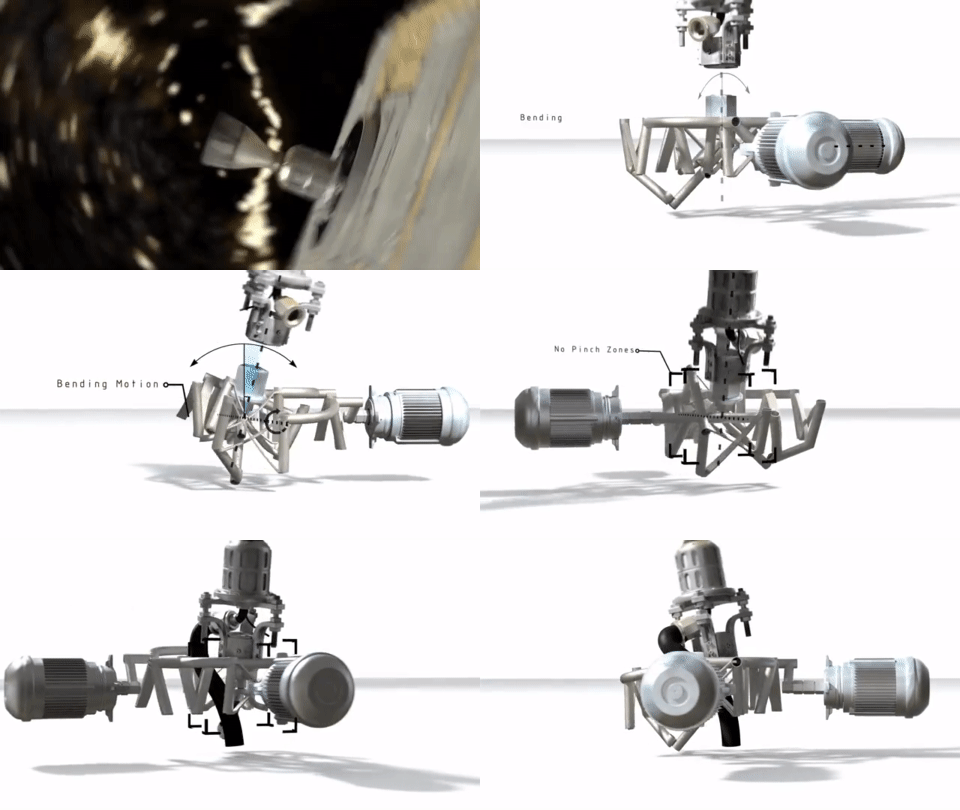
The mechanism could be used for many applications, including for pointing an antenna or for a thruster (see the videos below).
Learn More
Follow us at @byucmr on Instagram or learn more about compliant mechanisms by visiting cmr.byu.edu.
Compliant Mechanisms are specifically useful for space applications because they have reduced part count, they provide precision motion, and they don't require lubrication. Learn more at www.compliantmechanisms.byu.edu/about-compliant-mechanisms.
Technical Information
For in-depth technical information, see the following publication:
Merriam, E.G., Jones, J.E., Magleby, S.P., and Howell, L.L., “Monolithic 2 DOF Fully Compliant Space Pointing Mechanism,” Mechanical Sciences, DOI:10.5194/ms-4-381-2013, V. 4, pp. 381-390, 2013.
To learn more about compliant mechanisms in general, see the BYU Compliant Mechanisms Research (CMR) website or these books: Compliant Mechanisms, Handbook of Compliant Mechanisms