
Model of Marcel Duchamp's Apolinère Enameled by williamCromar (Impossible Bed Edition)
We calculate the final price from your selected file. You review and accept it before payment.
Saved on this device.
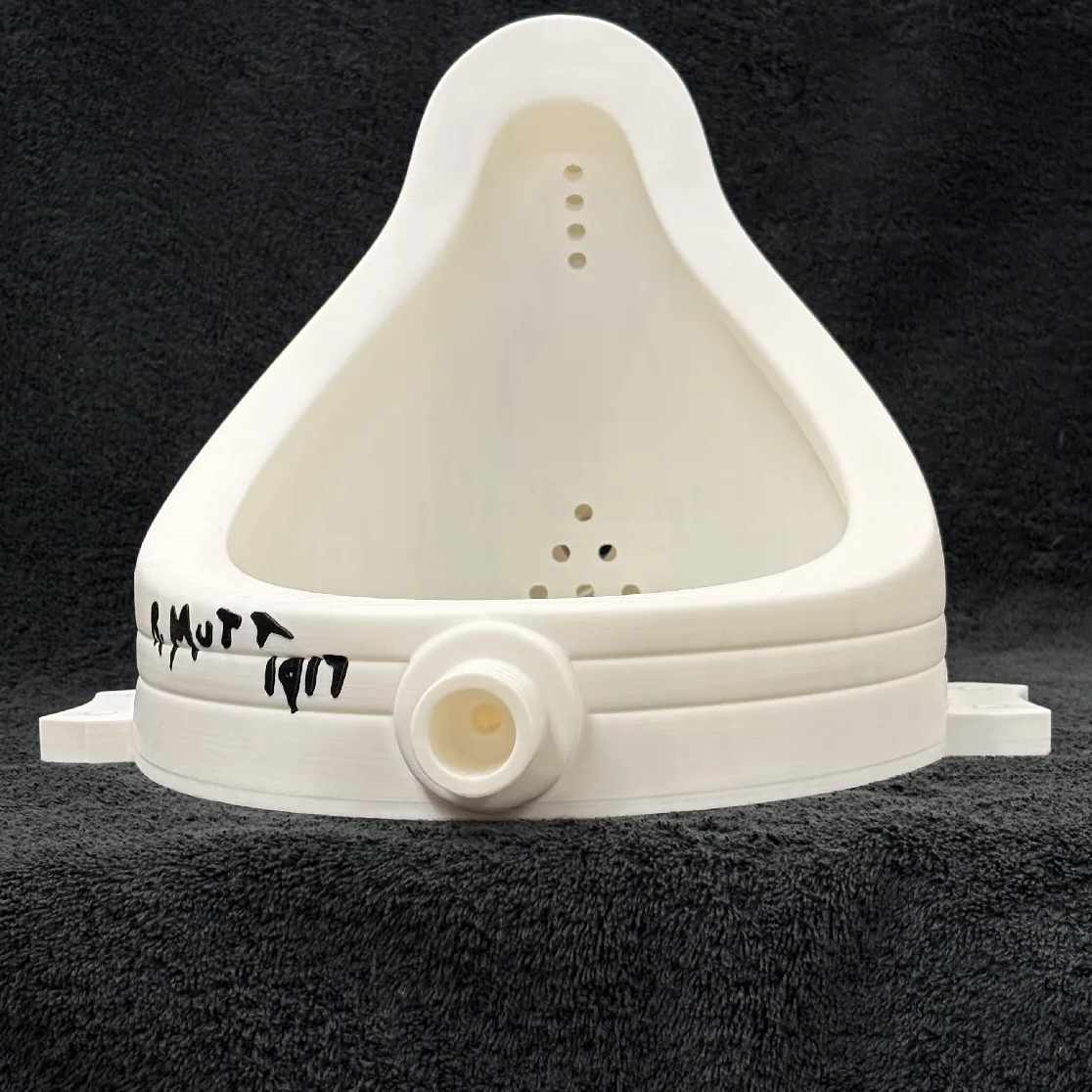
Part of Prêt à Faire, an independent transformative performance supported by Penn State Abington. CC BY-NC-SA 4.0.
- Rating
- 0 / 5
- Likes
- 2
- Downloads
- 11
- Makes
- 0
- Views
- 79
- Reviews
- 0
Updated at source:
Model information
- Source
- Printables
- Category
- Sculptures
- License
- Creative Commons — Attribution — Noncommercial — Share Alike
This open-access reference model is one in the collection Prêt à Faire: Printable Readymade Models. To explore full-scale geometric variations or untextured component archives operating under a separate commercial license framework as part of this broader marketplace critique, view the premium tiers associated with the collection. In the case of this model, there is no absolute scale, so no full-scale version is available (unless you want to experiment with the parts at 100% size, theoretically possible with some clever slicing, but a bit impractical!)
ABOUT THE ORIGINAL
This asset is an independent, transformative performance by williamCromar exploring distributed culture through the lens of public-domain source geometry. The historical referent—the 1916–17 assisted Readymade Apolinère Enameled—was constructed by adding paint, graphite, and structural backing to a common enameled tin advertisement for Sapolin industrial paint. The manipulated text features a phonetic pun on the name of poet Guillaume Apollinaire.
To support an instructional research initiative funded by a faculty grant from Penn State Abington, I forensically modeled this geometry from the ground up using public historical data. The original sign layout exploits an accidental optical illusion created by early industrial stamping processes. The central bed form in the original sign lacks a side rail because the stamped bas-relief technique could not resolve the subtle overlapping lines behind the footboard slats. This technical limitation created an impossible perspective. Rhonda Roland Shearer’s essay provides a detailed analysis of this optical conundrum that Duchamp so evidently appreciated.
Explore the historical research context of this study at:
Sample images:
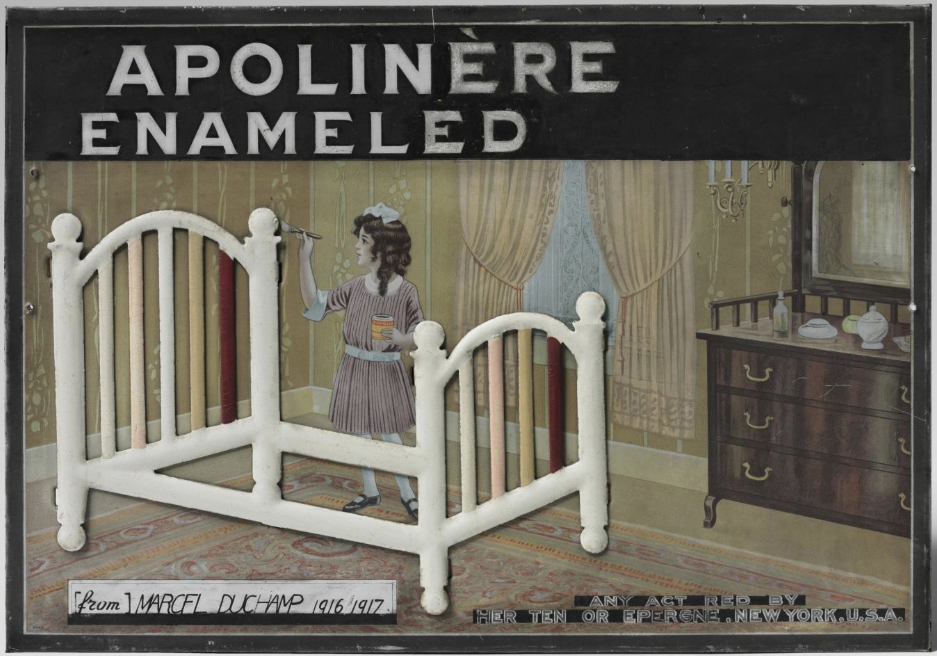 Philadelphia Museum of Art |  The Israel Museum | 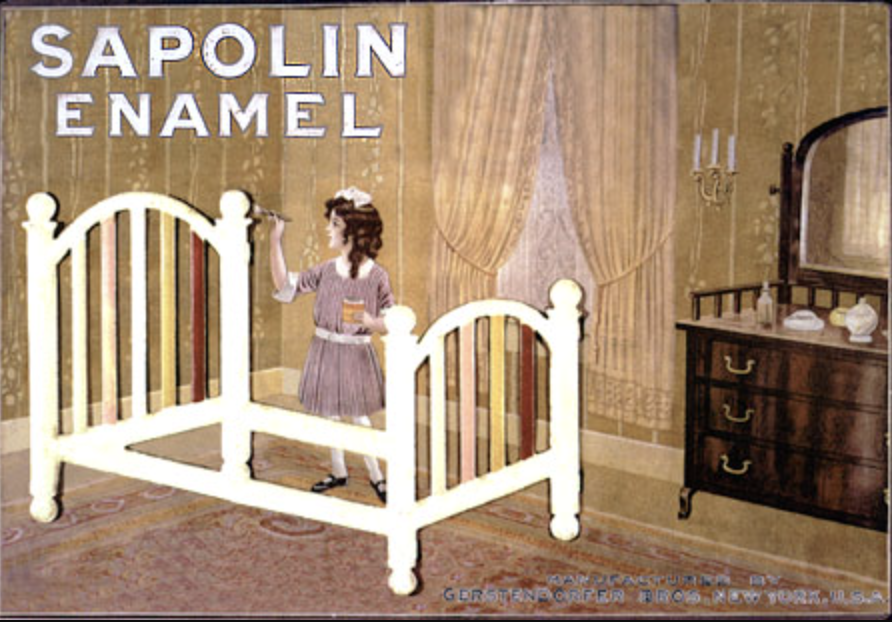 Rhonda Roland Shearer's perspective models |
My initial design direction attempted an optical translation similar to my lithophane work, similar to the L.H.O.O.Q. critique, but the results were underwhelming. I determined the most effective transformative approach was to isolate the sign's perspective distortion and digitally construct the "Impossible Bed" for fabrication as a multi-dimensional interpretation.
Other contemporary practitioners have engaged with this specific visual motif, including Sherrie Levine, John Baldessari, and Luca Maria Patella (who constructed contrasting "correct" and "erroneous" physical interpretations). My digital analysis adds a new observation to this scholarly lineage: the apparent "flaws" in the sign’s historical perspective can be mathematically attributed to structural friction between between perspective and orthographic projection methods. The uploaded CAD software screenshots illustrate this forensic development process.
 Sherrie Levine, |  Luca Maria Patella, Right Bed and Wrong Bed, 1983-5 |  John Baldessari, Double Bill: ...And Duchamp, 2012 |
PRINTING NOTES
As a work of Post-Appropriation, this model is an independent digital manifestation optimized specifically for FDM fabrication, structural durability, and scale variance. The geometry deliberately adapts historical visual motifs into a printable medium, celebrating physical deviations as part of the artwork's transformative expression.
The source files are drawn at full historical size and must be scaled within your slicer. Early prototyping loops revealed that vertical boundary bars required structural thickening to maintain stability during deposition at lower scale thresholds (such as 10% or 25% scale volumes). This listing incorporates preconfigured 3MF multi-material plating files alongside isolated component folders ("Iteration 2") configured for multi-part assembly to ensure predictable results across standard printing systems.
Recommended materials:
Creality White Hyper PLA
Atomic Filament Light Gray PLA
Cookiecad Pale Pink PLA
Cookiecad Pale Yellow PLA
Hatchbox Dark Red Pro PLA
My general settings:
Print Settings: 0.2mm Structural
Filament: PLA with appropriate profiles for the abovementioned materials
Printer: Prusa XL (for an up to 25% scale model) or MK4/MK3 (for up to 10%)
Supports: Paint-on as appropriate
Infill: 15%
Brim: On the handle only
Advanced settings:
Layers and perimeters: All defaults
Infill: Gyroid fill pattern, Aligned Rectangular top and bottom fill pattern
Support material: Organic style
Special notes:
Create a custom Concentric top and bottom infill pattern for the columns, which should be printed upright using Organic support.
If printing a 25% scale print on a Prusa XL, it takes some fiddling, but you CAN fit the long rails along the diagonal. See the last image in the illustrations above.
Stats for a 25% print on a Prusa XL:
Total material used: ~518 grams white, ~20 grams light gray, ~21 grams pink, ~20 grams yellow, ~17 grams maroon
Total time: ~31.5 hours
Total number of build plates: 2 to 6 - the colored boards can print without multi-material by placing them on a separate build plate for their specific color.
ASSEMBLY NOTES
I've deliberately created off-center and/or uniquely sized tabs and slots to assist with orientation during assembly. Use the illustrations as a guide when positioning elements to glue.
Glue must be used. I recommend Gloop for PLA, but standard-issue super glue probably works.
PRESENTATION NOTES
The assembled physical manifestation incorporates a privileged point of view from which the spectator experiences the unified perspective illusion documented in the historical original work. As an observer shifts position around the pedestal, the spatial illusion breaks down, revealing an almost Cubist articulation of physical space from the opposite vantage point. Place the work on a table or pedestal at an eye level that invites spectators to navigate the full 360-degree environment. Integrating the optional "look here" viewfinder on a common camera tripod can assist observers in isolating the primary optical intersection, as illustrated in the reference images.
CHANGE LOG
29 JUN 2026: Major architectural and file optimization updates: Revised all multi-part component tolerances and preconfigured 3MF plating layouts. Integrated an open-access file for an external viewfinder to assist with spatial orientation, to be used as you see at this link.
14 DEC 2025: Integrated an exploded-view assembly guide and a revised component layout ("Iteration 3") optimizing joint tolerances on the headboard and footboard panels for downscaled fabrications. Added photo documentation of a completed 25% scale assembly print utilizing split arches.
2 DEC 2025: Revised project documentation for layout clarity and consistent formatting across the Prêt à Faire collection. Removed early single-body multi-material files due to physical stability variations at large scales, replacing them with a stabilized multi-part assembly directory ("Iteration 2").
15 NOV 2025: Generated an initial pre-painted 3MF slicing layout configured for multi-material tool-changing setups.
2 NOV: I've included a 3MF file pre-painted for multi-material printing on the Prusa XL. This can be transferred to an MK3 or MK4 with MMU for printing at a smaller scale.
20 SEP: Fabricated a single-color initial prototype at 10% scale to analyze mechanical stability. Modified the underlying file parameters to increase the structural thickness of the vertical bars following physical deformation tests.
Disclaimer
Prêt à Faire is an autonomous artistic project, scholarly reference work, and institutional critique by williamCromar, supported by a faculty grant from Penn State Abington with fabrication assistance from the Abington MakerSpace. This project is entirely independent and maintains no formal affiliation, endorsement, or sponsorship with Association Marcel Duchamp, the Estate of Marcel Duchamp, ARS, ADAGP, or any curating museum. When referencing or sharing this work, users must maintain a clear distinction in authorship and nomenclature from the historical referent. Cite this asset as: Model of Marcel Duchamp’s [Object Name] by williamCromar. Basic models are available under a CC BY-NC-SA 4.0 license; premium tiers operate under a separate commercial framework. For full conceptual and legal text, visit https://sites.psu.edu/pretafaire/disclaimer-and-licensing/