
Stiffened Polygons
We calculate the final price from your selected file. You review and accept it before payment.
Saved on this device.
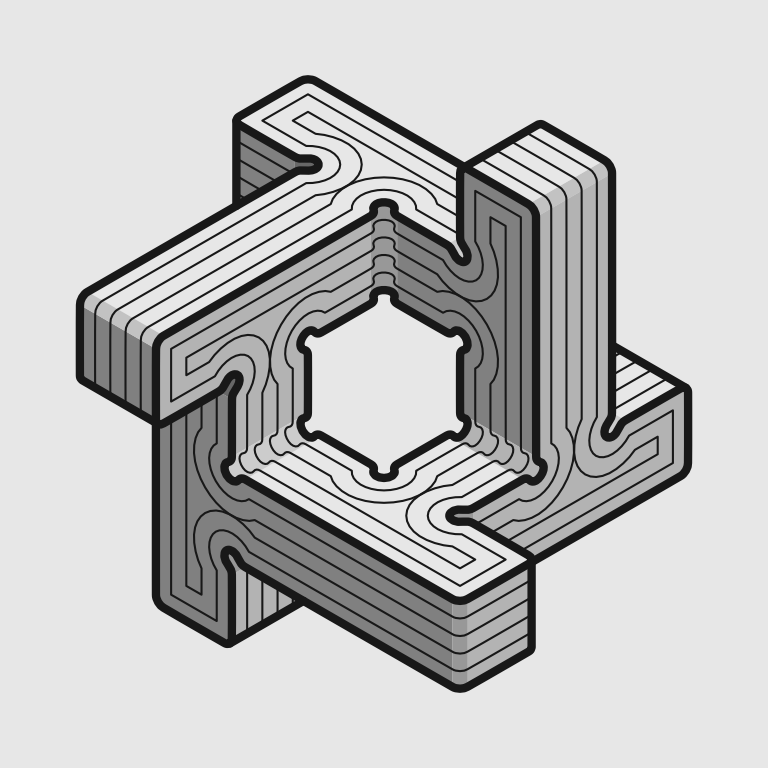
Polygons with 3d-printed strands as mechanical reinforcements. To introduce stiffness to a polygonal frame multiple…
- Rating
- 4.932 / 5
- Likes
- 966
- Downloads
- 2,851
- Makes
- 89
- Views
- 16,506
- Reviews
- 73
Updated at source:
Model information
- Source
- Printables
- Category
- Math
- License
- Creative Commons — Attribution — Noncommercial — Share Alike
Polygons with 3d-printed strands as mechanical reinforcements.
To introduce stiffness to a polygonal frame multiple triangles are inscribed into the shape, changing rotation with z-height. The triangles themselves are strands of filament extruded into the air. This technique is called bridging, because it doesn't make use of support structures (eventually the different triangles may touch each other). Each strand consist of two layers.
The diameter of all three polygons - pentagon, hexagon and heptagon - is approximately 10cm. The rotation of the triangle is bound to 1/3 of the length of the polygon outline, not to an angle. Therefore this principle is adaptive to the applied shape and every curve point is connected to exactly two strands. The result has a relative high stiffness compared to the amount of material used.
Geometry was created using Rhino/Grasshopper.
Print Settings
Printer:
Generic Printer
Rafts:
No
Supports:
No
Resolution:
0.2mm
Infill:
25%
Filament:
Generic PLA
Notes:
The examples were printed using the default "0.2mm Quality" from PrusaSlicer on a Prusa i3 MK3S. Extrusion width was 0.45mm, "Thin Walls" option should not be necessary.