
Hall Sensor Trigger Throttle Remote (for VESC)
Obliczymy ostateczną cenę na podstawie wybranego pliku. Sprawdzisz ją i zaakceptujesz przed płatnością.
Zapisane na tym urządzeniu.
Hall sensor based finger throttle remote with momentary reverse button. 100% printed, including spring. For VESC.
- Ocena
- 0 / 5
- Polubienia
- 4
- Pobrania
- 19
- Wydruki
- 0
- Wyświetlenia
- 211
- Oceny
- 0
Aktualizacja u źródła:
Informacje o modelu
- Źródło
- Printables
- Kategoria
- Vehicles
- Licencja
- Creative Commons — Attribution — Noncommercial — Share Alike
Well, there is a lot to say! But he’s the short version first:
I designed this device as a throttle for my DIY electronic Kettcar. I called it a remote, but it is actually connected to the motor controller with a four wire cable. These for wires are connected to the ADC port of a Vedder ESC (or VESC).
The throttle signal is created by a ss49e hall-sensor and a 5mm magnet. Additionally, a momentary button connects one signal wire to ground, to allow for enabling reverse mode.
As far as I understand this perfectly mimics regular hand throttles that exist for E-bikes.
Print Instructions:
Print the spring in TPU and at about 70-80% scaled X and Y size (so it gets its springiness). The ends might not fit perfectly into the receptacles, but can easily be thinned out with a scalpel or flush cutters.
Printing in PETG and PLA goes pretty smooth. I got good results with and without supports. The design tries to avoid requirement of supports, but it still helps. Especially to get the fit of the hall-sensor right.
The design uses between 0.05mm and 0.07mm of clearance on movable parts like the trigger. It is helpful to start from a two small offset and snug fit and then file away a bit of plastic to get a perfect fit. Instead of ending up with wiggle room in the trigger, which is annoying.
Adding a modifier to the trigger base, setting the infill to 100% for the trigger shaft, is recommended. The rest of the model can easily deal with 10 to 15% infill.
Use not use less than 2 shell layers and 3 top and bottom layers, to give the final thing a sturdy grip.
If you like the model, want to see how I designed it, or need to fit in a button of your own, feel free to make a copy in Onshape : https://cad.onshape.com/documents/7fbcc0460e3c09aed0dfb5c5/w/6bff8462b8239e45fa634973/e/1aca1453b885e1f99a434be5
Technical Detail:
The momentary button it’s just a random 8 x 8mm button with a very nice tactile feedback, which I took from my collection of switches.
As the ideal port for the cable connection, a USB-A port from an old computer case came in very handy.
One wire carries 3.3V from the VESC to the hall-sensor, one wire transfers the hall-signal back to the VESC, obviously ground, and the remaining wire is shorted to ground through the button.
The hall-sensor is a (any regular) bipolar linear sensor. That means without any magnet its output signal is about half of the input voltage.
One side of the magnet lowest the center of voltage, to around 0.8V, the other side increases the signal to about 2.5V. How much difference there is doesn’t play a great role because VESC learns the range automatically.
But, a key feature of my design is that the sensor and magnet are implemented in a way that gives out a low signal when in idle, by having the magnet near the sensor, and moving the magnet away lets the signal increase.
I call it a feature because while playing with the first iterations of the remote my Kettcar suddenly accelerated backwards when the cable disconnected from the remote, which is obviously not ideal ;)
The way it is now, you can add a pull-down resistor to the ADC signal pin, to make really sure there is no accidental throttle signal when disconnecting the remote.
Everything I described up to this point works very well. Disclaimer: I did not yet confirm, that shortening the RX pin of the ADC port to GND really acts as a switch to set the motor into reverse mode. This should work when control mode is set to “current reverse button” in the ADC app on the VESC) I read that in a forum.
More Detail:
About the spring, well it’s not a metal spring. It feels different. It pulls back slower and even takes the while for the last 10% of movement. But after using it a bit, it feels kind of nice and technically it doesn’t produce much of a problem (in my application).
As the file names tell, this is iteration 16 of the complete model. The first five were even deleted and are not included in the count. Of course I still see room for improvement, but I ended up using something like version 14 and I’m not yet planning on printing another one.
This is all I can tell about this specific model, if you have questions, please leave a comment.
Even More Detail:
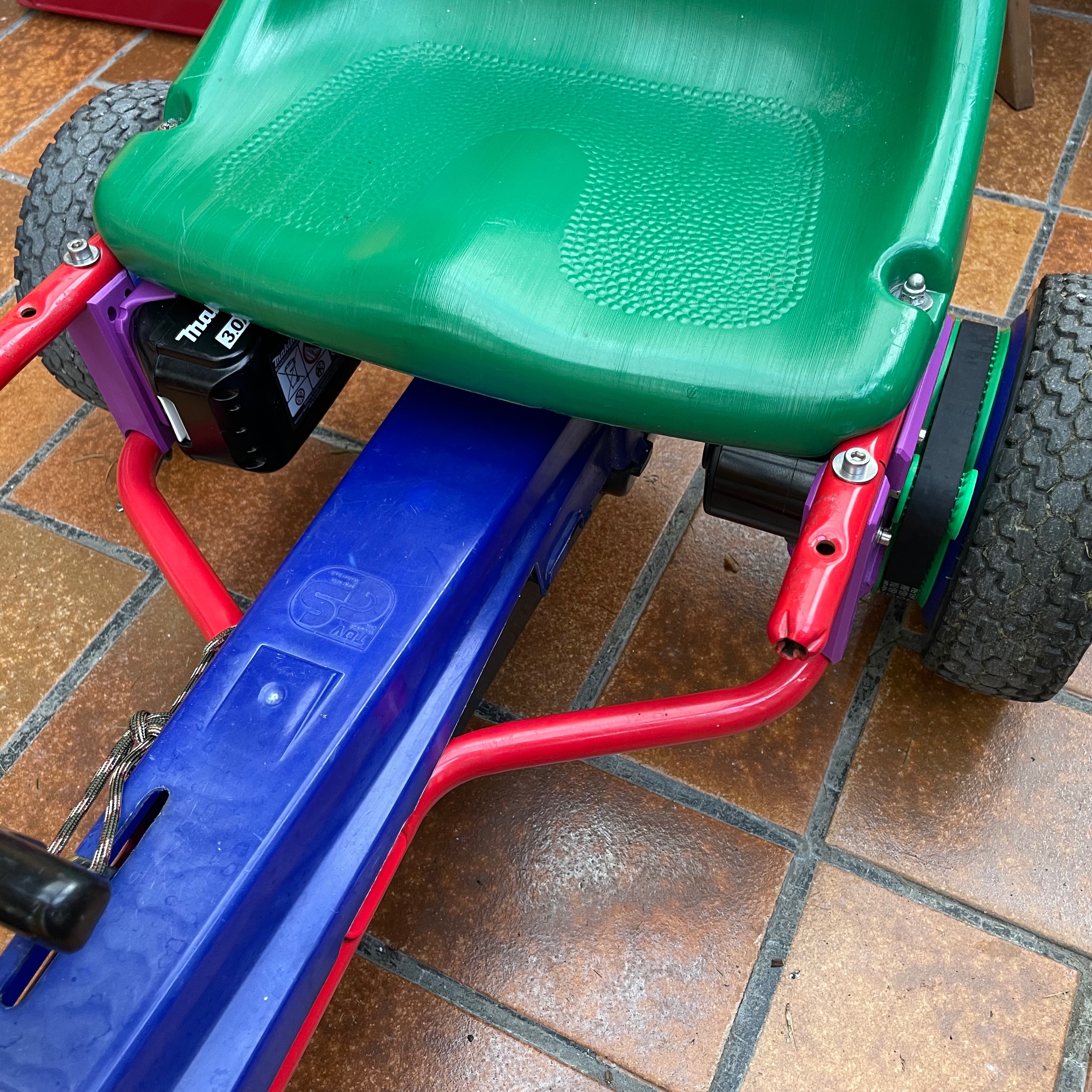
If you want to see where the remote is attached to, follow me. I am planning on posting more models in the future. For example, the motor mount for the e-Kettcar, including some pictures, but also a couple of other interesting projects and repair kits, for stuff that breaks around the house.
Finally, as I mentioned, next to Prusa, I’m a huge fan of Onshape. It is free and the perfect tool for a hobbyist 3D-printer enthusiast. Almost all my models can be found there and I‘ll make sure to always include a link.
Thanks to all the companies providing these cool “toys” and tools, and the platforms to build a community around it! And of course to the community! I already got a lot of inspiration off of project of others.
But because I just love the CAD designing process so much, I mostly create all my prints myself.