
F-15 Eagle print-in-place micro jet fighter
Obliczymy ostateczną cenę na podstawie wybranego pliku. Sprawdzisz ją i zaakceptujesz przed płatnością.
Zapisane na tym urządzeniu.

A small, simple and easy to print 1/320 scale fighter jet model.
- Ocena
- 5 / 5
- Polubienia
- 44
- Pobrania
- 497
- Wydruki
- 3
- Wyświetlenia
- 1190
- Oceny
- 1
Aktualizacja u źródła:
Informacje o modelu
- Źródło
- Printables
- Kategoria
- Vehicles
- Licencja
- Creative Commons — Attribution — Noncommercial — NoDerivatives
About the F-15 Eagle
The McDonnell Douglas F-15 Eagle is an American twin-engine, all-weather fighter aircraft designed by McDonnell Douglas (now part of Boeing). Following reviews of proposals, the United States Air Force (USAF) selected McDonnell Douglas's design in 1969 to meet the service's need for a dedicated air superiority fighter. The Eagle took its maiden flight in July 1972, and entered service in 1976. It is among the most successful modern fighters, with 104 victories and no losses in aerial combat, with the majority of the kills by the Israeli Air Force.
Although the F-15 was originally envisioned as a pure air superiority fighter, its design included a secondary ground-attack capability that was largely unused. It proved flexible enough that an improved all-weather strike derivative, the F-15E Strike Eagle, was later developed, entered service in 1989 and has been exported to several nations. Several additional Eagle and Strike Eagle subvariants have been produced for foreign customers, with production of enhanced variants ongoing.
The F-15 was the principal air superiority fighter of the USAF and numerous U.S. allies during the late Cold War, replacing the F-4 Phantom II. In USAF service, the aircraft saw combat action in the 1991 Gulf War and the conflict over Yugoslavia. The USAF began replacing its air superiority F-15 fighters with the F-22 Raptor in the 2000s. However reduced procurement pushed the retirement of the remaining F-15C/D, mostly in the Air National Guard, to 2026 and forced the service to supplement the F-22 with an advanced Eagle variant, the F-15EX, to maintain enough air superiority fighters. The F-15 remains in service with numerous countries.
About the model itself
You can find hundreds of fighter models on the Internet.
Some of them are, however, a faithful reproduction of the machine itself, but such a model is not great to 3D print (because of the thin wings, complicated engines and landing gear, it needs tons of supports etc.).
On the other side there are simple models of aircraft that are easy to print, but no longer represent the original plane.
I tried my best to create something in between, a model that is both easy to print and looks like the real aircraft. I spent a lot of time to adjust the wing thickness, the acceptable landing gear design and the optimal way to get rid of default supports and to make the plane look so reliable that even a person not interested in aviation could tell the difference between several models.
Printing
High quality settings, 0.12mm-0.15mm layer height (I am using 0.12mm)
0.4mm nozzle
NO supports (unless you choose a version without them)
100% infill
I reccomend to use raft to ensure that the model will not peel off mid-printing.
Printing (on my 3D printer) takes from 1h to 1h 40minutes depending on settings, printer efficiency and the size of a jet.
I recommend NOT to scale down the model, because some parts (air intakes, engines, nose) might be deformed, or not even printed, because they will become too thin for the slicer and printer. I also do not guarantee good results when scaling up.
Cleaning the model
Here's a small instruction how to remove the unnecessary parts after printing.
The photos show a MiG-29, but the instructions apply to all models.
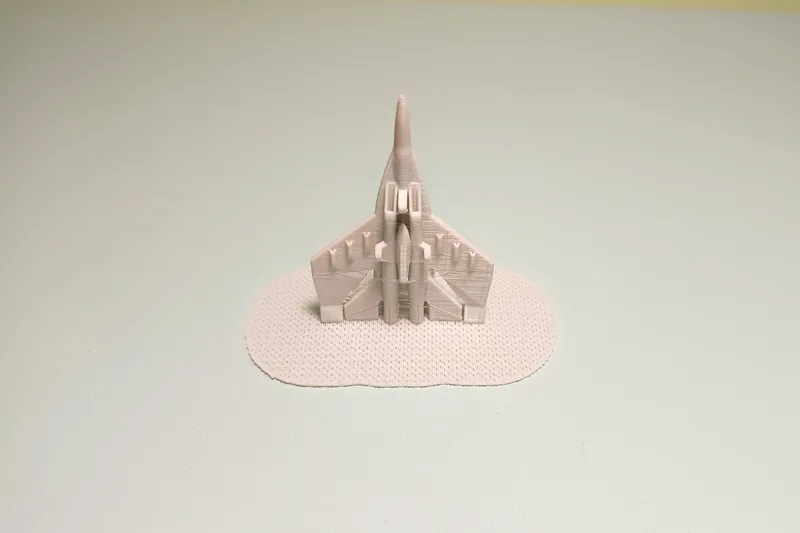
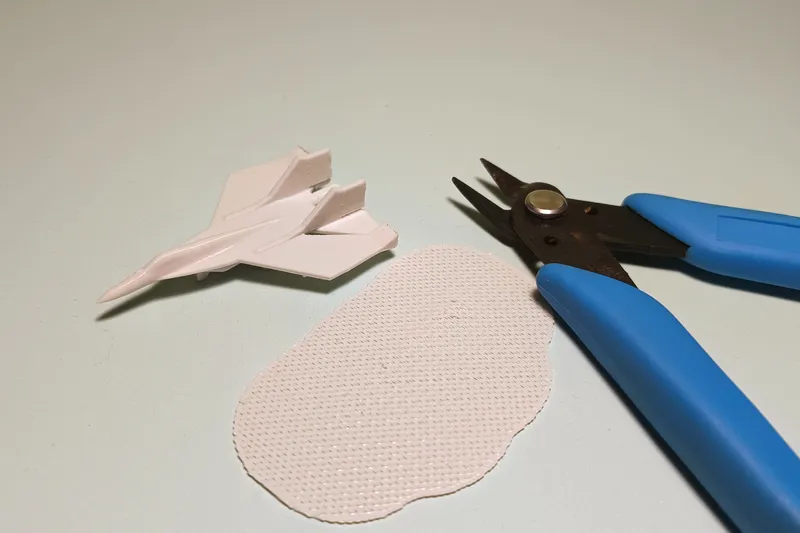
First, remove the raft with side cutters.
Then find the gaps in the wings (marked with red arrows). Don't forget about the engines and stabilizers.
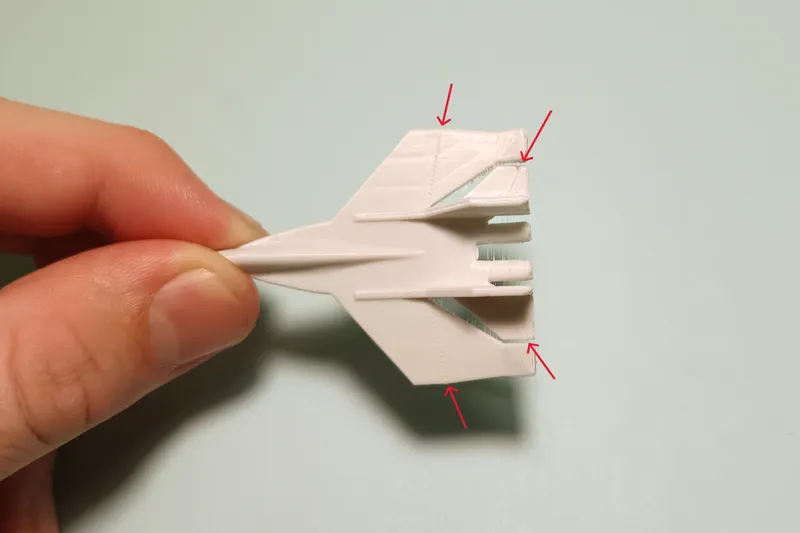
CAREFULLY break the supports with pliers, I do not reccomend to use hands, because the wing may break along the layers, not where it should be.
Remember, that even if that happen, there is no need to print the model again. Sometimes it is enough to glue the wing with superglue.
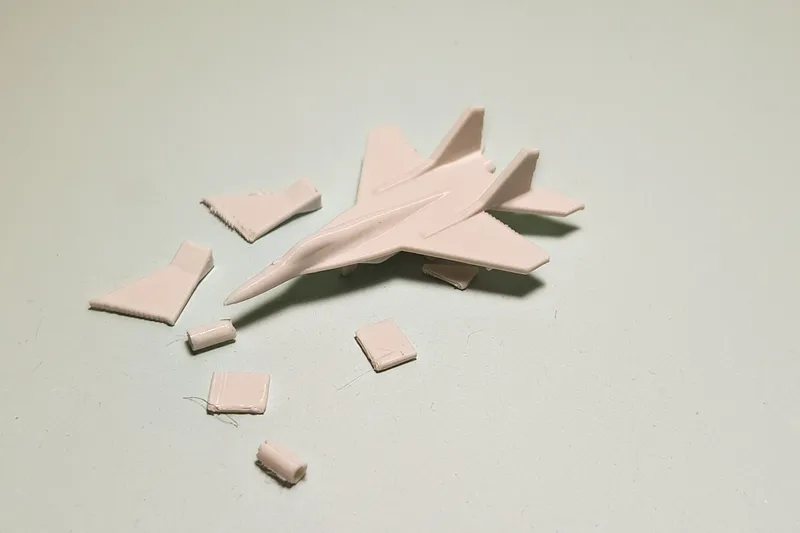
You can also smooth the wings with a small file or sandpaper and burn the strings with a lighter.
Additional information
If you enjoy my micro jets please leave a nice comment. I am working on some new arcrafts I will be uploading soon. I would be grateful if you would share with me your ideas for new fighters or something completely different. I am open to your suggestions.
I would just like to point out that I am not a professional and I treat creating models for 3D printing as a hobby. Therefore, I am asking for your understanding towards my work.