
1 / 6
7 Segment RGB LED Clock using Neopixels
Order a print of this model
We calculate the final price from your selected file. You review and accept it before payment.
Saved on this device.

A DIY 3D printable 7 segment clock using WS2812b neopixels, ESP-32 and Arduino FastLED library.
- Rating
- 5 / 5
- Likes
- 23
- Downloads
- 152
- Makes
- 2
- Views
- 1,356
- Reviews
- 3
Updated at source:
Model information
- Source
- Printables
- Category
- Home Decor
- License
- Creative Commons — Attribution
A DIY 7-segment clock built with WS2812b neopixels, ESP-32, FastLED library and 3D printed parts.
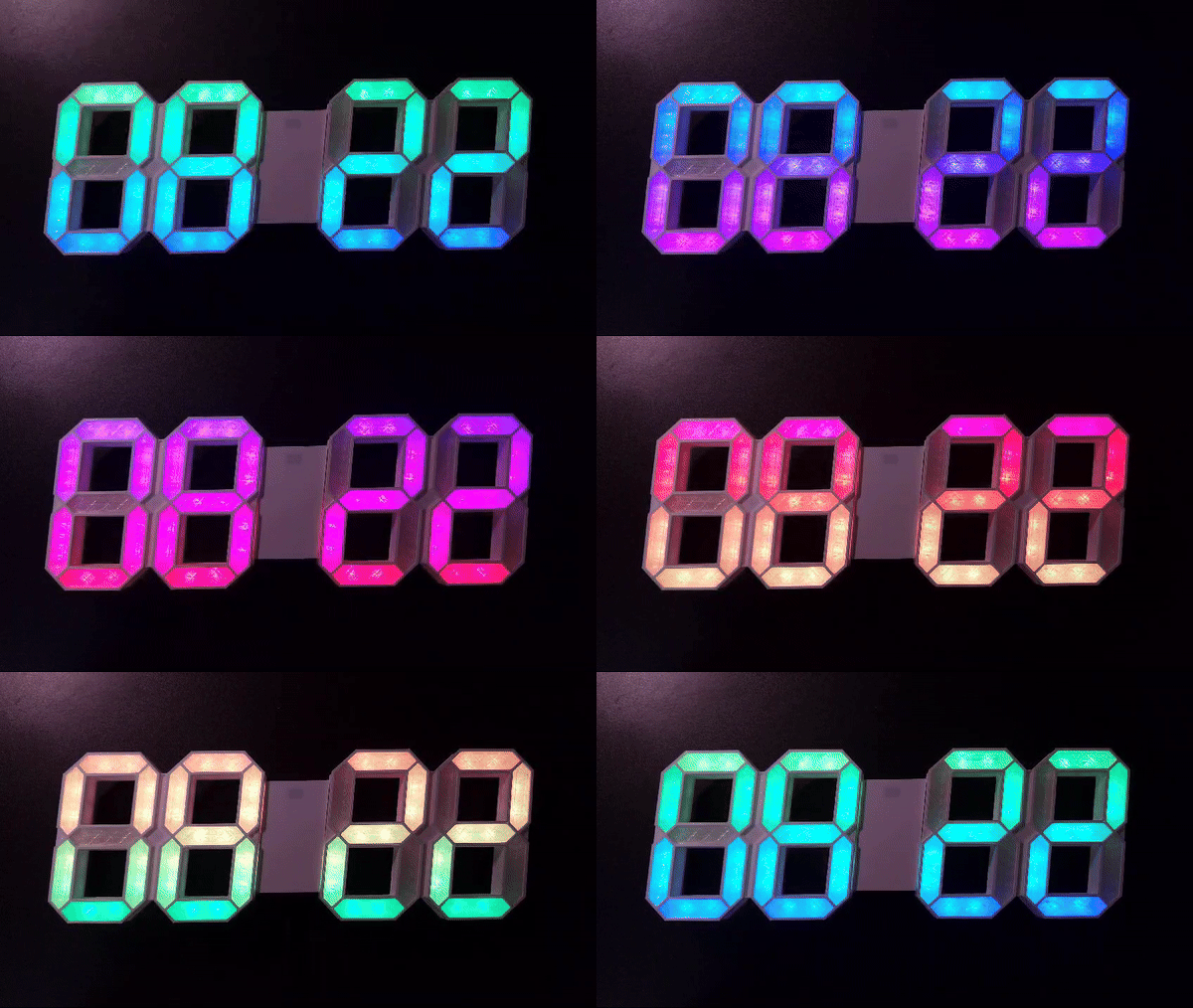
Features:
- Fully 3D printed, using only 2 types of PLA filament and a few M3 screws.
- 3d printable on small 3d printers like the BambuLab A1 mini.
- Powered via USB-C.
- Uses ESP-32 S3 (Seedstudio XIAO/WaveShare ESP32-S3 Mini)
- Syncs time with NTP using WiFi and Arduino's Time library
- Hugely customizable due to individually addressable LEDs (WS2812b) paired with the FastLED library
- Auto brightness using Ambient Light Sensor [APDS9930].
Print Quantity:
- Digits_Top - x2
- Digits_BottomPlate - x2
- MiddleBox_Bottom - x1
- MiddleBox_FacePlate_Light - x1
- DiffuserCells_Vertical - x16
- DiffuserCells_Horizontal - x12
- [optional] Wallmount - x2
Print Instructions:
- Only 2 types of filament required:
- Body: Any opaque filament (I used Cool White PLA)
- Diffusers: Transparent colorless filament (I used Natural PLA)
- For the Diffusers, have no more than 2 top and bottom layers. This makes them semi-transparent, and you can then experiment with infill percentage and pattern to give it a pretty nice effect
- For the Digits_Top file, have solid walls.
Hardware Required:
- 3D printed parts as mentioned.
- ESP 32 board in a small size (preferrably Waveshare ESP32 S3 mini OR SeedStudio XIAO)
- WS2812b neopixel strip 1m 60 LED/metre
- (optional) APDS9930 I2C ambient light sensor (or any other ambient light sensor - modify code accordingly)
- (optional) TTP223 touch switch (or similar)
- M3 screws: 10mm and 25mm
- Solid core wire for connecting LED segments (I used some old ethernet cables)
- Flexible (silicone) wire for connecting various components
- USB-C cable for powering the clock