
Motorized Rail Lift
Obliczymy ostateczną cenę na podstawie wybranego pliku. Sprawdzisz ją i zaakceptujesz przed płatnością.
Zapisane na tym urządzeniu.

I designed this lift to move my TV out of the way, when it is not in use.
- Ocena
- 0 / 5
- Polubienia
- 6
- Pobrania
- 17
- Wydruki
- 0
- Wyświetlenia
- 169
- Oceny
- 0
Aktualizacja u źródła:
Informacje o modelu
- Źródło
- Printables
- Kategoria
- Mechanical Parts
- Licencja
- Creative Commons — Attribution — Noncommercial — Share Alike
I created this lift for my television because I don’t have much space in my apartment, but I do have very high ceilings. The TV moves along a vertical pillar using a gear running on a rack, guided by aluminium rails.
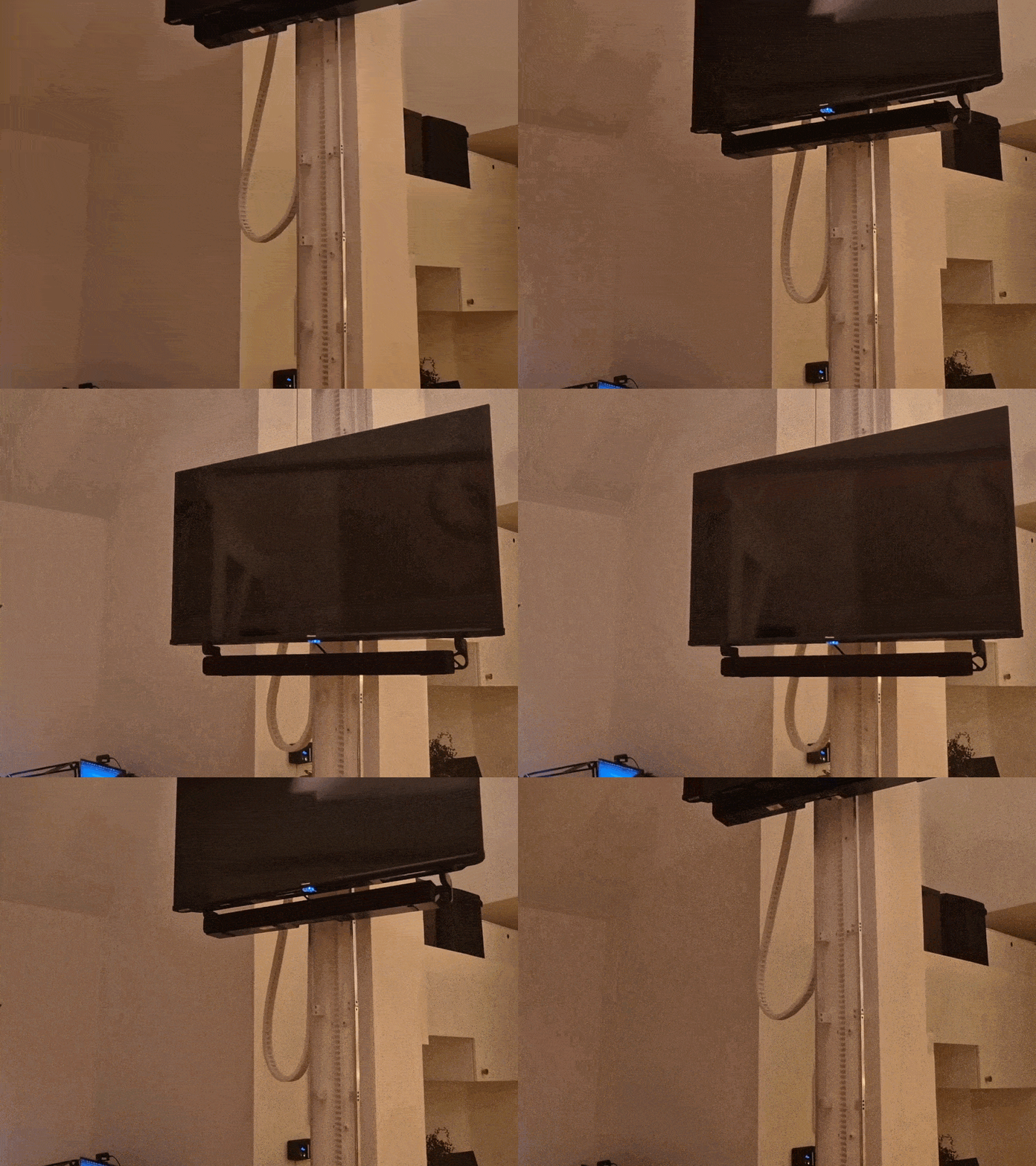
I used a 12V, 20RPM worm gear motor with 67 kg/cm torque (link below), controlled by an ESP32 running ESPHome (configuration file attached). The television is connected to a smart power socket, allowing the system to automatically detect when it turns on and lower the TV accordingly.
For the rails, I used inexpensive square aluminium extrusions with a side length of 11.5 mm from my local hardware store. These are mounted to the wall using the printed “Rail Holders.” I drilled through the extrusions and secured them with screws (see pictures). The carriage slides along the rails with 8 bearings (standard 22 mm skateboard bearings).
This project combines laser cutting and 3D printing, produced on my Bambu Lab H2D. The laser-cut parts are made from 3 mm wood. I’ve also uploaded STL files for these parts if you prefer to print them instead—just note that I haven’t tested the printed versions.
On the front of the carriage, I included multiple mounting holes so you can attach different devices—not just a TV. For my setup, I printed a VESA adapter that mounts the TV at an angle. Since this angle is specific to my use case, I didn’t include it in the files, but you can find it in the Onshape project.
I printed the main gear from carbon fiber-reinforced PA12, as it carries the full weight of the TV. Avoid brittle filaments here. I previously tried using PC, which unfortunately resulted in the loss of a brand-new TV. :(
In my build, I also added a cable chain and a steel cable system with a concrete counterweight. However, since this setup is highly specific to my installation, I didn’t include it in this upload. If you’re interested, you can explore it in the Onshape project.
This system—especially without counterweights—only works for very light TVs. Mine weighs around 8 kg, and without the counterweight, the motor can barely lift it. The counterweight also acts as a safety feature, preventing the TV from falling freely if something fails. Please make sure to implement your own safety solution if you attempt a similar build. I’ve already lost one TV to this project, and fortunately no one was hurt. Please be careful. I take no responsibility for any damage. This project is intended for experimentation only.
I realize this is a highly custom project that may not get many downloads, but I wanted to share it as a guide or source of inspiration for anyone interested in building something similar.
Parts I used:
1× Motor – https://amzn.to/4u1CqEj
1x Motor driver - https://amzn.to/4mFRfKi
1x ESP32 (running ESPHome) - https://amzn.to/4crb2tL
2x Endstop Switch - https://amzn.to/3QEojGJ
8× Ball Bearings (608ZZ) - https://amzn.to/4vJITWi
11.5 mm aluminium extrusion (1.5 mm wall thickness) - https://www.bauhaus.info/quadratrohre/kantoflex-vierkantrohr/p/10521785?fallback=1
68× M3 × 12 mm screws - https://amzn.to/4vPkM8S
8× M5 × 16 mm screws - https://amzn.to/4cYeLit
8× M5 washers - https://amzn.to/4cYeLit
1x USB-C PD Board (for Power supply) - https://amzn.to/4ew1AGM
1x USB-C PD Charger (for Power supply - https://amzn.to/3QU9akA